When Were Subtitles Invented? A Complete Timeline
51% of subtitled videos on Kapwing use colorful word-by-word animations.

The bold, word-by-word captions on your favorite creator’s latest video have a longer and stranger history than you would probably guess. The techniques behind them were not invented by TikTok, nor were they concocted in a Hollywood studio.
They were built, over roughly a century, by opera houses, silent-film title writers, deaf-access pioneers, anime fansubbers, and DVD rippers, and only much later standardized by the platforms and standards bodies we associate with subtitles today.
This is the history of subtitles: a story of how text on screen went from hand-drawn title cards to auto-generated captions that highlight each word as it is spoken.
We’ll run through cinema and broadcast, but it spend the most time where subtitles started to get really interesting: in the enthusiast communities and creator tools that turned captions from a plain-text afterthought into a core part of how modern video is made.
Table of Contents:
- Before Film: Subtitles Started on the Stage
- The Silent Era: When Text and Film First Met
- The Talkies Problem: Subtitling Proper Is Born
- Captions For Access: Text Moves to the Small Screen
- The Fansub Revolution: Subtitles Become Design
- Formats and the Web: Subtitles Get Portable
- Streaming Standardizes the Look
- The Creator Era: Captions Become the Video
- From Manual to Automatic: the Accuracy Leap
- Evolution of Subtitles in Film
- Frequently Asked Questions
Before Film: Subtitles Started on the Stage
Subtitles are older than film. When Italian operas were performed for audiences who didn’t speak Italian, theaters displayed translated text on cards or screens near the stage so the audience could follow along. Text positioned above a performance is still called a “surtitle” or “supertitle” today, and the idea is the same one that would later migrate to the bottom of a movie screen.
The word itself is a clue to what subtitles were for. A “subtitle” is text set below the main title, and once translated text began appearing at the bottom of the frame, the name stuck. What started as an opera-house convenience became, over the next hundred years, one of the most-used features in video.
The Silent Era: When Text and Film First Met
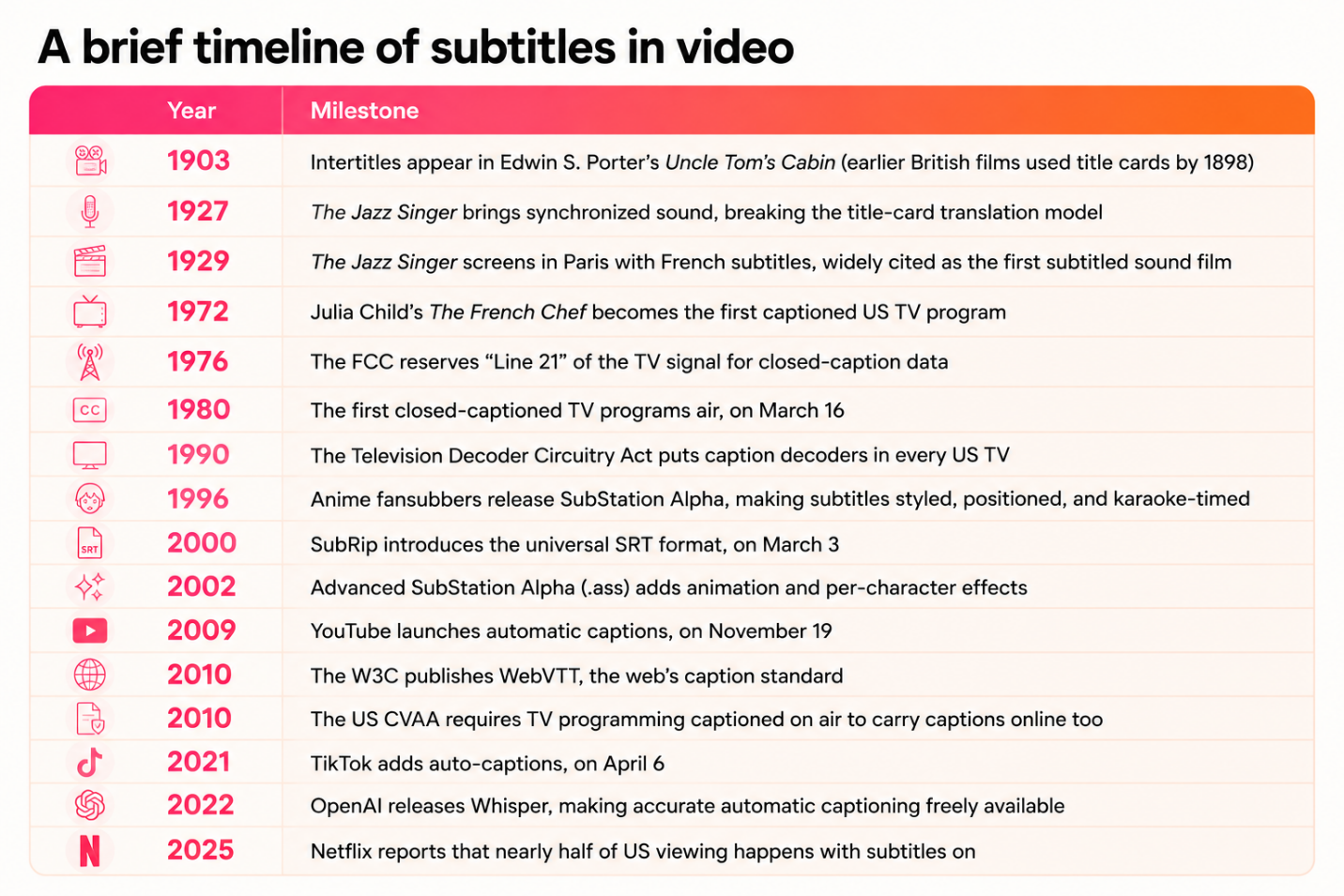
Once films grew long enough to need dialogue and narration, filmmakers turned to intertitles: frames of text, drawn or printed, inserted between shots. The technique is usually dated to Edwin S. Porter’s 1903 Uncle Tom’s Cabin, though earlier British films used title cards as far back as 1898. There were two kinds: dialogue intertitles, which carried what characters said, and expository intertitles, which filled in story the camera could not show.
Intertitles made translation almost trivial. To release a film in another country, a studio simply pulled the title cards, translated them, filmed the new cards, and slotted them back in. Where cards were not enough, live performers narrated: the Bonimenteur in France and the Benshi in Japan stood beside the screen, explaining the action and voicing the characters. Title writing was respected enough as a craft that the first Academy Awards in 1929 handed out a now-retired award for “Title Writing.”
The Talkies Problem: Subtitling Proper Is Born
Sound changed everything. When The Jazz Singer arrived in 1927 and dialogue became audible, the neat trick of swapping title cards stopped working. Foreign audiences could now hear the actors, but they could not understand them, and you could not translate a soundtrack by reprinting a card.
The solution was to print translated dialogue directly onto the film image. The Jazz Singer’s Paris premiere on January 26, 1929, is widely cited as the first subtitled sound film, carrying French subtitles, though film historians debate the details: some record true subtitles superimposed on the image, while others describe translated text projected on a separate screen beside it. A Danish-subtitled release of The Singing Fool followed later that year. Studios weighed subtitling against the alternative, dubbing, and the choice largely came down to cost and market size. Smaller markets subtitled because it was cheap; larger ones dubbed. That split is still visible on streaming menus today, and it is where cinema’s part of this story ends.
Captions For Access: Text Moves to the Small Screen
The next leap was not about translation at all. It was about access, and it introduced a distinction that still trips people up, so it’s worth understanding the difference between captions and subtitles: subtitles generally assume you can hear and just need the words in your language, while captions are written for viewers who cannot hear the audio, so they also describe music, sound effects, and who is speaking.
The line between the two is not always sharp. Subtitles for the deaf and hard of hearing, or SDH, carry the spoken dialogue like a subtitle but also flag music, sound effects, and speaker changes like a caption, which is why they’ve become the default on most streaming platforms.
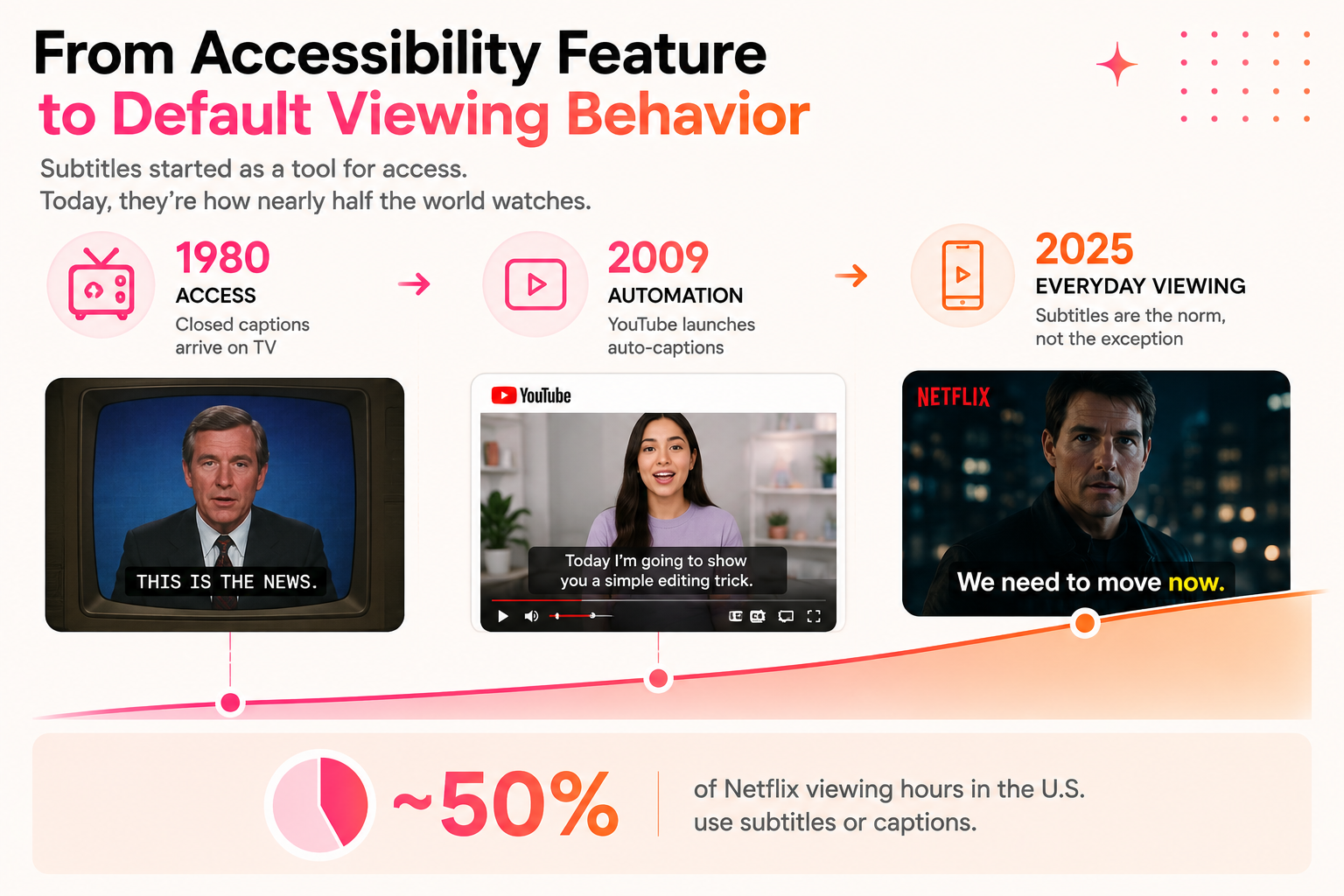
In the United States, that work was led by Malcolm Norwood, widely called the father of closed captioning. The milestones came quickly once the technology matured. In 1972, WGBH in Boston added open captions to The French Chef with Julia Child, the first US program captioned for deaf and hard-of-hearing viewers. Because those captions were visible to everyone, engineers set out to build a version viewers could switch on or off. The FCC reserved “Line 21” of the television signal for caption data in 1976, the National Captioning Institute was founded in 1979, and on March 16, 1980, the first closed-captioned programs aired on ABC, NBC, and PBS. The 1990 Television Decoder Circuitry Act required caption decoders in every TV 13 inches or larger, which quietly made captions universal.
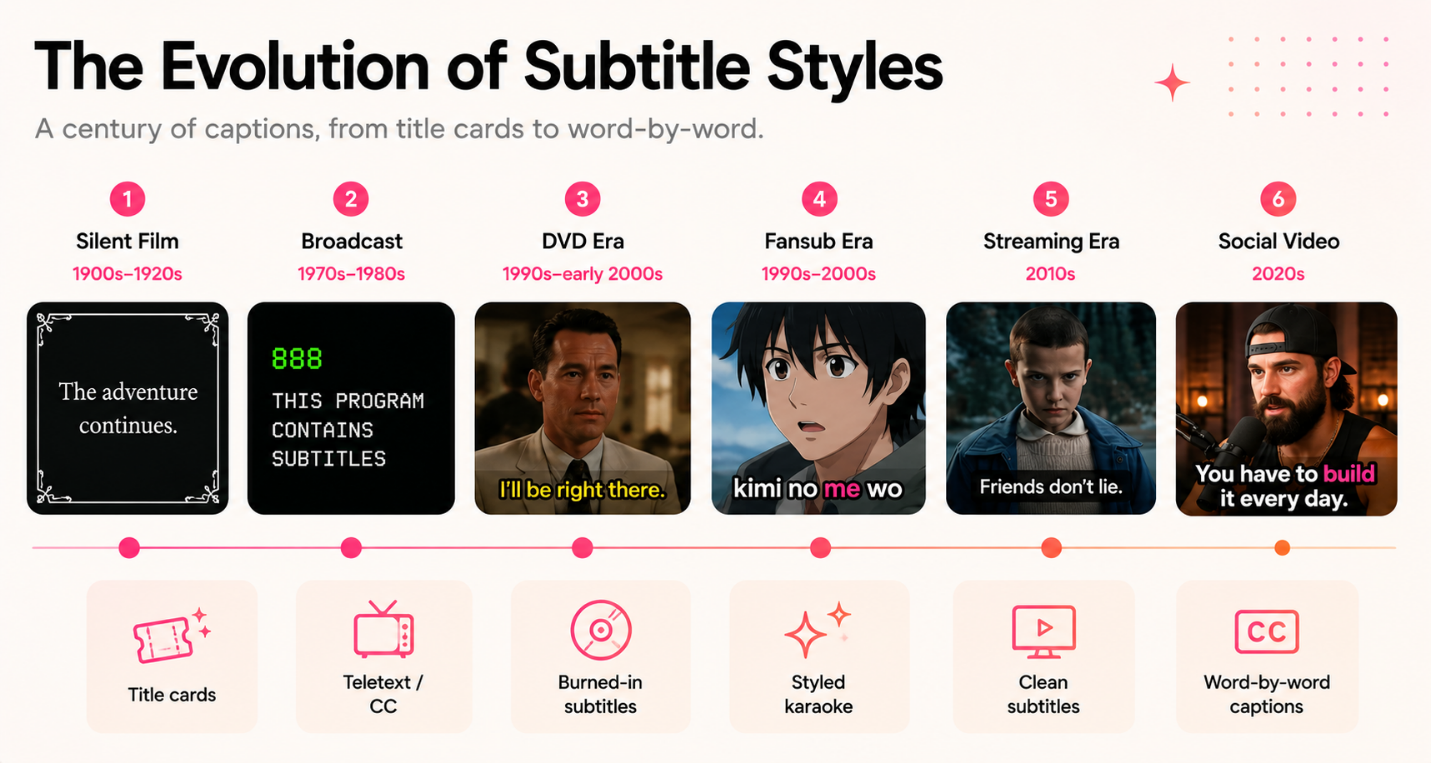
Britain took a parallel path through teletext. The BBC’s Ceefax system carried subtitles on page “888,” a number so associated with captions that it became UK shorthand for turning subtitles on. The look of this era, blocky monospaced type in a black box, is the ancestor of the “retro” caption styles creators reach for today.
The Fansub Revolution: Subtitles Become Design
Here the story leaves the broadcasters behind, because the next real innovation in subtitles did not come from a studio or a standards committee. It came from anime fans.
In the 1990s, fans who wanted to share Japanese anime that had never been licensed abroad started subtitling it themselves. These “fansubbers” hit a wall that broadcasters never had to care about: plain subtitle text was not enough. Anime is full of on-screen signs, layered dialogue, and opening and ending theme songs, and fansubbers wanted to translate all of it, position notes exactly where they belonged, and style captions to match the show.
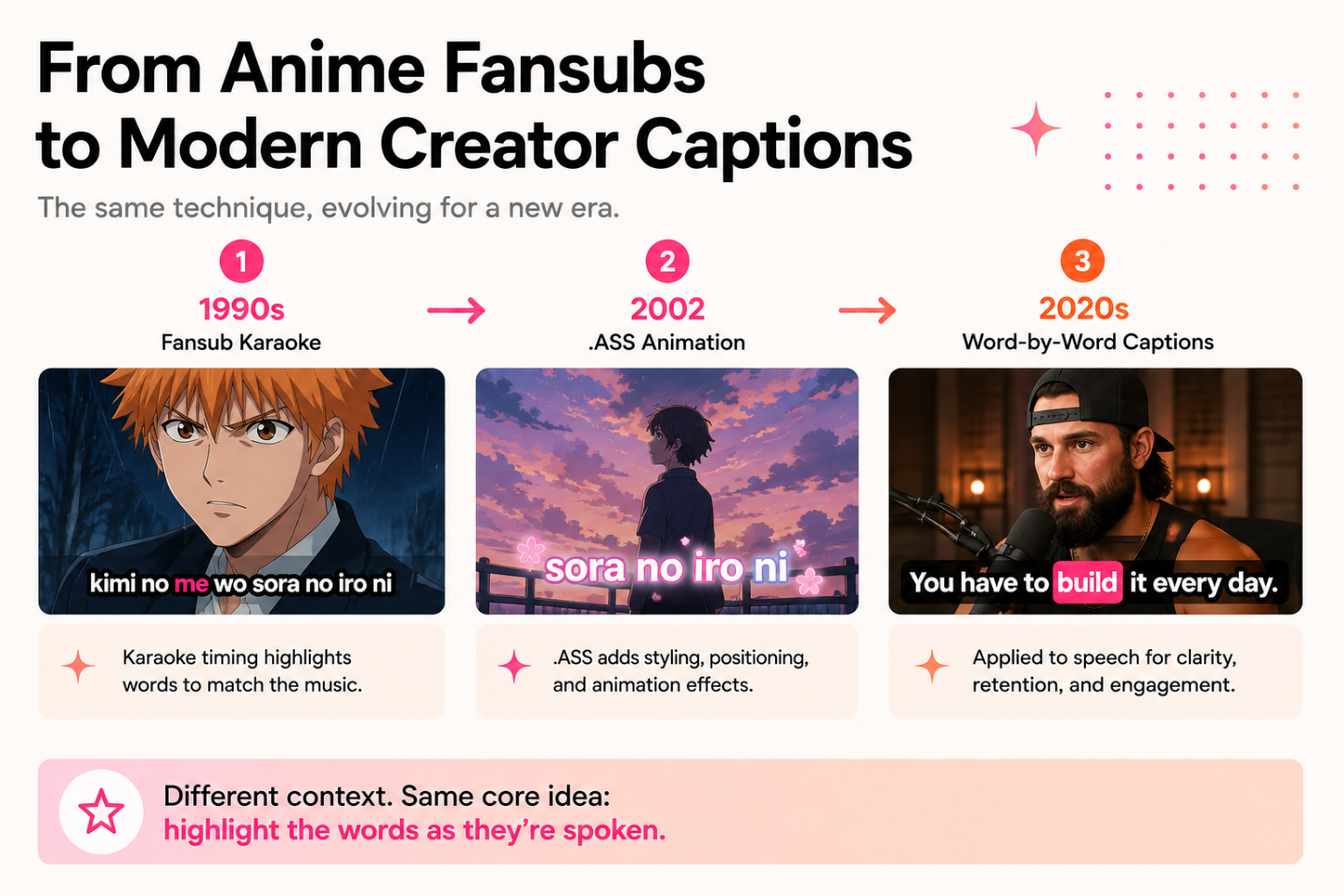
So in 1996, a programmer named CS Low, known online as Kotus, built SubStation Alpha for the anime fansubbing community. It let subtitlers control fonts, colors, and placement, and it added something no mainstream tool had: karaoke effects that highlighted lyrics word by word, in time with a song. In 2002, its successor, Advanced SubStation Alpha (the .ass format), went further, adding layers, transparency, rotation, and per-character animation. Paired with the editor Aegisub, it turned subtitles into fully designed, animated objects. Fansubbers could hardcode captions into the video (a “hardsub”) or ship them as a separate file (a “softsub”), position translator’s notes in the margins, and animate a show’s theme song like a music video.
This matters more than it sounds, because it is the direct ancestor of the caption styles that dominate social video now. The word-by-word highlight that creators call the Hormozi style is, technically, karaoke timing applied to speech instead of song lyrics, and karaoke timing is exactly what fansubbers built into .ass two decades earlier. The professional world mostly ignored the format. The one major exception is Crunchyroll, which carried that fansub DNA straight into licensed, mainstream anime streaming and still relies on .ass today.
Formats and the Web: Subtitles Get Portable
While fansubbers were pushing style, a parallel community was solving a different problem: how to get subtitles out of a disc and into a plain, editable file. The answer, once again, came from an enthusiast scene rather than the industry.
In 2000, a French programmer working under the handle “Brain” released SubRip, a free Windows tool that pulled subtitles off DVDs and saved them as a simple text file. The format it wrote, .srt, was almost aggressively basic: a number, a start and end time, and a line of text, readable and fixable in any text editor. That simplicity is exactly why it won. SubRip’s SRT became the universal subtitle format, the one nearly every tool and platform can still read and write. If .ass was the format for people who cared how subtitles looked, SRT was the format for everyone who just needed them to work.
That universality is also why SRT is so easy to work with: because it’s just timed text, you can open and fix an SRT file in any text editor, correcting a typo or nudging a timecode without special software.
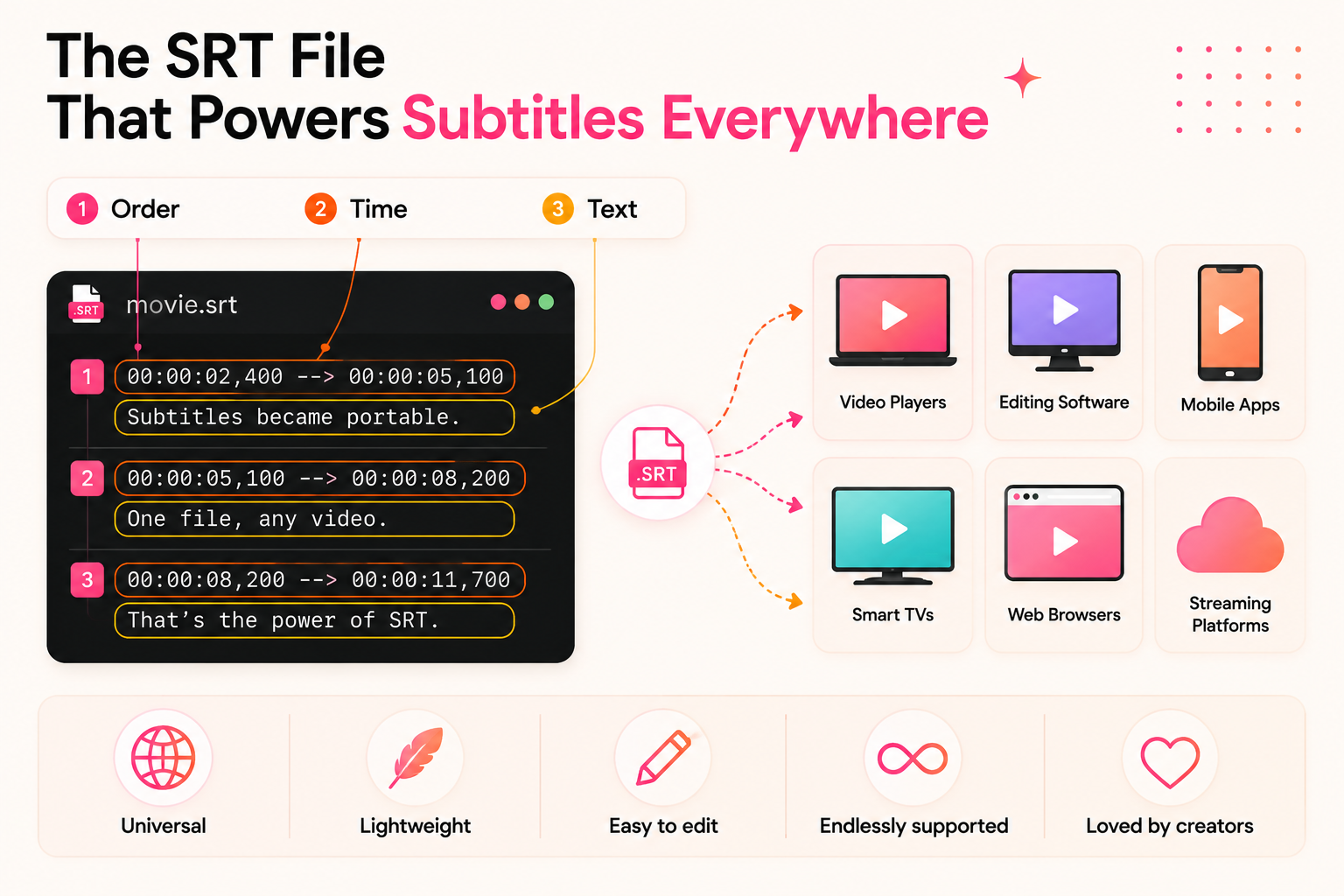
The web eventually formalized its own version. In 2010, the WebVTT format was published by the W3C, based directly on SubRip, to power captions in HTML5 video. And YouTube turned subtitling into a mass-market feature: after adding manual captions in the late 2000s, it launched automatic captions on November 19, 2009, using the same speech-recognition engine as Google Voice, and paired them with machine translation into dozens of languages. For the first time, a machine, not a person, was writing the captions, and hundreds of millions of videos could be captioned without anyone typing a word.
US law caught up with the move online that same year. The 21st Century Communications and Video Accessibility Act, signed in 2010, required video that had been captioned on television to keep its captions when it moved to the internet, extending the caption mandate from the TV set to the browser. It carved out one telling exception: user-generated and internet-only video was left out, which is why a creator’s original upload has never been legally required to be captioned the way a rerun of a broadcast show is. The captioning of social video, in other words, was driven by audience behavior, not by law.
Streaming Standardizes the Look
As streaming took over, subtitles got a consistent, global aesthetic for the first time. Netflix published a detailed timed-text style guide, standardized on clean white type with a limit of 42 characters per line, and made subtitles a first-class part of the experience in every market it entered. Foreign-language hits carried that habit into the mainstream, and reading subtitles stopped feeling like a foreign-film chore.
The scale of the shift shows up in Netflix’s own numbers. In 2025, the company reported that nearly half of all its US viewing hours happen with subtitles or captions on, and it added a dialogue-only subtitle option for the many viewers who want captions without the extra sound-effect cues of traditional closed captions. The clean streaming look became a style in its own right, one that creators now imitate deliberately.
The Creator Era: Captions Become the Video
Then video went vertical, mobile, and silent, and subtitles stopped being an accessory. On social feeds, most video autoplays without sound, and a large majority of it is watched on mute, which means on-screen text is not a convenience for some viewers. It is how most people consume the content at all.
Creators figured this out before the platforms did. Long before any native tool existed, they were burning text overlays into their videos by hand and leaning on third-party captioning apps, and the text-to-speech “robot voice” trend turned on-screen text into a format of its own. Platforms caught up in 2021: TikTok launched auto-captions on April 6, initially in American English and Japanese, and framed it as an accessibility feature that also served the many people watching without sound.
The bigger change was stylistic. Broadcast and streaming captions are “closed” captions, a separate track a viewer can toggle. Social creators went the other way, burning captions permanently into the video as “open” captions, because burned-in text looks identical on every platform and never depends on a player supporting subtitle files. And the style they converged on is the animated, word-by-word look popularized by Alex Hormozi and used by creators like MrBeast, Gary Vee, and Iman Gadzhi: large, all-caps, condensed sans-serif type (often Montserrat Black, Anton, or Bebas Neue), a heavy outline, and a yellow or green highlight on the active word. It is loud by design, built to be read at a glance on a muted phone and to pull the eye to the single most important word in each beat.
That style is the fansub karaoke technique reborn: the same word-by-word highlight, the same idea of animating text in time with audio, applied to a talking head instead of an anime theme song. Two decades and an entirely different community apart, the technique came back.
Kapwing’s own platform data shows how thoroughly this has taken over. Among videos that include subtitles, 51% use a color word-by-word animation, and the most popular preset creators reach for, after the default, is one called “Prime.” (Fittingly, Kapwing’s default subtitle font is Montserrat, the same family that anchors the Hormozi look.)
From Manual to Automatic: the Accuracy Leap
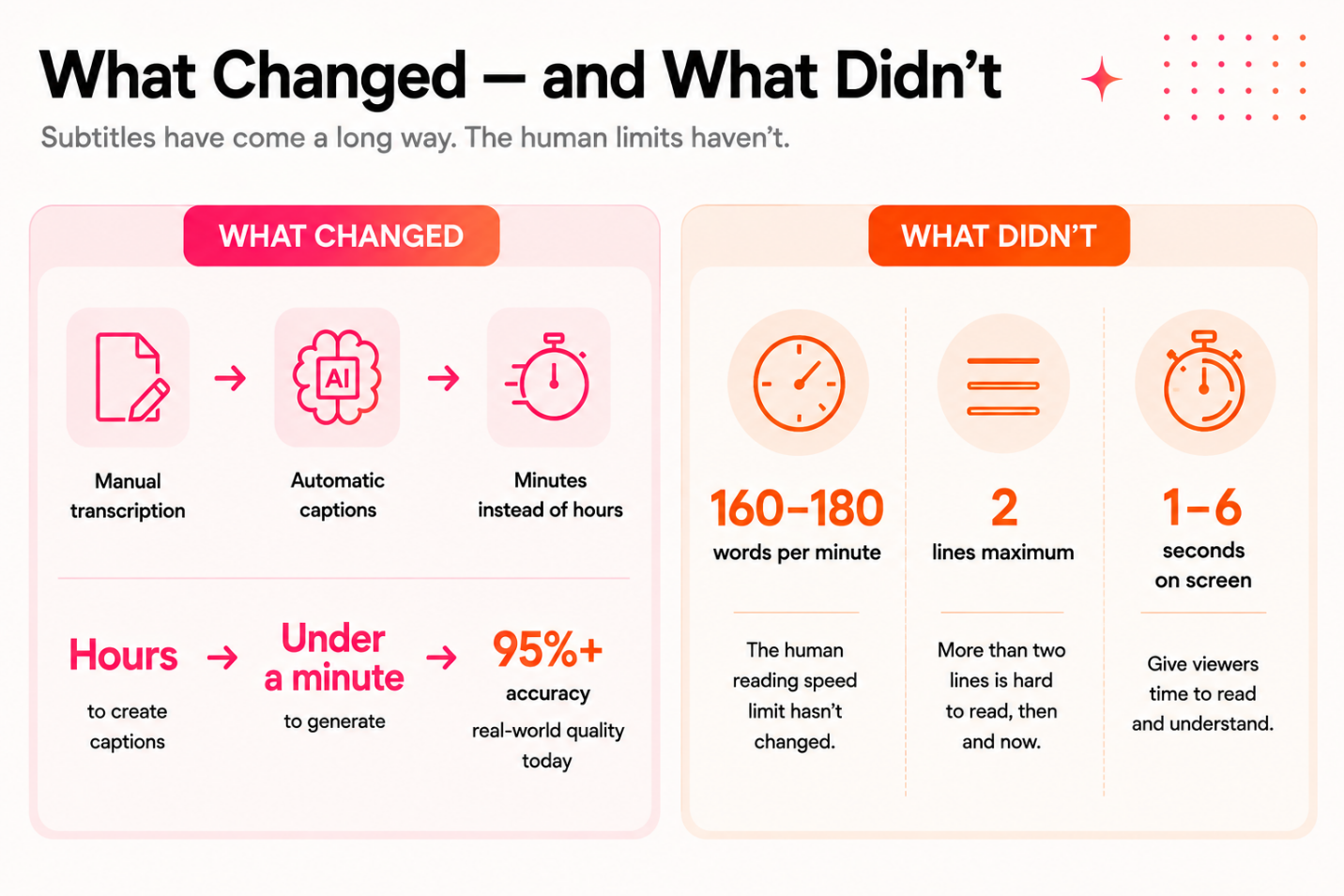
For most of this history, subtitles were slow, manual work. Someone transcribed the audio, timed each line by hand, and checked it frame by frame. Early automatic captions, when they arrived, were rough enough that they were not considered reliable for accessibility, often landing in the 60 to 80% accuracy range.
That has changed fast, and one release marks the turning point. In 2022, OpenAI released Whisper, an open-source speech-recognition model trained on more than 680,000 hours of audio, and within months nearly every major captioning tool was benchmarking against it. Leading engines now transcribe clear conversational English at better than 95% accuracy, though accuracy still varies with heavy accents, background noise, and less-common languages. Modern tools can also generate captions in one language and translate them into a hundred others in a couple of clicks. A workflow that once took an afternoon now takes under a minute. Kapwing’s auto-subtitle generator, for instance, transcribes a video automatically, applies a style across the whole thing, and exports captions or translates them into more than 100 languages. The one rule that has not changed: automatic captions still need a human to check them, because a confident mistake in your captions undermines trust faster than almost any other error.
History of Subtitles
For all the upheaval in tools and styles, the constraints that govern good subtitles have barely moved, because they are set by how fast people read, not by technology. The BBC’s subtitle guidelines recommend a reading speed of 160 to 180 words per minute, roughly 15 characters per second. Subtitles should run no more than two lines, break at logical points like punctuation, and stay on screen long enough to read but not so long they lag the audio, generally between one and six seconds. Professional subtitlers still time captions to shot changes so the text and the picture cut together.
What is striking is that these rules apply just as much to a word-by-word TikTok caption as to a BBC broadcast. The platforms and the aesthetics could not be more different, but a viewer’s eyes have the same limits they did in 1980. Getting the font, size, and contrast right matters for exactly the same reason it always has, which is why the fundamentals of readable subtitle design are worth knowing whatever style you are working in.
The arc runs from a hand-drawn card spliced between shots in 1903 to a caption that highlights each word as you speak it in 2026. Along the way, the people who pushed subtitles forward were rarely the ones you would expect. Silent-film title writers, deaf-access engineers, anime fansubbers, and DVD rippers each solved a problem the mainstream industry was not paying attention to, and the platforms formalized their work afterward.
That history is worth keeping in mind the next time you add captions to a video. The word-by-word style you pick from a menu in seconds is the direct descendant of effects that fansubbers hand-built in the 1990s, running on a format a DVD ripper wrote in 2000, following reading rules a broadcaster set in 1980. If you want to see how the whole lineage looks in practice, Kapwing’s subtitle template gallery collects the styles from every one of these eras, from retro broadcast to Netflix-clean to creator word-by-word, ready to apply to your own video.
Cite this article: You’re welcome to reference any milestone or statistic here with a link back to this page. Suggested citation: Kapwing, “A History of Subtitles in Video” (2026), https://www.kapwing.com/resources/history-of-subtitles-in-video/. The Kapwing platform figures are original first-party data and may be cited with attribution to Kapwing.
Frequently Asked Questions
Who invented subtitles?
There is no single inventor. Showing translated text alongside a performance began in opera houses, printed intertitles appeared in film by 1903, and the styled, animated captions common today were pioneered by anime fansubbers in 1996.
What was the first movie with subtitles?
The Jazz Singer is widely cited as the first subtitled sound film, screened in Paris in 1929 with French subtitles, though film historians debate exactly how those subtitles were displayed.
What is the difference between subtitles and captions?
Subtitles generally translate dialogue for viewers who can hear the audio, while captions are written for deaf and hard-of-hearing viewers and also describe music, sound effects, and who is speaking. For a fuller breakdown, see captions vs. subtitles.
When did closed captioning start?
Closed captions first aired in the United States on March 16, 1980, on ABC, NBC, and PBS. The technology had been demonstrated in the early 1970s, and open captions appeared on Julia Child’s The French Chef in 1972.
When did TikTok add captions?
TikTok launched automatic captions on April 6, 2021, though creators had been burning text onto their videos by hand well before that.
What is the most popular subtitle style?
The bold, word-by-word “Hormozi” style dominates short-form video. On Kapwing, 51% of subtitled videos use a color word-by-word animation, the modern descendant of the karaoke timing fansubbers built in the 1990s.
Last updated: [Month] 2026. This article traces the documented history of subtitles and captions from theatrical surtitles through modern creator captions, and is reviewed periodically to keep dates, standards, and platform details accurate. Milestones are drawn from primary and authoritative sources, including Google’s, TikTok’s, and OpenAI’s own announcements, the National Captioning Institute, the FCC, the W3C, the BBC’s subtitle guidelines, and format documentation for SubStation Alpha, SubRip, and WebVTT. Where the historical record is contested, such as the earliest use of intertitles, the piece notes the uncertainty rather than asserting a single first. Kapwing platform statistics are drawn from aggregate, anonymized product data.