How to Make Vox-Style Animations (Step-by-Step Guide)
Learn how to make Vox-style animations with AI.

Vox Media publishes videos online to help explain some of the chaos happening around us. From science to economics, Vox's YouTube videos help viewers understand common phenomenon that impact human behavior and society.
These videos are particularly popular for their collage-style animations. While these effects look like they require hours of work in After Effects. However, AI image and video generators have made it possible to recreate a similar documentary aesthetic using a much simpler workflow. Below is the video that we created with the following tutorial:
In this guide, we'll walk through how to make Vox-style animations with AI video generation, from writing a script to generating animated paper collages and editing everything into a finished video. We'll also explain how to keep the visual style consistent across scenes and adapt the workflow for different types of stories.
Table of Contents:
What Is Vox-Style Animation?
Vox-style animation is a form of documentary motion graphics that uses layered visual elements to explain a story. Instead of relying entirely on traditional footage, creators combine photographs, maps, newspaper clippings, illustrations, and typography into animated compositions.
Common visual characteristics include:
- Layered paper cutouts: Photographs, documents, and graphics that appear physically cut out and arranged on top of one another.
- Archival textures: Newsprint, halftone photography, faded maps, and visible paper grain.
- Limited color palettes: Desaturated beige, black, and gray, with occasional red or yellow accents.
- Stop-motion movement: Elements slide, drop, or snap into position rather than moving with smooth, continuous animation.
- Documentary narration: A voiceover carries the story while each animated scene illustrates a specific detail.
Although Vox’s video producers are some of the best in their fields, amateur video creators can emulate this production style with accessible editing techniques.
How to Make Vox-Style Animations With AI
The workflow involves six main stages: writing the script, dividing it into scenes, generating the images, animating them, creating a voiceover, and assembling the final video.
Step 1: Choose a Topic and Write Your Documentary Script
Start by choosing a documentary topic. Historical events, unsolved mysteries, biographies, and major news stories are good candidates because they naturally involve dates, locations, people, and documents that can become visual elements.
For this workflow, we used a detailed master prompt, which turns an AI chatbot into a documentary production assistant. Paste the master prompt into ChatGPT, Claude, or Gemini.
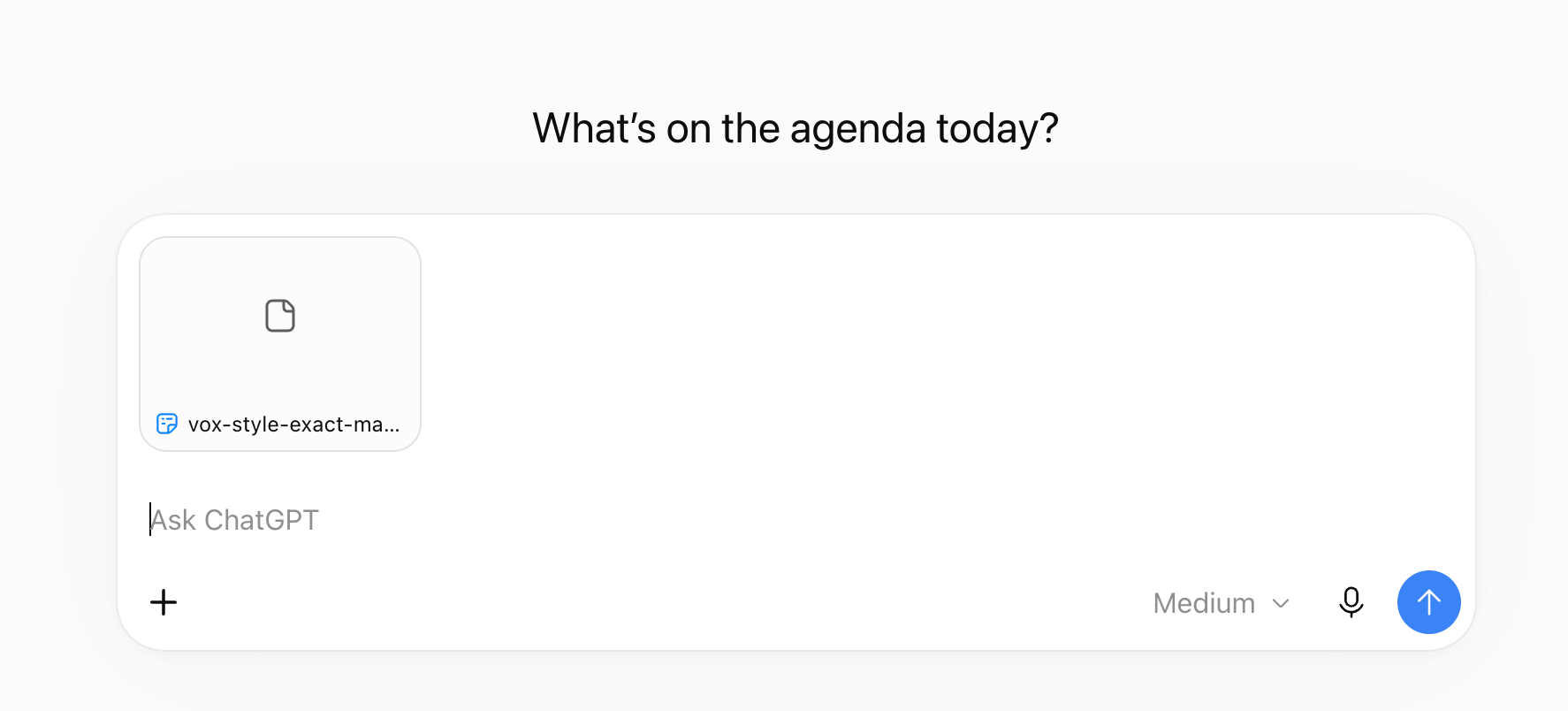
The chatbot will first ask you to upload a source-material PDF containing additional references or type skip to use the built-in instructions.
You can download the source-material PDF below and upload it.
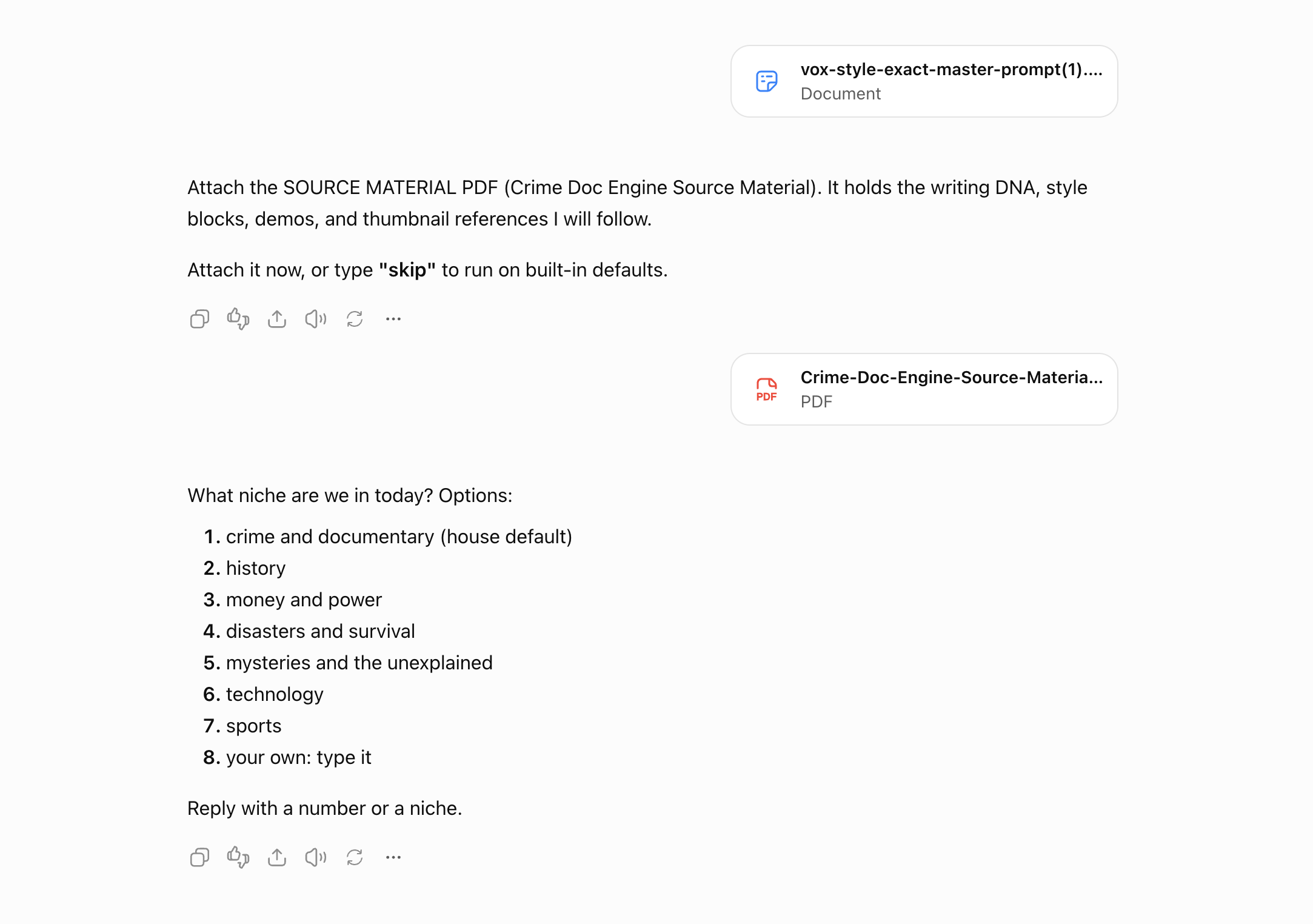
Next, you'll choose a niche from categories such as crime, history, technology, sports, or mysteries. The chatbot will suggest ten documentary ideas before asking you to select a topic and a video length.
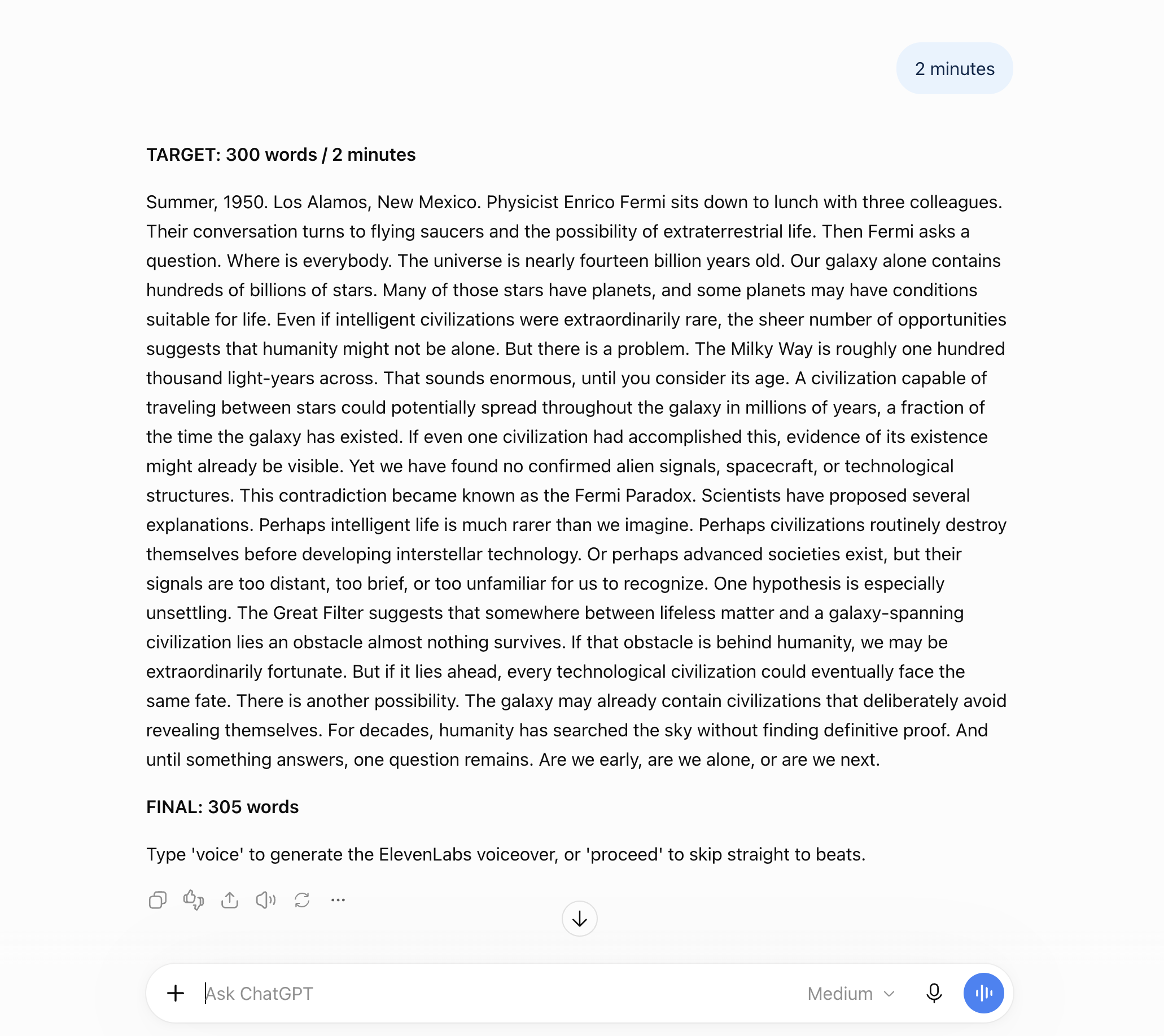
Once you've selected a duration, the AI will write a complete script. Review and edit the generated script before continuing.
Step 2: Break the Script Into Visual Scenes
Once your narration is finished, the next step is to divide it into smaller sections called visual beats.
Each beat represents one idea in the narration that can be illustrated with a single image. Rather than generating a continuous documentary animation, you'll create individual scenes to combine later. A short documentary might contain 12–15 beats, while a five-minute documentary could contain more than 100.
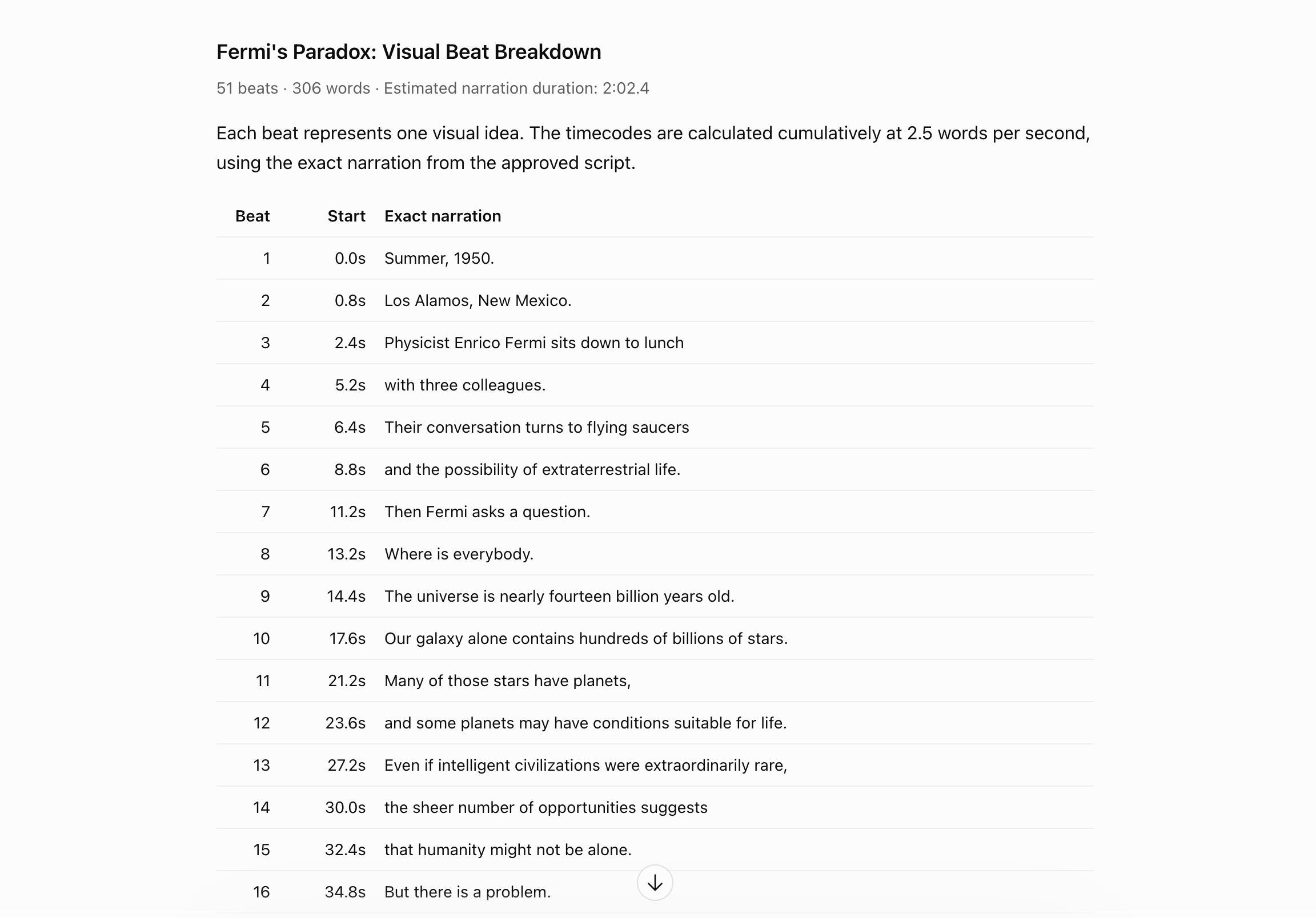
The chatbot will break the narration into beats of approximately two to three seconds, or five to eight spoken words. It also generates a table containing the beat number, starting timecode, and exact narration words.
Review this breakdown before generating your images. Each beat should communicate one visual idea rather than trying to illustrate an entire sentence containing several different events.
Step 3: Generate the Paper-Collage Images
Now you'll generate one image for every visual beat. These images will become the finished compositions that your AI animations build toward.
The master prompt already contains the exact image-generation instructions, so you don't need to write each prompt manually. The chatbot will export the completed prompts into a .txt file, with one prompt per scene and blank lines separating them.
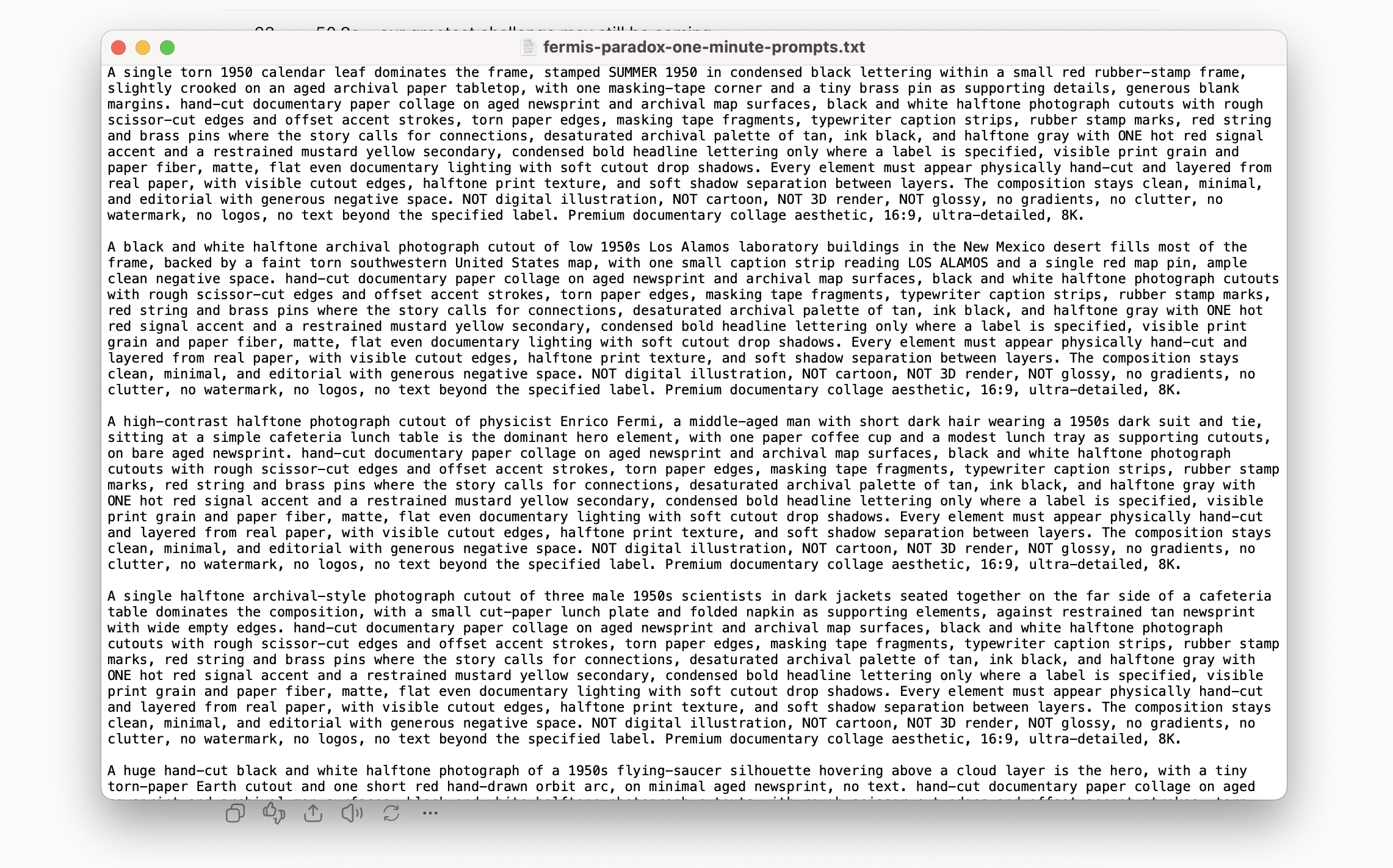
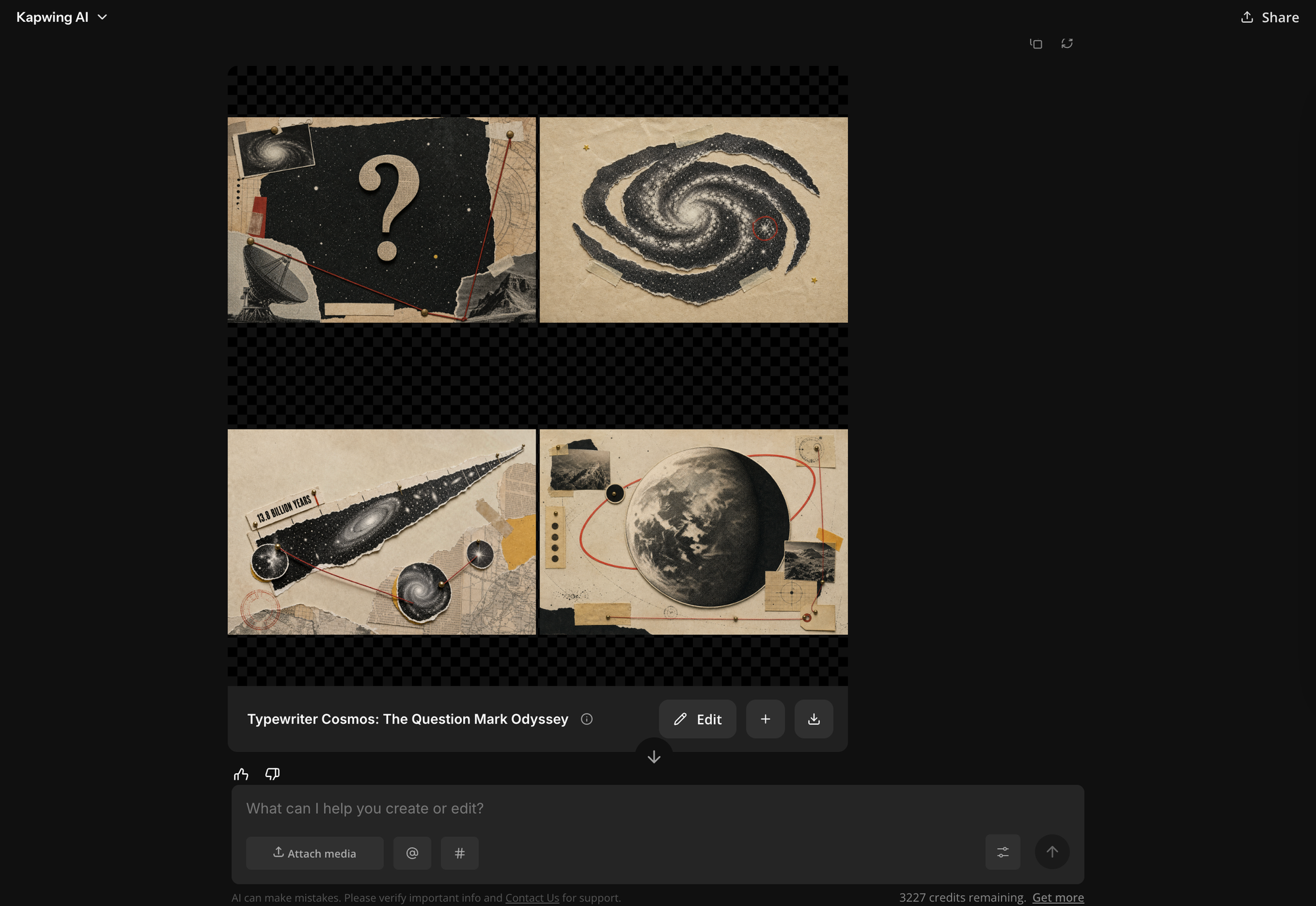
Open Kai and paste these image prompts into the prompt box. You can only generate 4 images at once, so you'll need to do this in batches.
Make sure to label each image by its order, to not get confused during later steps.
Step 4: Animate Each Collage Image With AI
Now that you've generated all your paper-collage images, the next step is to turn each one into a short animation.
Instead, you'll animate each image separately using the prompt below, then combine the finished clips during editing.
Vox Video Animation Prompt
Transform the provided image into a 10-second premium editorial documentary paper-collage animation. Preserve the final composition of the provided image exactly. Do not redesign, reposition, resize, or replace any element. The provided image is the FINISHED frame that the animation builds toward.
Style: hand-cut documentary paper collage in motion. Aged newsprint and archival surfaces, halftone photo cutouts, torn edges, tape, stamps, red string, typewriter strips. Every element moves as a rigid physical paper piece. Visible cutout thickness, print grain, soft layered shadows. Stop-motion cadence, stepped easing, 2-3 frame holds, the hand-made "cutting on twos" feel. Never smooth CGI motion.
CAMERA, STRICT: the camera stays completely locked for the entire clip. No zoom, no pan, no tilt, no rotation, no orbit, no dolly, no tracking, no handheld shake, no focus pulls, no reframing, no cuts, no transitions, no morphing, no object replacement, no time skips. One continuous static shot.
0 TO 7 SECONDS, BUILD-ON ASSEMBLY: the frame opens on the EMPTY background plate only: the bare aged-newsprint or archival surface with its stains, grain, and any fixed scaffolding (a map base, a timeline line, a corkboard), with every story element absent. Elements then enter one by one, back to front, in narrative order: background scraps settle first, then the hero cutout slides in with paper drag and a small settle, supporting cutouts drop or pin on with a 2-frame stamp settle, tape presses down, typewriter strips slide in, stamps slap on, red string draws itself from pin to pin, marker underlines and arrows draw themselves last. Each entrance lands with a tiny handcrafted bounce and casts a real layered shadow. No element moves again after it lands. By 7 seconds the frame exactly matches the provided image.
7 TO 10 SECONDS, LIVING PAPER POSTER: everything holds position. Only subtle life remains: paper corners lift a millimeter in a draft, halftone dots shimmer faintly, string tension quivers once, shadows breathe, stamp ink glistens subtly. Nothing changes location, nothing scales, nothing rotates significantly, nothing enters or exits.
AUDIO: no music, no narration, no voices. Only close-up paper ASMR and faint scene-appropriate ambience: paper sliding, cardstock taps, tape press, stamp thud, string zip, pin click, soft room tone. All subtle.
FINAL RULE: the finished clip must feel like a real editorial paper collage assembling itself on a table, then holding as a living poster, matching the provided image exactly from 7 seconds to the end.
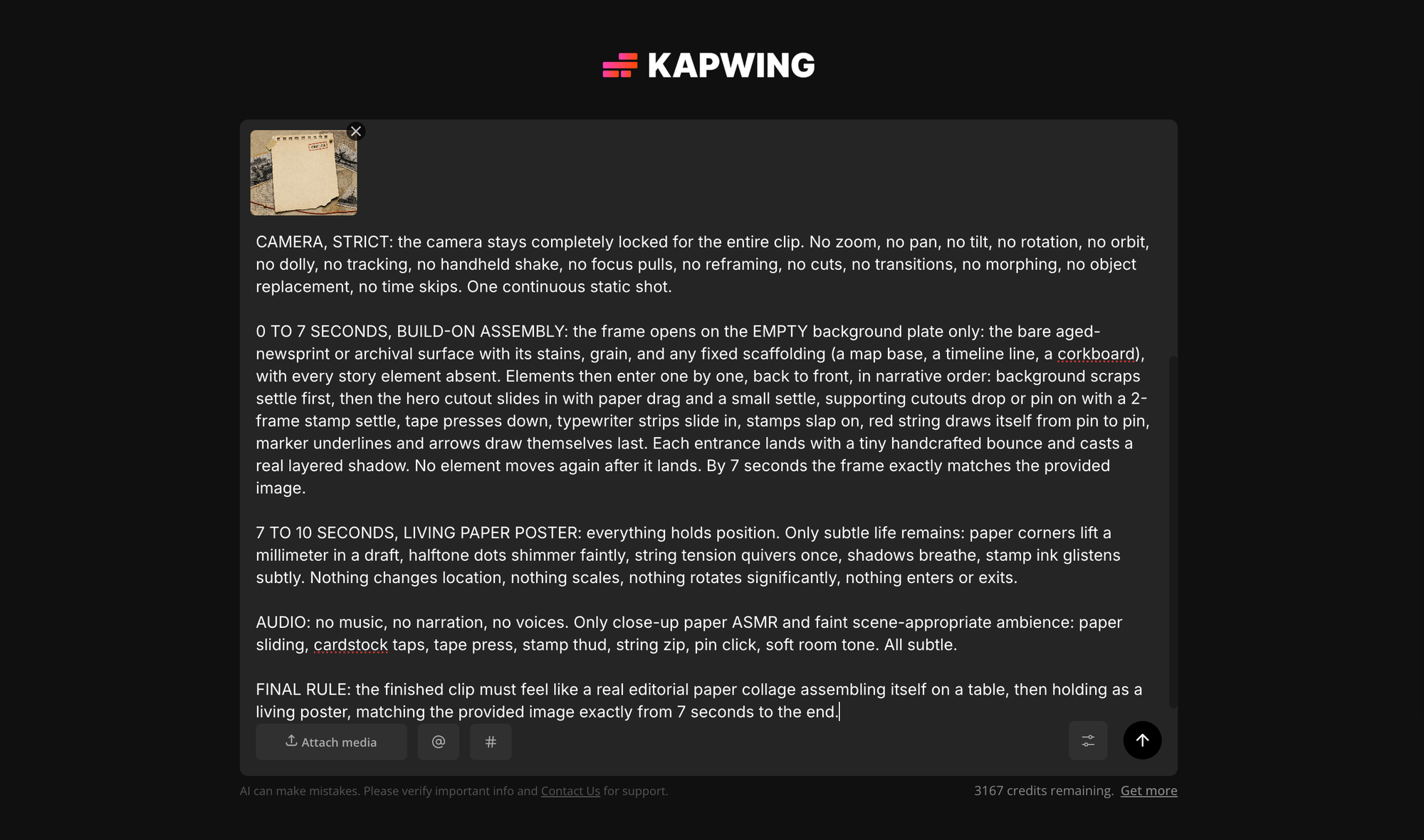
Check that the paper moves naturally, the camera stays stationary, and the animation ends on the reference image.
Then, repeat for the remaining images.
Step 5: Generate the Documentary Voiceover
With your scenes ready, create the narration. The master prompt includes a dedicated voiceover stage using ElevenLabs. To generate the narration, return to your chatbot and type: voice
The chatbot will prepare a copy-paste version of the script along with the recommended voice settings.
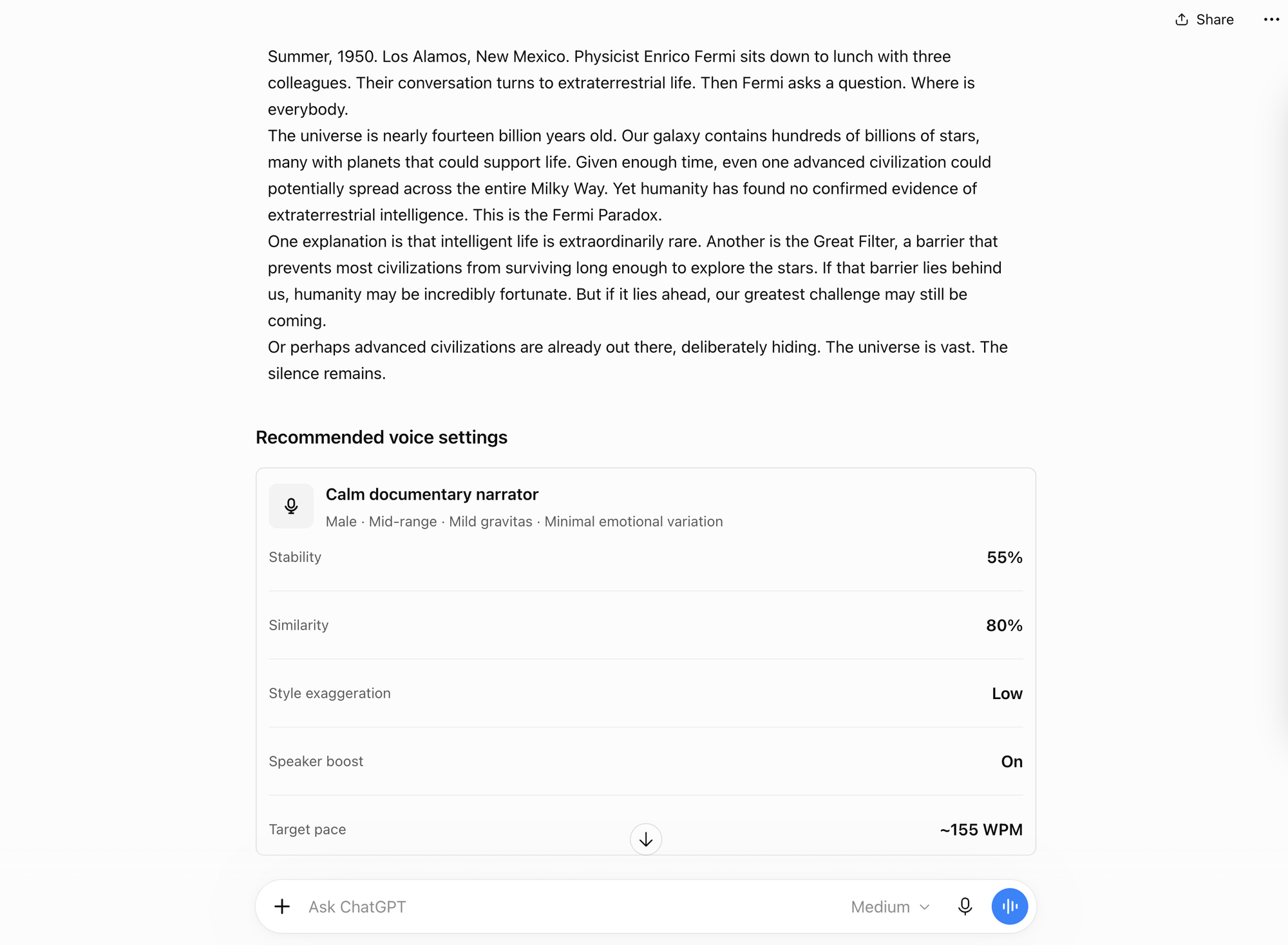
Copy and paste this prompt into Kai to generate a voiceover.
Make sure to suggest ElevenLabs as the model.
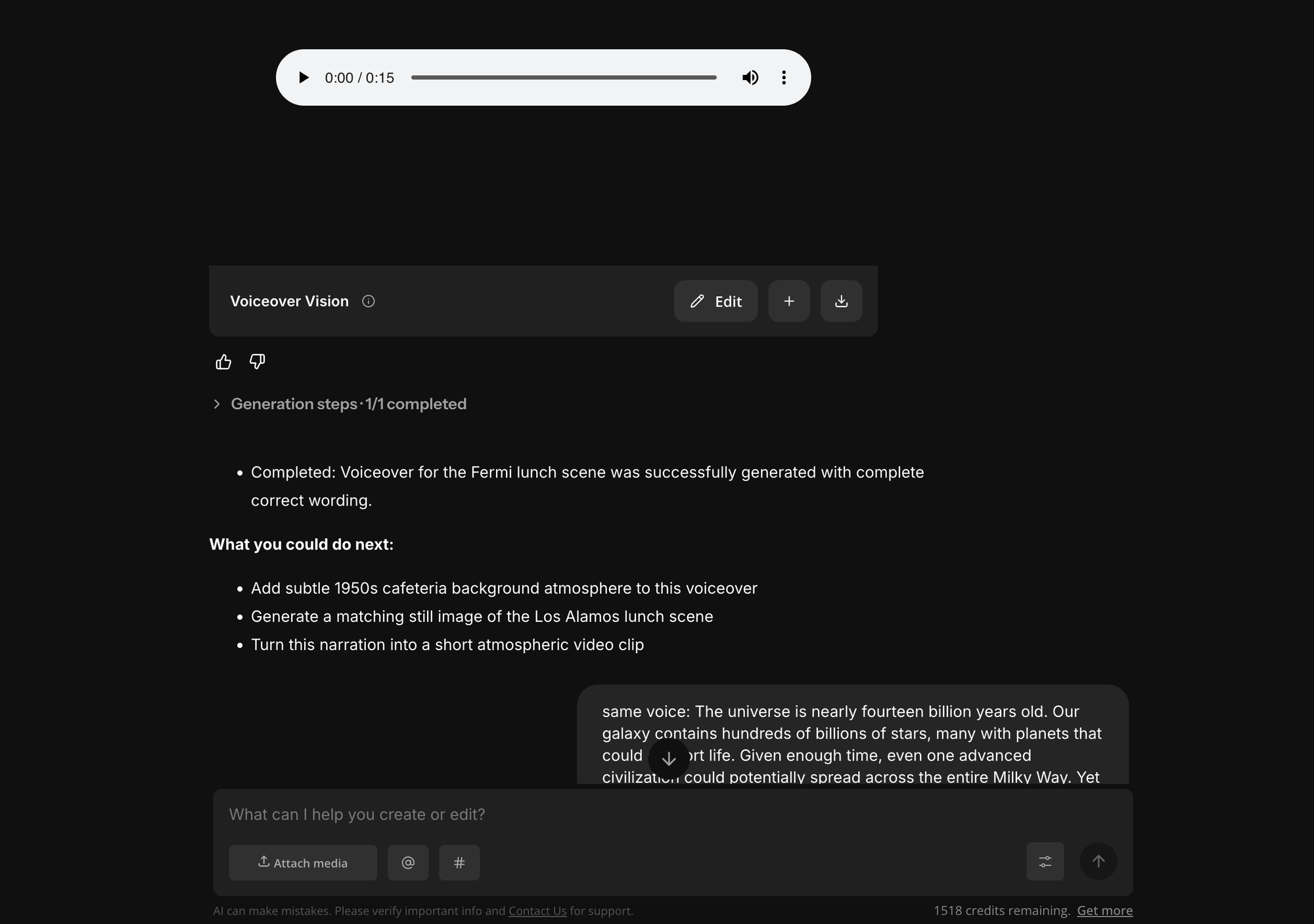
Step 6: Edit the Animations Into a Finished Documentary
The final step is to assemble your animated clips and narration into a complete video.
Open the Studio and upload the generated animation clips and your voiceover, then arrange the scenes in the order specified by your visual beat breakdown.
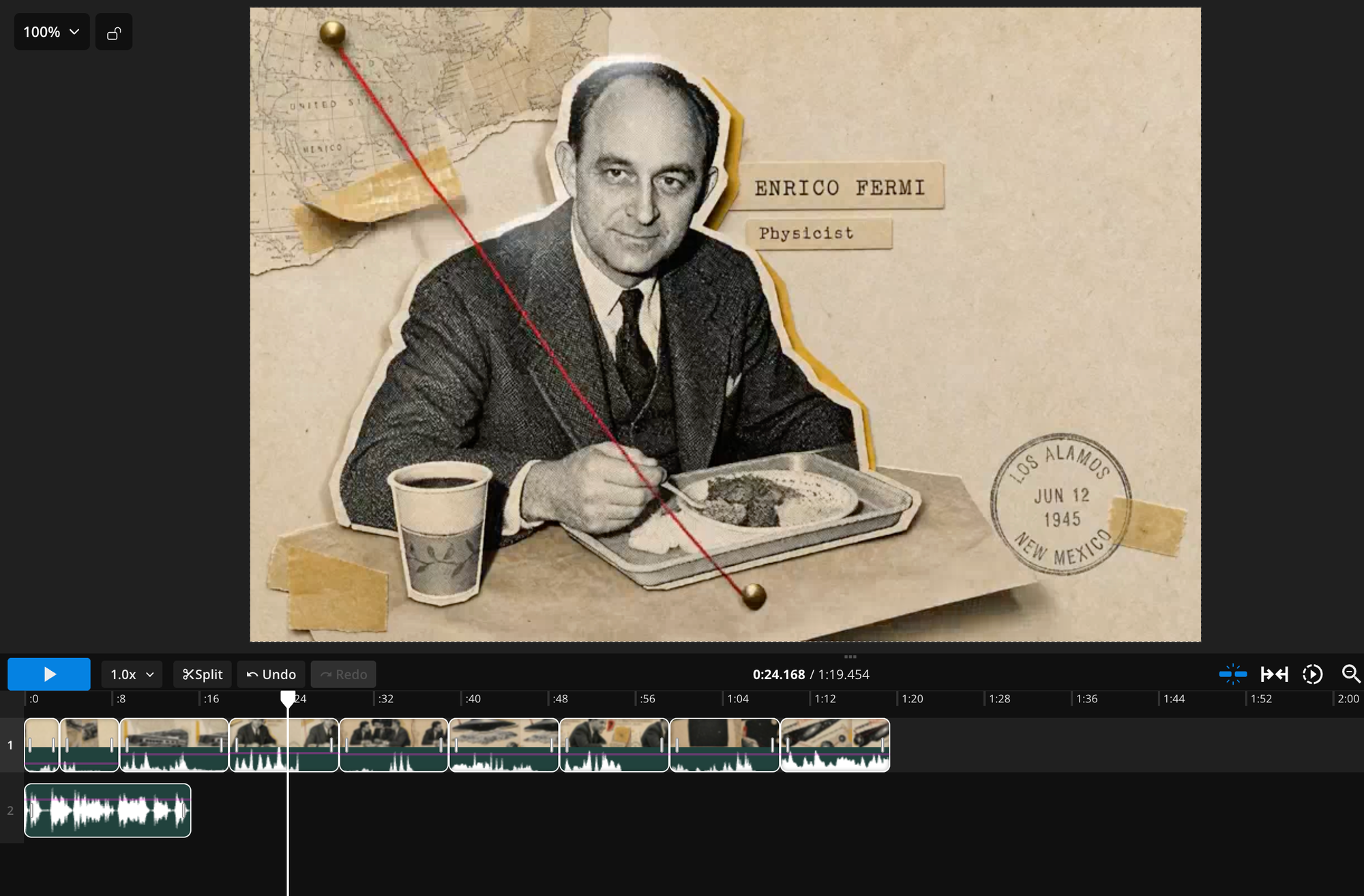
Use the narration as your timing reference. Each animated collage should appear when its corresponding detail is mentioned.
Because the generated animations are six seconds long, some clips will need to be shortened significantly. You can trim the beginning or end of each animation, depending on whether the paper assembly or the finished composition is more important to that moment.
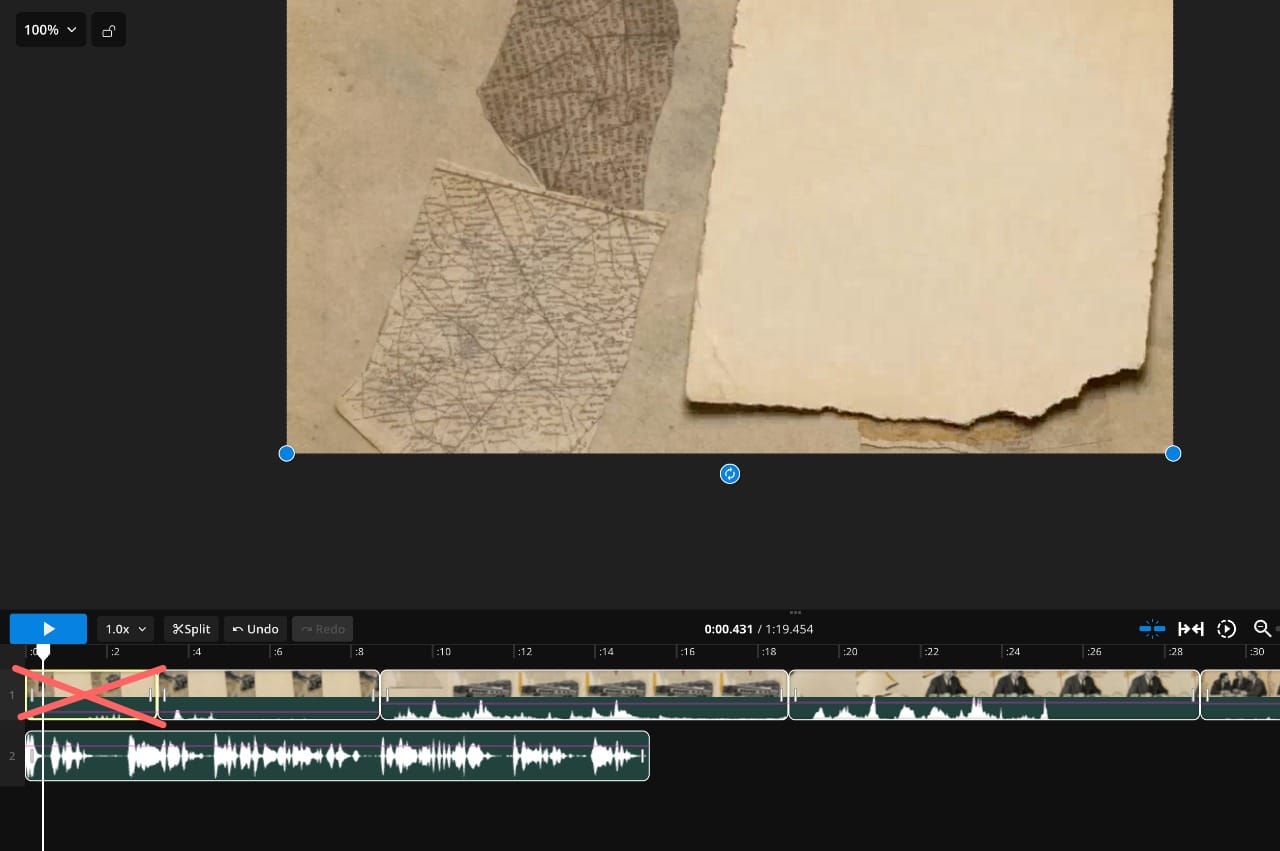
Once the timing is set, add the finishing touches:
- Background music: Choose a subtle documentary soundtrack that supports the narration without overpowering it.
- Sound effects: Paper shuffles, stamp impacts, typewriter clicks, and other tactile sounds can reinforce the stop-motion effect.
- Subtitles: Use automatic subtitles to make the documentary easier to follow, especially on social media.
- Transitions: Favor simple cuts over elaborate transitions. The paper animations already provide much of the visual movement.
Frequently Asked Questions
Can you make Vox-style animations with AI?
Yes. AI image generators can create layered documentary collages, while image-to-video models can animate those compositions. You can then combine the resulting clips with narration, music, and subtitles in a video editor.
Can you create Vox-style animations for free?
You can experiment with this workflow using free plans or credits from AI tools, although availability and generation limits vary. Creating longer documentaries with dozens of animated scenes may require additional credits or a paid plan.
What AI tools can make Vox-style animations?
The demonstrated workflow uses ChatGPT or another chatbot for writing and prompt generation, Google Flow for image and video creation, and ElevenLabs or another text-to-speech tool for narration. A video editor such as Kapwing can be used to assemble and finish the documentary.
Do you need After Effects to make documentary animations?
No. While After Effects offers detailed manual control over layered motion graphics, AI image-to-video tools can produce paper-collage animations without traditional keyframing. The tradeoff is that AI-generated movement may be less predictable and require multiple attempts.
How long should each AI documentary animation be?
The reference workflow generates six-second animated clips and trims them to match narration beats of approximately two to three seconds. The ideal length depends on the complexity of the visual and how long viewers need to understand it.
What is the difference between Vox-style animation and regular AI video?
Vox-style documentary animation emphasizes editorial composition, typography, diagrams, archival imagery, and information-driven storytelling. Regular AI video generation can involve almost any visual style, including photorealistic footage, cinematic scenes, or character animation.
Can you use Vox-style animations for YouTube Shorts?
Yes. The same visual workflow can be adapted to vertical video by generating 9:16 compositions and keeping important details within the central viewing area. Short-form versions generally benefit from fewer elements, larger labels, and faster visual changes.