How Many People Use Subtitles in 2026?
More than 50% of Americans use subtitles at least some of the time
Subtitles are now a regular part of how Americans watch video. A 2025 survey by AP-NORC found that half of U.S. viewers use subtitles at least some of the time, while about one in three use them always or often (source). Another survey by Preply in August 2022 showed that 50% of Americans watch content with subtitles most of the time (source). Usage is even higher among viewers under 45.
Subtitles have quietly shifted from an accessibility feature to a default viewing habit.
This article pulls together the most reliable data on subtitle usage in 2026: how many people use them, who uses them most, why they turn them on, and what changed in the last two years, including a new EU legal mandate that made captions a compliance requirement.
Original Kapwing data: Kapwing completes more than 4.6 million subtitle-generation jobs a year, which offers an unusually direct view of how caption use is changing. Between 2024 and 2026, the share of videos exported from Kapwing that include subtitles rose from 38% to 51%. In other words, a majority of finished videos now ship with captions, up from roughly a third two years ago. These first-party figures are free to cite with attribution and a link to this page.
Fast Facts on Subtitle Usage in 2026:
- 51% of videos exported from Kapwing now include subtitles, up from 38% in 2024 (Kapwing platform data, based on 4.6M+ subtitle jobs a year)
- 33% of Americans always or often use subtitles when watching TV or movies (AP-NORC, 2025)
- Nearly half of all US Netflix viewing hours happen with subtitles or captions on (Netflix, 2025)
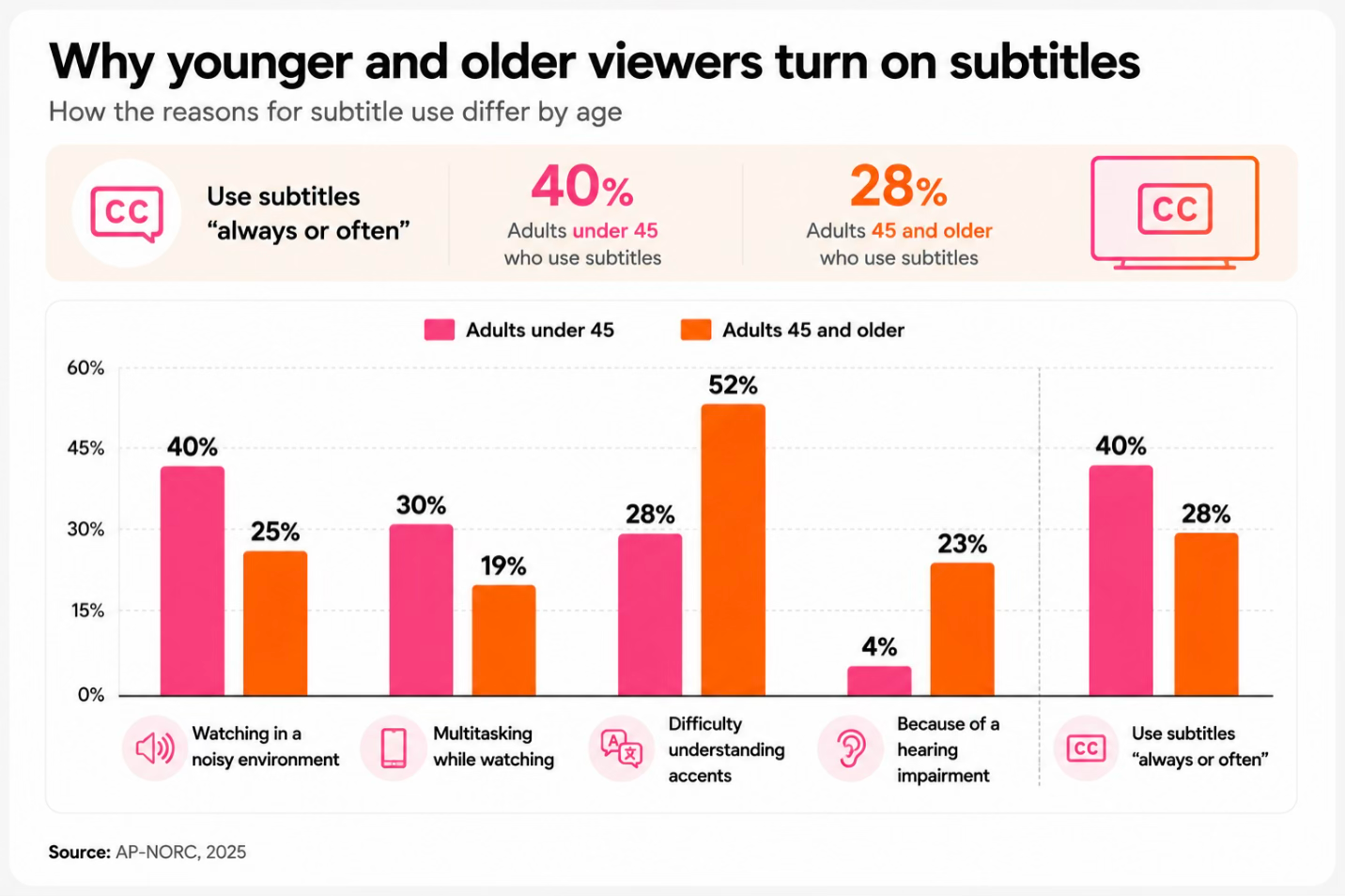
- 40% of adults under 45 use captions always or often, versus 28% of older adults (AP-NORC, 2025)
- 55% of Americans keep subtitles on at least some of the time (CBS News poll)
- 56% of people under 35 use subtitles even when the audio is in their own language (CivicScience)
- 59% of Gen Z and 52% of millennials watch with subtitles (YPulse, 2023, via Axios)
- Roughly 80% of people who use captions do not have a hearing impairment (Verizon & Publicis Media)
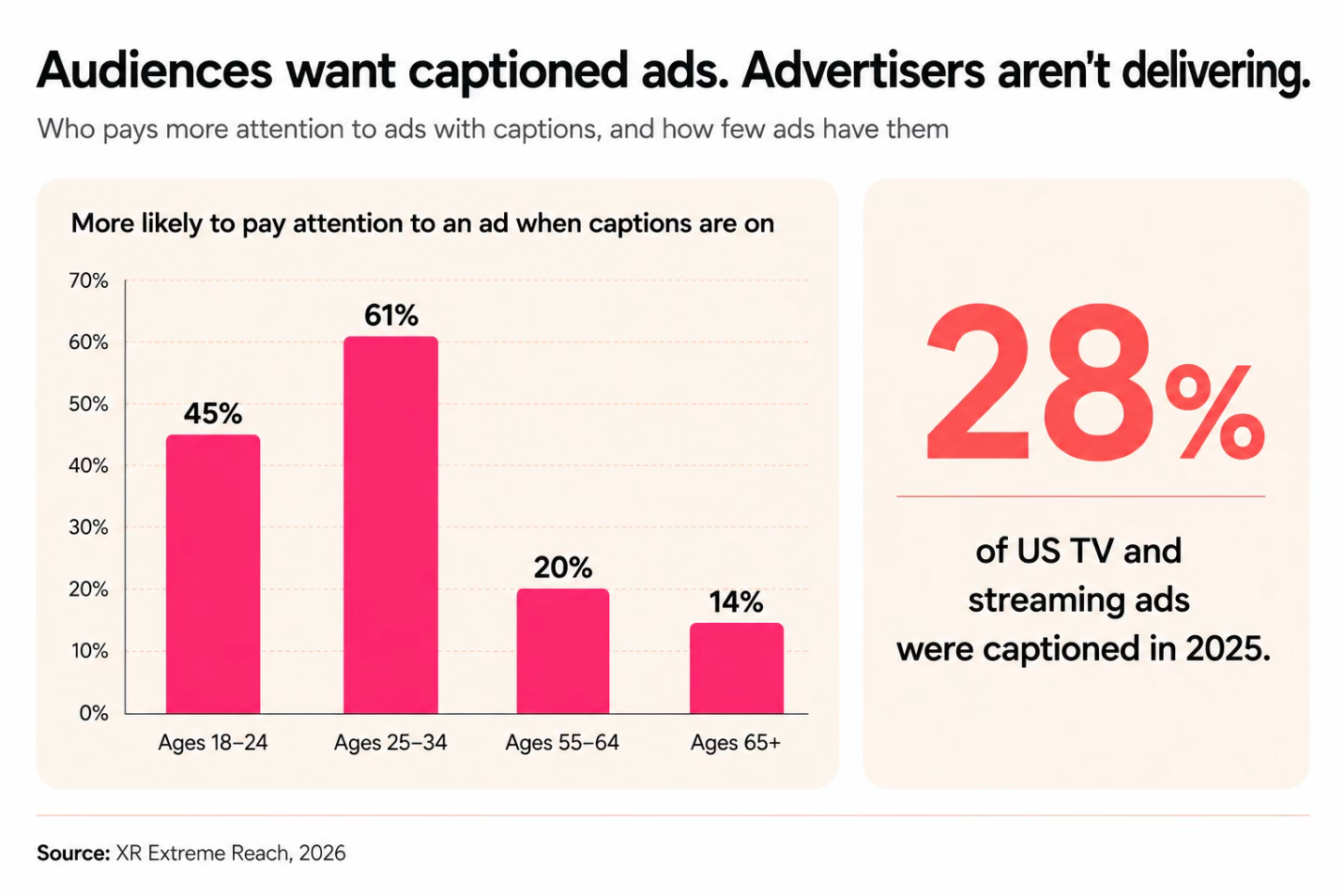
- 61% of 25–34-year-olds say captions make them more likely to pay attention to ads, yet only 28% of US ads were captioned in 2025 (XR Extreme Reach, 2026)
- Since June 2025, the EU's Accessibility Act has required many businesses to add captions to the videos in their digital products and services (European Accessibility Act)
Table of Contents:
- How Many People Use Subtitles in 2026?
- Why Do People Turn Subtitles On?
- The Generational Divide
- When Are Subtitles Legally Required?
- Who Captions Help, Beyond Hearing Loss
- Do Subtitles Actually Boost Engagement?
- How Creators Make Subtitles in 2026
- How to Make Better Subtitles
How Many People Use Subtitles in 2026?
Around one-third of Americans regularly watch videos with subtitles, while more than half use them at least some of the time. The exact figure depends on how each survey defines subtitle use.
A 2025 AP-NORC survey from the University of Chicago found that 33% of Americans use subtitles always or often. A CivicScience survey of 1,774 US adults produced a similar result, with 36% saying they always or usually use captions, even when watching content in a language they understand.
When occasional use is included, the figure rises above half. A CBS News poll found that 55% of Americans keep captions on at least some of the time, including 34% who use them all the time and 21% who use them sometimes.
Here’s how the numbers compare across the major recent surveys and platform data:
Definitions of subtitle use vary between studies, so the figures are not directly interchangeable. The source column shows whether each study measures regular, occasional, or overall use.
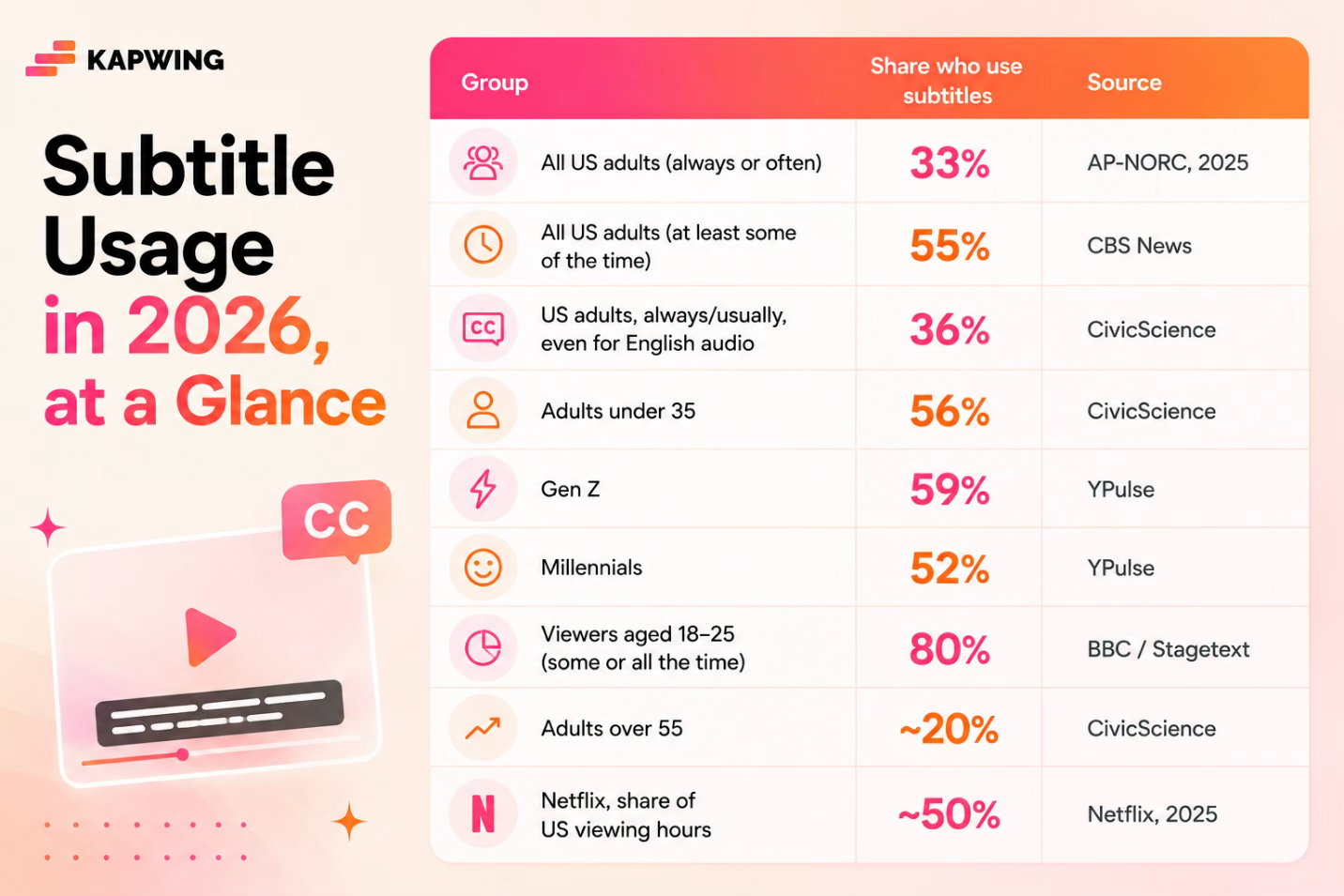
Taken together, the surveys paint a consistent picture: subtitles are now a routine viewing habit for a substantial share of Americans. A 2026 Preply survey also found that 53% of Americans use subtitles more than they used to, suggesting the habit is continuing to grow.
Streaming platforms are seeing the same behavior. In April 2025, Netflix reported that nearly half of all US viewing hours happen with subtitles or captions turned on. Netflix subsequently introduced a new subtitle option showing spoken dialogue without the speaker labels and sound-effect cues included in traditional closed captions.
The shift is not limited to the US. A 2026 survey from XR Extreme Reach, covering the US, UK, France, Spain, and Germany, found that 80% of viewers use captions at least sometimes.
Why Do People Turn Subtitles On?
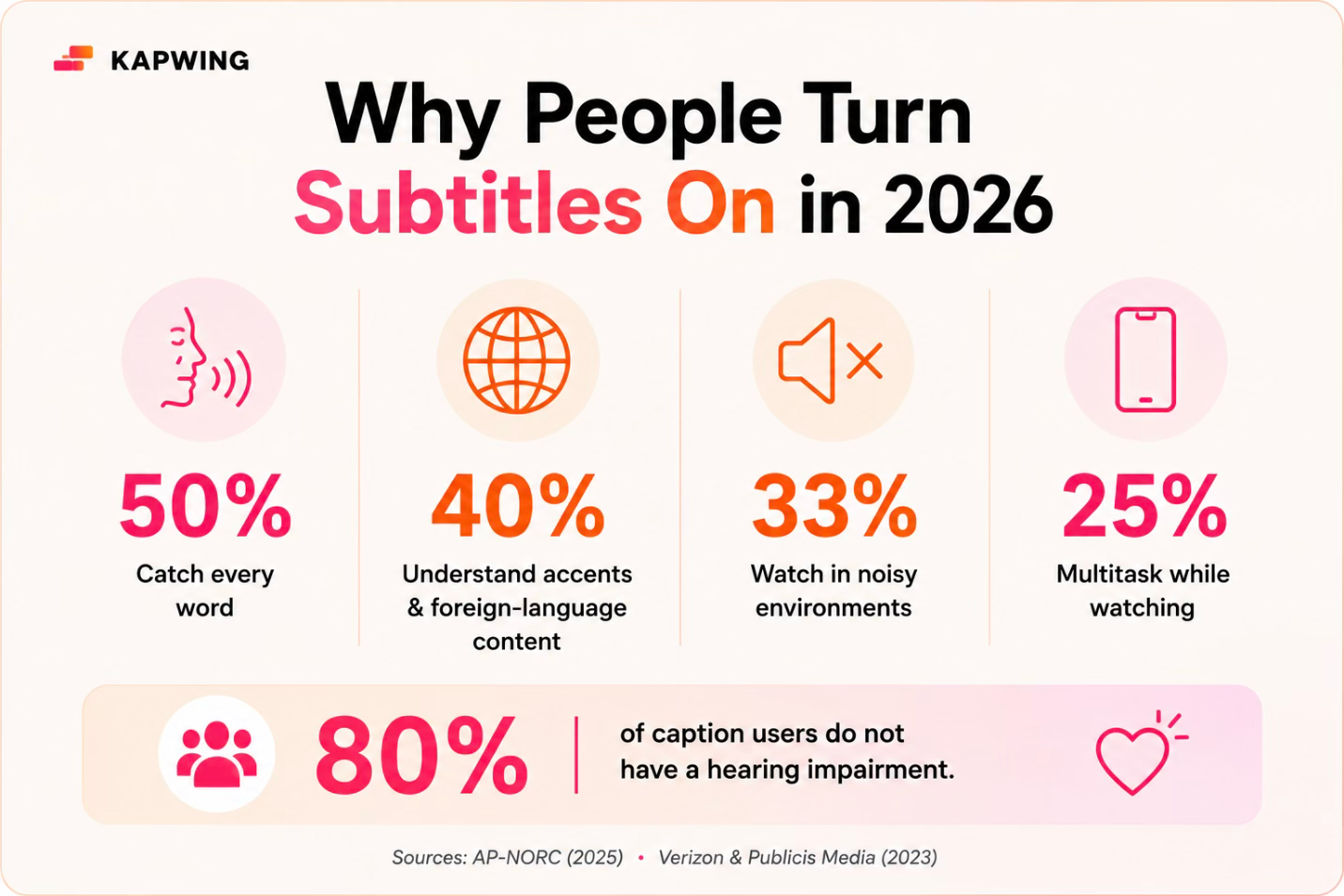
If hearing loss isn't the main reason most viewers use subtitles, what is? The AP-NORC data shows that understanding dialogue is the biggest driver, followed by language, viewing environment, and audio quality.
- 50% want to catch every word. The most common reason is simply not wanting to miss dialogue.
- 40% use subtitles to understand accents or enjoy content in another language. International streaming hits such as Squid Game have helped normalize subtitled viewing.
- 33% turn them on because of noisy surroundings.
- 25% use them because of poor audio or while multitasking.
Other surveys reinforce the same pattern. A 2026 Preply survey found that 78% of viewers struggle to hear dialogue over loud background music, while 55% say on-screen dialogue is harder to understand than it used to be.
Research commissioned by captioning charity Stagetext found another important reason: 42% use subtitles to help them concentrate. Among caption users, 74% said subtitles improve their viewing experience, including 35% who said they make it “a lot better.”
The common thread is control and comprehension. People watch video while multitasking, in noisy environments, on small devices, and alongside increasingly complex audio mixes. Subtitles give viewers another way to follow what is being said without relying entirely on the audio.
And for most caption users, hearing loss isn't the reason. Research from Verizon and Publicis Media found that roughly 80% of people who use captions do not have a hearing impairment. Captions remain essential for accessibility, but their widespread use now extends far beyond audiences with hearing loss.
The Generational Divide
The averages hide a steep generational split. Older viewers are the least likely to use captions, and younger viewers are the most likely, even though older viewers are far more likely to have genuine hearing difficulty.
This younger skew is especially important because subtitle use has spread fastest among viewers under 45 — the same audiences that make up a large share of streaming, social video, and creator-led media consumption.
The generational divide is also where the numbers become truly striking. CivicScience found that 56% of people under 35 use subtitles even for English-language content, while only about one in five viewers over 55 do.
A 2023 YPulse survey reported by Axios found that 59% of Gen Z and 52% of millennials watch with subtitles, with Gen Z men the most likely group of all at 61%. Earlier BBC-reported research from Stagetext found that four out of five viewers aged 18 to 25 use subtitles all or part of the time, and that young people were roughly four times more likely than older viewers to keep them on.
The most convincing explanation ties back to short-form video. A generation that grew up on TikTok, Reels, and YouTube Shorts learned to watch video with text on screen and the sound off by default, and that habit carried over to television and streaming. Stagetext has attributed the shift to exactly this generational change: for younger viewers, captions are simply the norm. For more on how short-form has reshaped viewing habits, see Kapwing's short-form video statistics.
If your audience skews young, assume a majority are watching with captions, and design your videos accordingly.
When Are Subtitles Legally Required?
Accessibility law is becoming an increasingly important reason for businesses and public organizations to caption video. In some sectors and jurisdictions, captions are no longer simply an engagement feature: they form part of a legal accessibility obligation.
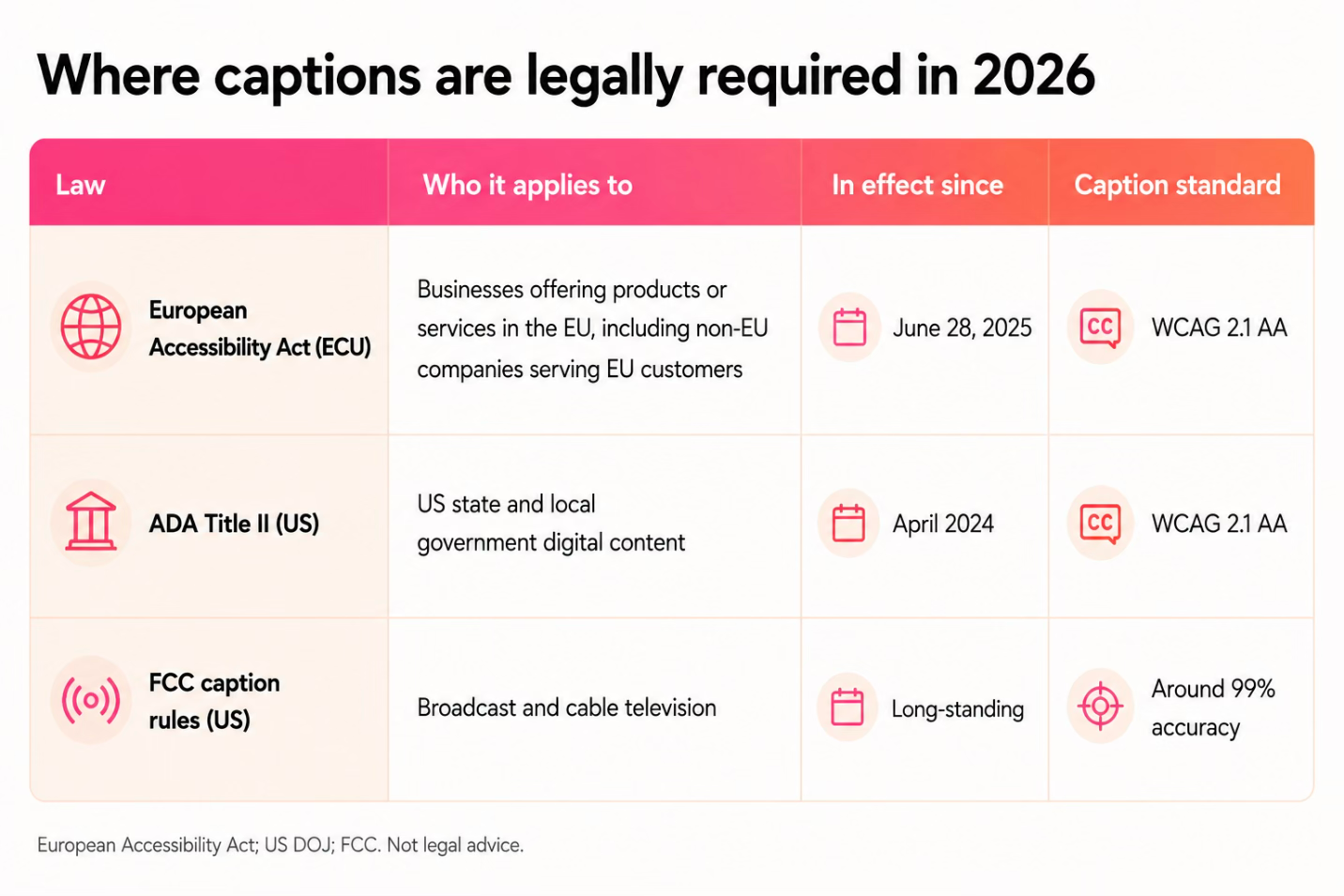
One of the biggest recent changes is the European Accessibility Act (EU Directive 2019/882), which became applicable on June 28, 2025. It covers specified consumer products and services, including e-commerce, banking, e-books, electronic communications, passenger transport services, and services providing access to audiovisual media. Businesses offering covered products or services in the EU can therefore face accessibility requirements even when they are based outside the EU.
For video, the exact requirement depends on the service and content. The Act's accessibility requirements include providing subtitles where instructions are delivered through video and ensuring that accessibility features such as subtitles for deaf and hard-of-hearing viewers are transmitted with adequate quality and synchronized with the audio and video by services providing access to audiovisual media.
There are transitional provisions, but they should not be treated as a blanket extension to 2030. Certain products already being used to provide services can continue during a transitional period ending June 28, 2030, while service contracts agreed before June 28, 2025 can continue until they expire, for no more than five years. Penalties for non-compliance are determined by individual EU member states.
The United States has its own accessibility requirements. In 2024, the Department of Justice updated Title II of the Americans with Disabilities Act to require state and local government websites and mobile apps to meet WCAG 2.1 Level AA. Following a 2026 extension, larger public entities generally have until April 26, 2027, while smaller entities and special district governments generally have until April 26, 2028, to comply.
The FCC also maintains closed-captioning quality requirements for television programming. Rather than specifying a single numerical accuracy threshold, its standards focus on accuracy, synchronicity, completeness, and placement.
The accessibility need behind these rules is substantial. More than 1.5 billion people worldwide live with some degree of hearing loss, according to the World Health Organization, and that figure could approach 2.5 billion by 2050.
For creators and businesses, the practical shift is important. Captions have long been promoted as a way to improve comprehension and engagement, but for organizations covered by accessibility legislation, they can also be part of meeting a legal accessibility standard. That requires more than simply generating text: captions need to accurately communicate dialogue and, where necessary for understanding, identify speakers and relevant non-speech audio.
Kapwing has published an EAA compliance checklist and a guide to captions that meet EAA requirements for teams working through these requirements.
Who Captions Help, Beyond Hearing Loss
Captions remain essential for deaf and hard-of-hearing viewers. The National Institute on Deafness and Other Communication Disorders estimates that 1 in 8 Americans aged 12 or older — around 30 million people — have hearing loss in both ears. But research increasingly shows that captions can benefit a much wider audience too.
Language learners are one major group. A meta-analysis of captioned video research found that same-language captions have a large positive effect on both listening comprehension and vocabulary acquisition for people learning a second language. More recent research has reinforced the vocabulary benefit: a Language Learning meta-analysis covering 49 studies found that learners acquired more vocabulary from captioned video than from the same content without captions.
Researchers have even proposed a “subtitle principle” to describe this effect: when people are watching content in a second language, written captions can support comprehension rather than simply distracting from the audio. They can help viewers identify individual words, connect spoken and written forms, and recover information they did not fully process through listening alone.
Captions can also make video easier to process for some neurodivergent viewers, including people with ADHD, autism, auditory processing difficulties, or dyslexia. Providing speech in both audible and written form gives viewers another way to follow the information when processing spoken dialogue is difficult. The benefit is not universal, however: for some people, additional on-screen text can increase cognitive load rather than reduce it, particularly when captions are inaccurate or poorly synchronized.
The result is that the audience who benefits from captions is much larger than the audience who strictly depends on them for accessibility. Designing video for people who rely on captions can also make content easier to understand for language learners, neurodivergent viewers, and anyone who finds spoken dialogue difficult to process.
Do Subtitles Actually Boost Engagement?
Preference and accessibility aside, there is also a business case for captions. The strongest research is several years old, so the exact performance lift should not be treated as universal, but controlled studies and audience research consistently show benefits for watch time, completion, recall, and discoverability.
A note on the caption stats you'll see everywhere: Search for the value of captions and you'll find confident claims that they generate 40% more views, 38% more engagement, or 15–25% more reach. Treat those figures with caution. Many are repeated without a clear original study, methodology, or sample size, and they often measure different outcomes. When you need a number you can defend, look for a named source, a date, and an explanation of exactly what was measured.
One of the most widely cited studies is a 2019 report from Verizon Media and Publicis Media, based on a survey of 5,616 US consumers. It found that 80% of respondents were more likely to watch an entire video when captions were available. Captioned ads also produced an 8% lift in ad recall, a 10% lift in ad memory quality, and a 13% lift in brand linkage.
Separate Facebook research found that captioned video ads increased average view time by around 12%. That is an older platform-specific finding rather than a guarantee for every type of video, but it provides measured evidence that captions can help viewers stay with content longer.
Part of the reason is that video is often consumed without sound. The Verizon/Publicis research found that 69% of consumers watched video without sound in public places, while another report on the study said 92% watched mobile video with the sound off at least some of the time. Older Facebook publisher data showed the same behavior: Digiday reported in 2016 that around 85% of video views for some major Facebook publishers occurred without sound.
Captions can also contribute to discoverability. In a controlled study, Discovery Digital Networks added closed captions to a selection of YouTube videos and recorded a 7.32% overall increase in views, rising to 13.48% during the first 14 days. The experiment also showed that YouTube indexed words contained only in the caption file, allowing the videos to appear for searches based on spoken content.
The strongest recent evidence comes from advertising. In 2026, XR Extreme Reach found that 61% of 25-to-34-year-olds said captions make them more likely to pay attention to an ad, the highest proportion of any age group. Across US respondents overall, 41% said captions increased their attention to advertising.
Yet advertiser adoption still trails audience behavior. XR's ad-delivery data showed that only 28% of US TV and connected-TV ads included captions in 2025.
Taken together, the evidence does not support one universal claim such as “captions increase engagement by 40%.” What it does support is a more useful conclusion: well-designed captions can improve the chances that viewers understand, continue watching, remember, and discover video content — particularly when they are watching without sound.
How Creators Make Subtitles in 2026
One reason subtitles have become so widespread is that they are now much faster to produce. Automatic speech recognition (ASR) can generate a first draft of a transcript in seconds or minutes, replacing much of the manual transcription work that captioning once required.
The technology has improved substantially, although accuracy still depends on the content. In 3Play Media's 2025 State of Automatic Speech Recognition study, which tested leading speech-to-text engines across more than 205 hours of real-world audio, the best-performing content categories recorded word error rates of around 4–5%. Performance declined with factors such as background noise, specialist terminology, names, overlapping speech, and unscripted dialogue; sports content had an average error rate of almost 15%.
As a result, automatic captions have become the starting point for many professional workflows rather than necessarily the finished product. 3Play Media's State of Captioning research found that 47% of organizations use auto-generated captions to create a foundational transcript before human review. Only 14% considered automatic captions alone fully accessible, highlighting the importance of checking accuracy when captions are being created for accessibility or compliance.
Kapwing's own platform data shows how quickly automated subtitling has become part of everyday video creation. Across more than 4.6 million subtitle jobs processed annually, the share of exported Kapwing videos containing subtitles increased from 38% in 2024 to 51% in 2026. Audience surveys measure demand for subtitles; Kapwing's data shows creators increasingly responding to that demand by adding them.
For creators, the workflow that once required manually transcribing and timing every line can now be handled largely automatically. Kapwing's auto-subtitle generator generates an editable transcript from a video or audio file. Creators can then correct the text, adjust timing and styling in the Subtitle Editor, burn captions directly into the finished video, or download them as SRT, VTT, or TXT files.
The same workflow can also handle localization. Kapwing's Subtitle Translator supports translation across 100+ languages, allowing creators to generate and edit translated subtitle tracks without starting again from a blank transcript. For more on that shift, see Kapwing's video translation statistics and its experiment comparing two ways to translate YouTube videos.
How to Create Better Subtitles
Adding subtitles is step one. Making them easy to read is just as important. Good subtitles need accurate timing, clear text, strong contrast, and placement that lets viewers follow the dialogue without obscuring important parts of the video.
A few principles hold up across accessibility guidance and subtitle research. Use a clear, readable font, keep lines short, and make the text large enough for the format it will be viewed in. There is no single ideal font size for every video: vertical social clips, landscape YouTube videos, and television content all have different viewing conditions. Kapwing's own subtitle system now takes this into account, adjusting caption length, size, and placement according to the video's aspect ratio.
Contrast is essential. WCAG recommends a minimum contrast ratio of 4.5:1 for normal text, so captions need to remain distinguishable even as the background changes. White text over a dark or semi-transparent background is a common solution, but the important factor is maintaining sufficient contrast throughout the video.
Placement matters too. Traditional captions normally sit toward the bottom of the frame, but creators should avoid covering faces, labels, or other important visual information. On TikTok, Reels, and Shorts, interface elements also occupy significant areas of the screen, so subtitles often need to be moved higher into the platform's safe zone. Kapwing's research-backed guide to the best fonts for subtitles covers these design considerations in more detail.
For social video, creators are also increasingly treating subtitles as a visual element rather than plain text. Kapwing's platform data shows that, excluding the default style, Prime is the most popular subtitle preset, while 51% of subtitled videos use a color word-by-word animation that highlights each word as it is spoken. Kapwing's current caption work similarly prioritizes platform-aware styling and word-by-word effects for social content.
That style can make fast-moving short-form content easier to track, particularly when viewers are watching without sound. But animated subtitles and accessibility captions serve slightly different purposes: where accessibility is the priority, accuracy, synchronization, readability, and completeness should come before visual effects.
Subtitles have become part of the finished video rather than an optional add-on. Between viewer preference, generational change, accessibility requirements, and increasingly automated creation tools, the evidence suggests caption use will continue to grow. In 2026, publishing without subtitles doesn't just make a video less accessible — it can also make it harder for a significant share of the audience to follow.
For more data on the changing video landscape, see Kapwing's research on video translation statistics, short-form video statistics, and AI-generated video statistics.
Last updated: August 2026. This article is reviewed and refreshed quarterly to reflect new survey data, accessibility regulations, and platform changes. Usage figures are drawn primarily from original surveys and first-party sources, including AP-NORC, CBS News, CivicScience, YPulse, Preply, Stagetext, NIDCD, and XR Extreme Reach. Research on captions and learning is based on peer-reviewed meta-analyses.
Kapwing platform statistics — including subtitle-generation volume, the share of exports containing subtitles, and subtitle-style usage — are based on aggregate, anonymized product data covering more than 4.6 million subtitle-generation jobs annually. Where possible, primary sources are prioritized over secondary reporting.