Video Translation Statistics: How Many Creators Localize Their Content in 2026?
91% of businesses use video as a marketing tool in 2026
The average internet user watches 19 hours of online video per week. Video accounts for 82% of all internet traffic. And yet, fewer than half of those creators and businesses translate any of it.
That's a problem. Over 6 billion people are online, most of whom don't speak English. Creators and brands that localize their content gain access to audiences their competitors simply can't reach. The ones that don't are leaving the majority of the internet on the table.
This article compiles the most important statistics on video translation, localization, dubbing, and multilingual content strategy in 2026. Use it to benchmark your own approach, build a case for investing in translation, or understand how localization affects engagement and revenue.
How Many Creators and Businesses Translate Their Video Content?
There's a wide gap between how many people create video and how many make it accessible across languages.
Most Brands and Creators Still Don't Translate
According to 3Play Media's State of Captioning report, only 43% of people are translating their video content. The primary reason: a lack of budget and time.
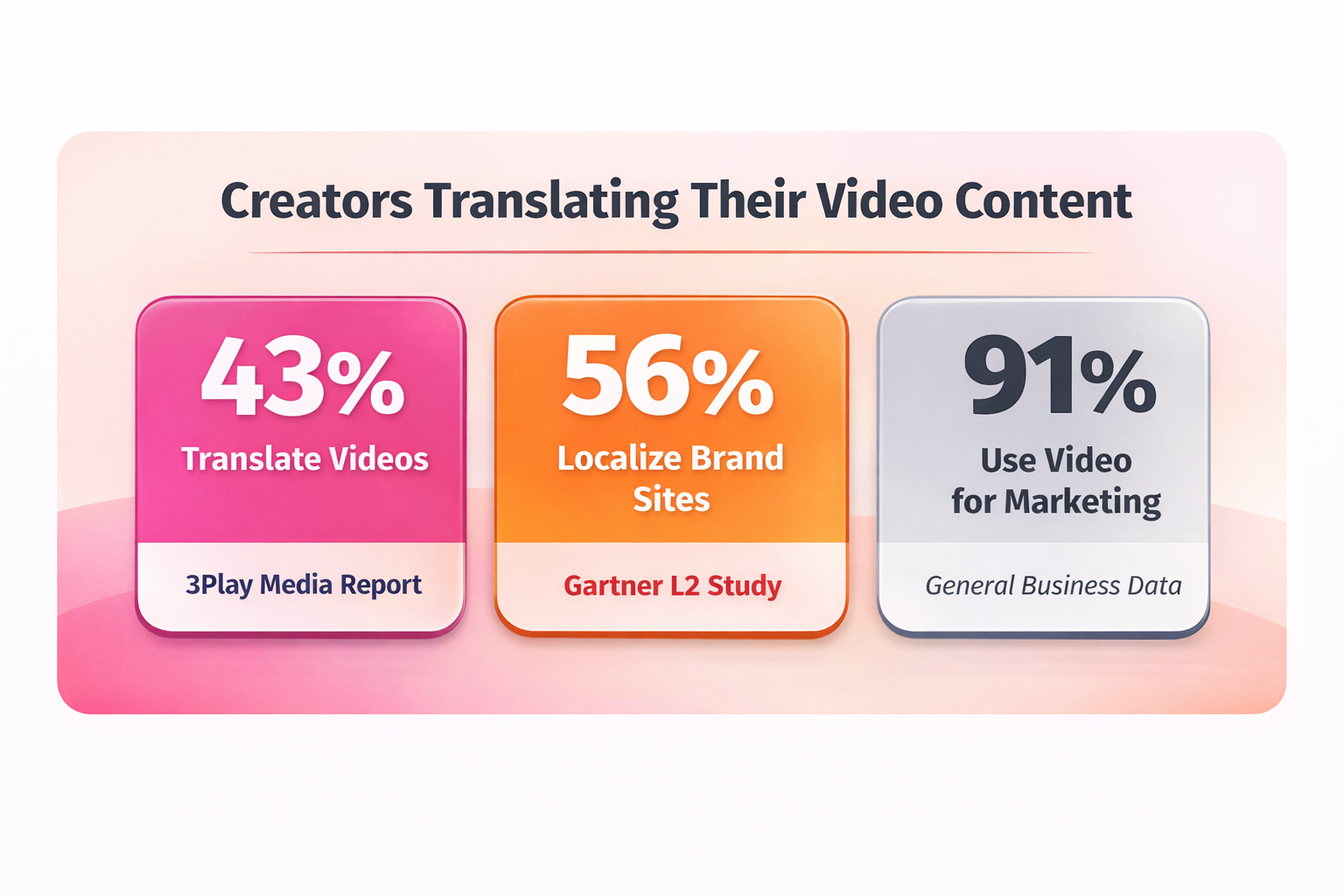
A Gartner L2 Intelligence Report echoes that finding. Only 56% of brand websites with video had localized those videos at all. Nearly half of the brands producing video were leaving it in a single language.
Compare that to overall video adoption. 91% of businesses now use video as a marketing tool, and 93% of marketers call it an important part of their strategy.
But translation adoption drops by nearly half. The industry has agreed that video works. It hasn't caught up on the idea that video should work in more than one language.
The barrier is practical, not intellectual. Most creators understand that a global audience exists. But traditional translation workflows (hiring voice talent, managing subtitle files, coordinating across agencies) have been expensive and slow. For a solo creator or small team, localizing a single video into two or three languages could eat an entire week.
Adoption Is Accelerating Fast
That resource barrier is now rapidly collapsing. YouTube rolled out auto-dubbing to millions of Partner Program channels in 2024 and 2025, giving creators a zero-effort entry point into multilingual audio.
According to AIR Media-Tech, 13% of creators across their network of 3,000 channels have invested in professional dubbing, and another 36% have experimented with auto-dubbing or AI tools.
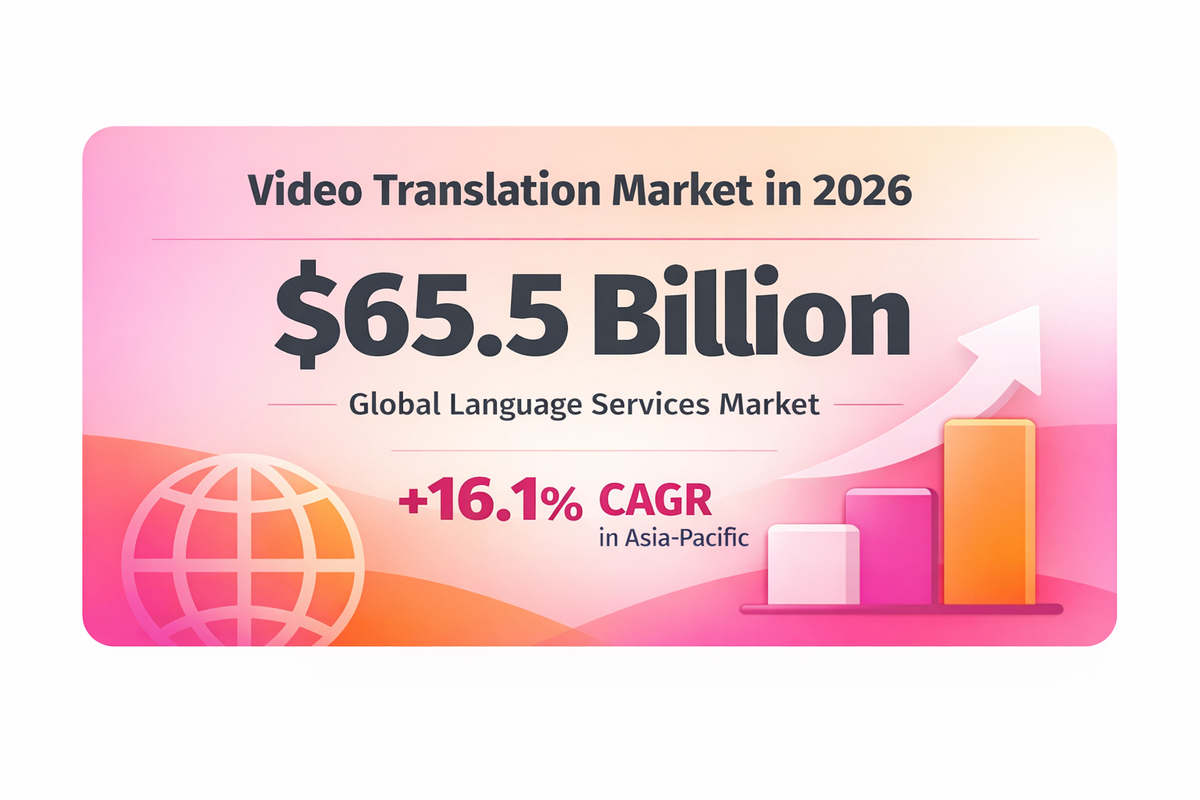
The broader industry reflects the same trajectory. The global language services market is projected to reach $65.5 billion in 2026, with Asia-Pacific growing fastest at a CAGR of 16.1%.
Neural machine translation now accounts for 85% of enterprise deployments, up from 50% in 2020.
Tools like Kapwing's Video Translator have made it possible for individual creators to translate, dub, and subtitle videos in a single workflow. Work that once required a localization agency and a five-figure budget can now happen in an afternoon.
As AIR Media-Tech puts it, by 2026, the creators who haven't started translating will be competing against the ones who already publish in 20+ languages.
How Video Translation Affects Viewer Engagement
Multiple studies and platform-level experiments have measured the direct impact of translation on views, watch time, and conversions. The results are consistent.
Viewers Overwhelmingly Prefer Content in Their Native Language
According to Harvard Business Review research, 72.1% of consumers spend most or all of their time on websites in their own language.
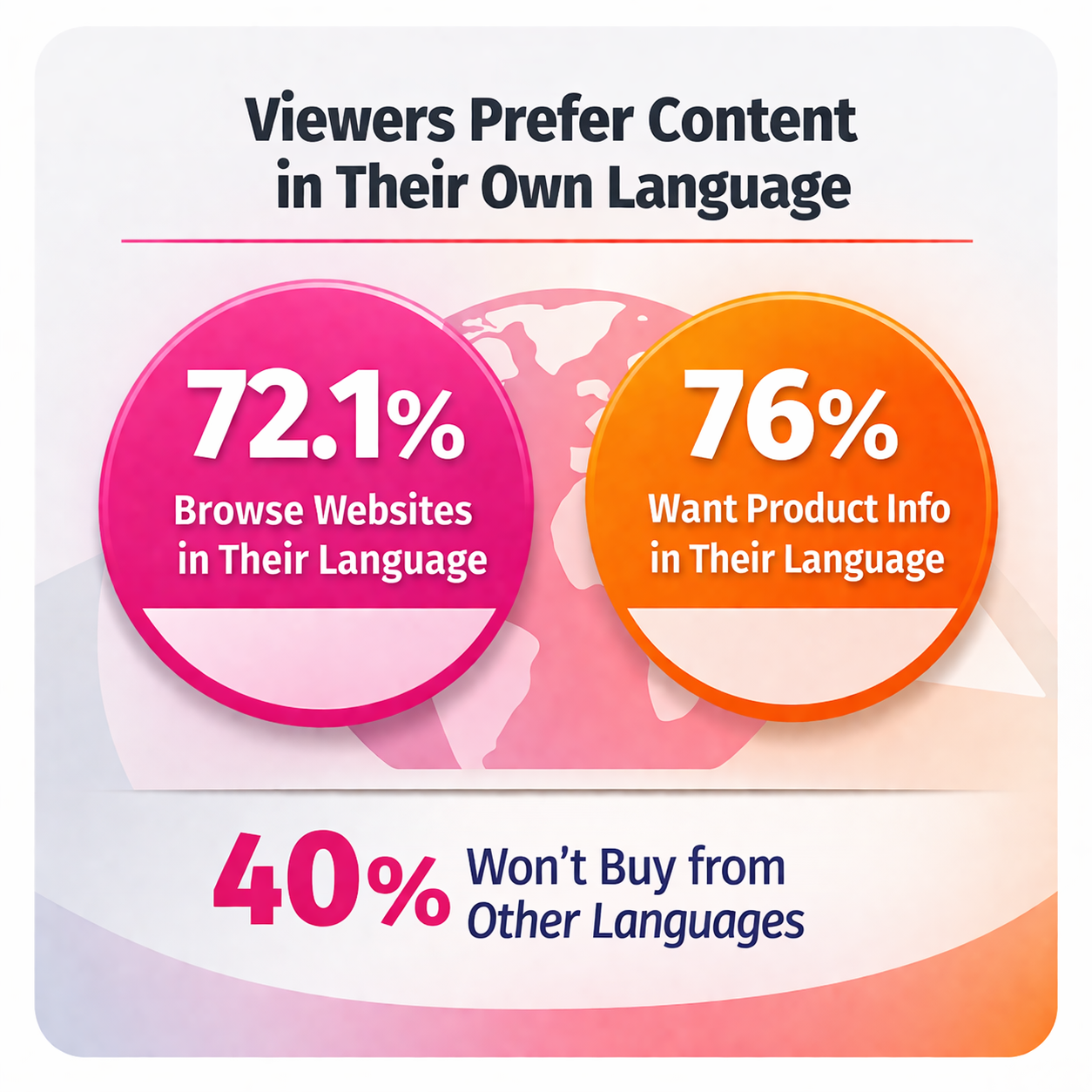
CSA Research's "Can't Read, Won't Buy" study, which surveyed 8,709 consumers across 29 countries, found that 65% prefer content in their native language and 76% of online shoppers want product information in their own language.
40% say they will never buy from websites in other languages.
When three-quarters of your potential audience would rather consume content in their language, leaving video untranslated becomes a measurable drag on reach and conversion.
Translated Videos Get More Views and Longer Watch Time
Discovery Digital Networks, a YouTube network managing around 100 million videos, ran a controlled test and found that adding subtitles increased views by 7.32%.
Dubbed content produces an even larger lift. AIR Media-Tech reports +45% views on average from cross-seeding multi-language audio tracks.
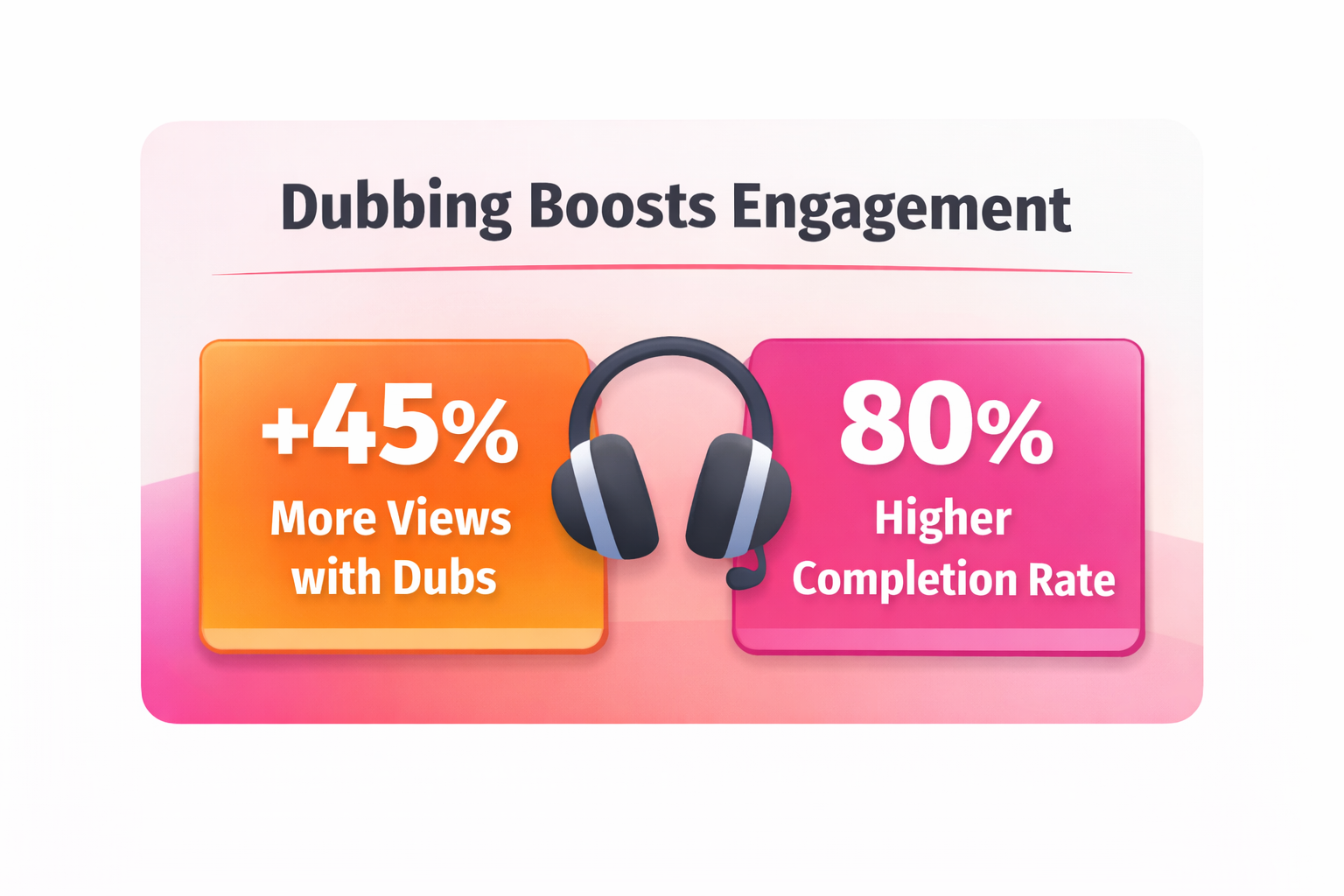
A 2026 study cited by Listen2It found that localized videos see a 40% increase in engagement compared to non-localized versions.
Viewers are 80% more likely to watch a video through to completion in their native language.
Retention data from other sources tells a similar story. Kapwing's subtitle statistics research found that 80% of viewers are more likely to finish a video with subtitles, and subtitles increase view time by an average of 12%.
But the method of localization matters. Kapwing affiliate Lucas Conde ran a direct comparison: he took a viral Portuguese video, dubbed it into Spanish using Kapwing's AI Dubbing, and published it two ways on YouTube the same day.
One version went up as a dubbed audio track on his main channel. The other went to a dedicated Spanish-language channel. After 90 days, the audio track had 32 views. The dedicated channel had 3,897. That's over 100x the performance from the same dubbed video. (Read the full case study.)
Translation Drives Measurable Business Results
According to OneSky's localization research, localization boosts website visits by 70% and conversion rates by 20%.
These gains hold across industries and company sizes. Trivago used AI to localize TV ads in 10+ languages featuring the same actor, significantly cutting production time and costs. BassFishingProductions launched 14 localized channels in 4 months, with the largest reaching 250,000 subscribers.
Smaller creators see impact, too. Lucas has already begun selling digital products to his Spanish-speaking audience, a market he described as "something I thought would be impossible two years ago."
The Global Video Audience by the Numbers
Understanding why translation matters starts with understanding who's watching.
Most of the Internet Doesn't Speak English
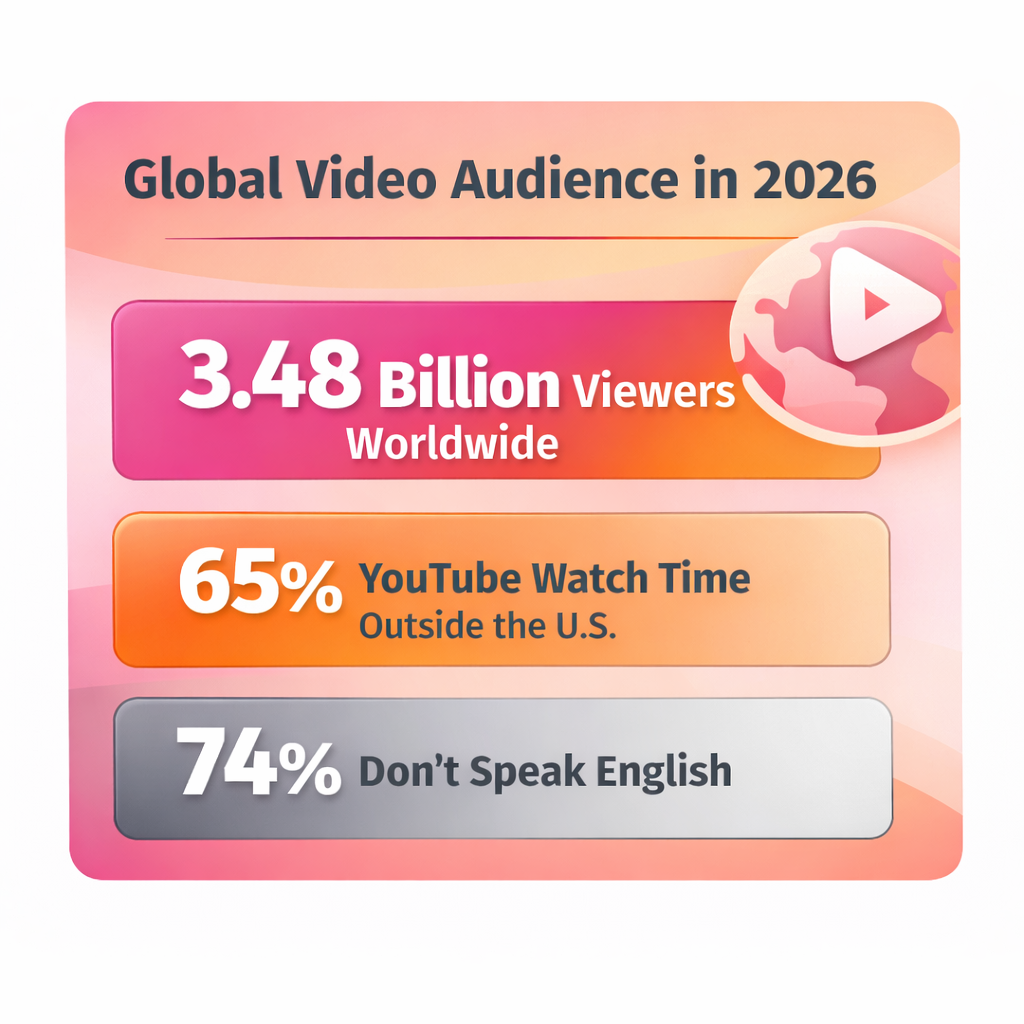
65% of YouTube watch time comes from outside the United States.
The platform operates 100+ local versions with 80 language interfaces, serving 2.7 billion monthly active users.
Those numbers keep growing. YouTube now accounts for 12.5% of all TV viewership, and Shorts alone generates over 200 billion daily views. That audience dwarfs any single-language market.
But only 25.9% of internet users worldwide speak English. The other 74% are watching billions of hours of content and being served by a fraction of available video.
Over 6 billion people are online, and nearly two-thirds use social media daily.
Global video audiences are expected to reach 3.48 billion viewers in 2026. Any creator producing exclusively in English is invisible to the majority of the internet.
The Platforms Reward Multilingual Content
YouTube's algorithm favors dubbed content. Creators with dubbed audio tracks see 25%+ of their watch time from non-primary languages. MrBeast and Mark Rober now publish in 30+ languages. Jamie Oliver tripled his views with dubs.
Translated metadata (titles, descriptions, tags) creates a new search surface area in every language you add. You stop competing with every English-language video on the same topic and enter a less crowded market where the same content can rank for an entirely different audience.
Lucas, who runs localized channels in Portuguese, Spanish, and English, describes this as essential:
"When dealing with another language within your niche, you'll find yourself surrounded by different competitors and consistent, repeating title and thumbnail patterns in that language."
His approach of researching Spanish-language search results to design localized thumbnails produced 5,300 views on a brand-new channel with just 51 subscribers.
High-Growth Regions Represent Untapped Revenue
Low-CPM ("cost-per-mile," the cost an advertiser pays for 1,000 ad impressions) but high-volume markets like Indonesia, India, and Vietnam are scaling into billions of views.
High-CPM regions like Germany remain underserved by English-only creators, meaning localized content can command premium ad rates with relatively little competition. Market research shows subtitling demand in tier-2 languages (Amharic, Uzbek, Sinhala, Yoruba) has grown by 31%.
Brands are following. In 2023, companies spent $400 million on multilingual influencer content, localizing over 60,000 creator videos.
Streaming platforms allocated 12% of their localization budgets to personalized metadata, trailers, and thumbnails.
Dubbing vs. Subtitles: What the Data Says
Neither is universally better. The right approach depends on the audience, content type, and distribution strategy.
Audience Preferences Vary by Region and Age
A Morning Consult study found that audiences in Russia, Germany, Italy, Spain, Mexico, Brazil, and France largely prefer dubbed content, reflecting decades of dubbing infrastructure. Audiences in China, South Korea, India, and Japan tend to prefer subtitles.
Age matters too. 80% of 18--25-year-olds watch TV with subtitles some or most of the time, the highest of any age group, despite having the fewest hearing problems.
Kapwing's subtitle statistics research shows that Gen Z has turned captions from an accommodation into a baseline expectation. Children skew toward dubbing for a simpler reason: they can't read fast enough to follow subtitles during fast-paced content.
Subtitles Are Cheaper, but Dubbing Drives Deeper Engagement
Creating translated subtitles takes roughly 2--4 hours per minute of content.
Traditional dubbing can take 1--2 weeks per minute when you account for casting, recording, lip-sync, and post-production.
AI dubbing has drastically compressed that gap. Companies using voice cloning report a 60% decrease in localization time.
Tools like Kapwing's AI Dubbing generate a dubbed track in minutes, with auto-timing adjustments and pronunciation rules you can save for fine-tuning audio-video alignment and correcting difficult or branded terms.
Quality is converging, too. A University of Jyväskylä study found that AI-translated marketing videos were rated less natural than human translations, but viewers were equally willing to like, share, and comment on both. Engagement was identical. Only the perception of naturalness differed.
Adoption reflects the cost gap: 61% of people who localize use subtitles, while only 12% use dubbing. As AI dubbing costs keep falling, that ratio will shift.
The Best Strategy Is Often Both
Subtitles provide crawlable text that search engines index. Dubbed audio keeps viewers watching longer. According to a Verizon and Publicis Media study, 37% of viewers say subtitles encourage them to turn the sound on.
Used together, subtitles make dubbed content discoverable while the dubbed audio makes it watchable. Each format covers the other's weakness.
How Much Does Video Translation Cost?
Traditional Dubbing vs. AI-Powered Translation
Professional dubbing runs $15–50+ per finished minute, depending on language, voice talent, and quality tier. A 10-minute YouTube video dubbed into three languages through an agency could cost $1,500--$3,000, with weeks of turnaround.
AI tools have restructured that math. Kapwing's Video Translator lets creators dub into 40+ languages at a fraction of traditional cost. Translation Rules save custom translations for brand names and acronyms. Pronunciation Rules use phonetics to correct specific terms. Both reduce the post-production work that made localization prohibitive for small teams.
The Hidden Cost of Not Translating
Over 80% of the world doesn't speak English. For a creator producing only in English, that's an audience cap imposed by language alone, regardless of content quality or distribution strategy.
BassFishingProductions creator Bobby put it plainly: by only making content in English, "over 80% of the people in the world can't watch my videos."
Four months after launching localized channels, his largest had 250,000 subscribers. The question isn't whether you can afford to translate. It's whether you can afford not to.
Video Translation Trends to Watch in 2026
AI Dubbing Is Becoming the Default
YouTube's auto-dubbing expansion has normalized multilingual video. But the bigger shift is in dedicated tools that give creators control over quality and distribution.
Voice cloning, which preserves a creator's tone across languages, is projected to reach a $2 billion market by 2026. Paired with automatic lip syncing, dubbed content is becoming harder to distinguish from natively produced video.
Platform-native tools aren't the whole answer, though. Lucas found that YouTube's auto-dubbing showed English-translated content to his Portuguese-speaking audience, ultimately sending "bad signals and the wrong audience to his videos.
Short-Form Localization Is the Next Frontier
TikTok has no native audio translation. For a platform with over 1 billion monthly active users, that's a significant gap.
New short-form subtitle and dubbing tools are launching rapidly to fill it, most designed to localize sub-90-second content in minutes. Translating a 60-second video into three additional languages now takes minutes, and the ROI on proven content is immediate.
Translated Content Is Becoming an SEO Strategy
Less than 5% of people cite SEO as a reason to add captions. But translated subtitles create crawlable metadata in every language. A video with Spanish subtitles becomes discoverable to Spanish-language queries. Add Japanese, German, and Portuguese, and the search footprint multiplies.
Translated metadata compounds the effect. When Lucas translates titles, descriptions, and tags for each localized channel, he creates keyword surface area in languages where competition is lower than in English. Kapwing's Video Translator supports this with SRT, VTT, and TXT exports, making multilingual distribution straightforward.
One Language Is a Ceiling
Translating video content is no longer optional for creators and brands with global ambitions. The audiences exist, the tools have caught up, and the early movers are capturing outsized returns.
To see how our affiliate Lucas tested YouTube's auto-dubbing against dedicated localized channels and what the data revealed, read our companion case study: Study: YouTube Auto-Dubbing vs. Manual Localization: Which Gets More Views?
For more on how subtitles affect engagement and reach, see our companion piece: 80% of People Prefer Video Subtitles. Here's How They Affect Engagement.