
55 AI-Generated Video Statistics: Disclosure, Detection, and Trust
AI-generated video is projected to account for 10% of all digital video content in 2026
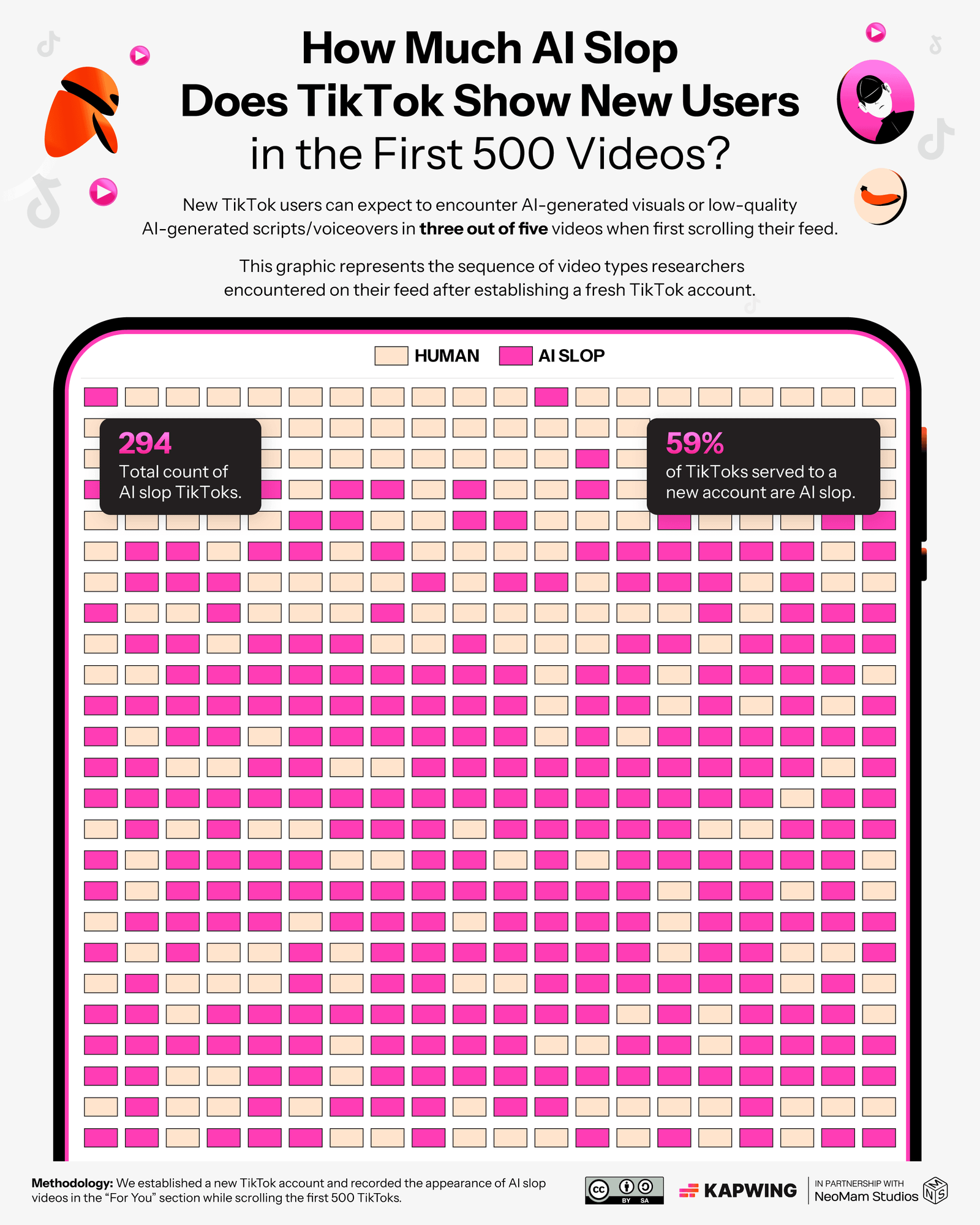
As of 2026, only 9.5% of people can reliably tell an AI-generated video from real footage, and Kapwing's own research found that 60% of a new TikTok feed is AI slop or brainrot. Put those two numbers together, and the picture is clear: AI video is everywhere, and almost no one can spot it by eye.
That's why disclosure, detection, and trust have become the defining questions of the era. When viewers can't tell, what earns or loses their confidence is the label you add, the platform's policy, and how carefully you handle bias and quality.
This article compiles the most important statistics on AI-generated video in 2026: how much of it there is, whether anyone can detect it, what audiences want, and how disclosure, platform policy, and regulation are reshaping the rules.
It includes original research from Kapwing's analysis of leading AI video models and platforms, alongside primary sources cited throughout. The pattern underneath all of it is simple: as AI video becomes normal, transparency shifts from a liability into a competitive advantage.
TL;DR: AI-generated video is projected to make up 10% of all digital video in 2026, and 78% of marketing teams already use it. Viewers can no longer reliably detect it, which is why audiences increasingly rely on labels. 84–91% want AI disclosure to be standard. Research shows that disclosing AI use, paired with strong creative, tends to protect or even build trust. Kapwing's own analysis adds two warnings to the mix: AI video models still carry significant race and gender bias, and low-quality AI content now floods social feeds. Platforms have responded by labeling automatically, and the EU AI Act's transparency rules take effect in August 2026.
Table of Contents:
- The Rise of AI-Generated Video
- How Much AI Video Is Already in Your Feed
- Detection: Why Your Label Matters Now
- What Audiences Actually Want
- The Disclosure Gap
- The Transparency Dividend: Does Disclosure Help or Hurt?
- Bias and Quality: A Different Kind of Trust Problem
- Platform Labeling Policies in 2026
- Watermarking, Provenance, and Regulation
The Rise of AI-Generated Video
AI video has moved from novelty to standard practice in about two years. If you're using it, you're part of a mainstream shift, not an experiment.
- AI-generated video is projected to account for 10% of all digital video content in 2026, up from a negligible share three years earlier.
- 78% of marketing teams now use AI-generated video in at least one campaign per quarter, and 73% of Fortune 500 companies have integrated AI video tools into their workflows.
- The AI video generation platform market was valued at $6.2 billion in 2025 and is projected to reach $47.8 billion by 2034, a 25.4% CAGR.
- AI video generation volume grew roughly 840% between January 2024 and January 2026, one of the steepest adoption curves of any creative technology.
- AI video cuts average production costs by around 91%, from roughly $4,500 per finished minute with traditional methods to roughly $400 per minute.
- The average time to produce a 60-second marketing video dropped from about 13 days to 27 minutes with AI tools, according to industry surveys.
- Virtual influencers are now a commercial force. Kapwing's analysis of the top AI and computer-generated influencers found that Brazilian virtual influencer Lu of Magalu earned an estimated $2,539,680 in a single year, and the biggest virtual influencer on TikTok, Nobody Sausage, has 22.1 million followers. (Kapwing original research)
Sources: PatentPC, Vivideo AI Video Statistics, MarketIntelo, Kapwing Virtual Influencers Report
How Much AI Video Is Already in Your Feed?
To understand how common AI video has become, Kapwing ran its own analysis of the YouTube feed and TikTok FYP page.
The findings show just how much synthetic and low-effort AI content audiences now scroll past every day, often without realizing it.
- 21% of the first 500 YouTube Shorts served to a brand-new account were AI-generated, and 33% were "brainrot", meaning a fresh feed can be one-fifth to one-third low-quality synthetic or compulsive content before you follow anyone. (Kapwing original research)
- South Korea's AI slop channels have amassed 8.45 billion views on YouTube, the most of any country and 1.6x the second-place total. (Kapwing original research)
- The single most-viewed AI slop channel, India's Bandar Apna Dost, has 2.07 billion views and estimated annual earnings of around $4.25 million. (Kapwing original research)
- The category with the highest slop density on TikTok is Kids (57.4%). Science and Education (35.0%), Health (33.8%), and History (33.5%) are the nearest contenders.
- Independent analysis aligns with these findings: roughly 1 in 10 of the fastest-growing YouTube channels globally were showing AI-generated content only, according to a 2025 Guardian analysis of YouTube data.
- 59% of the first 500 TikTok videos served to a brand-new account were AI-generated. (Kapwing original research)
Sources: Kapwing YouTube AI Slop Report (Kapwing original research), The Guardian, Kapwing TikTok AI Slop Report
Detection: Why Your Label Matters Now
Disclosure matters because detection has effectively broken down. Viewers can't tell, and most automated tools can't either, so the honest signal has to come from you and the platform.
- Only 9.5% of people can reliably distinguish AI-generated video from real footage, according to Runway's Turing Reel study.
- Humans correctly identify high-quality synthetic videos only about 24.5% of the time in controlled testing.
- 53% of consumers cannot correctly identify an AI-manipulated video when they encounter one.
- For audio, humans average about 73% accuracy on authenticity, dropping below 60% for clips shorter than 20 seconds.
- By 2026, AI-generated images, audio, and video are widely described as indistinguishable from authentic content under unaided human review and by most automated detectors.
- The market for detecting deepfakes and synthetic media is projected to grow from $5.5 billion in 2023 to $15.7 billion in 2026, reflecting how seriously the industry takes the verification problem.
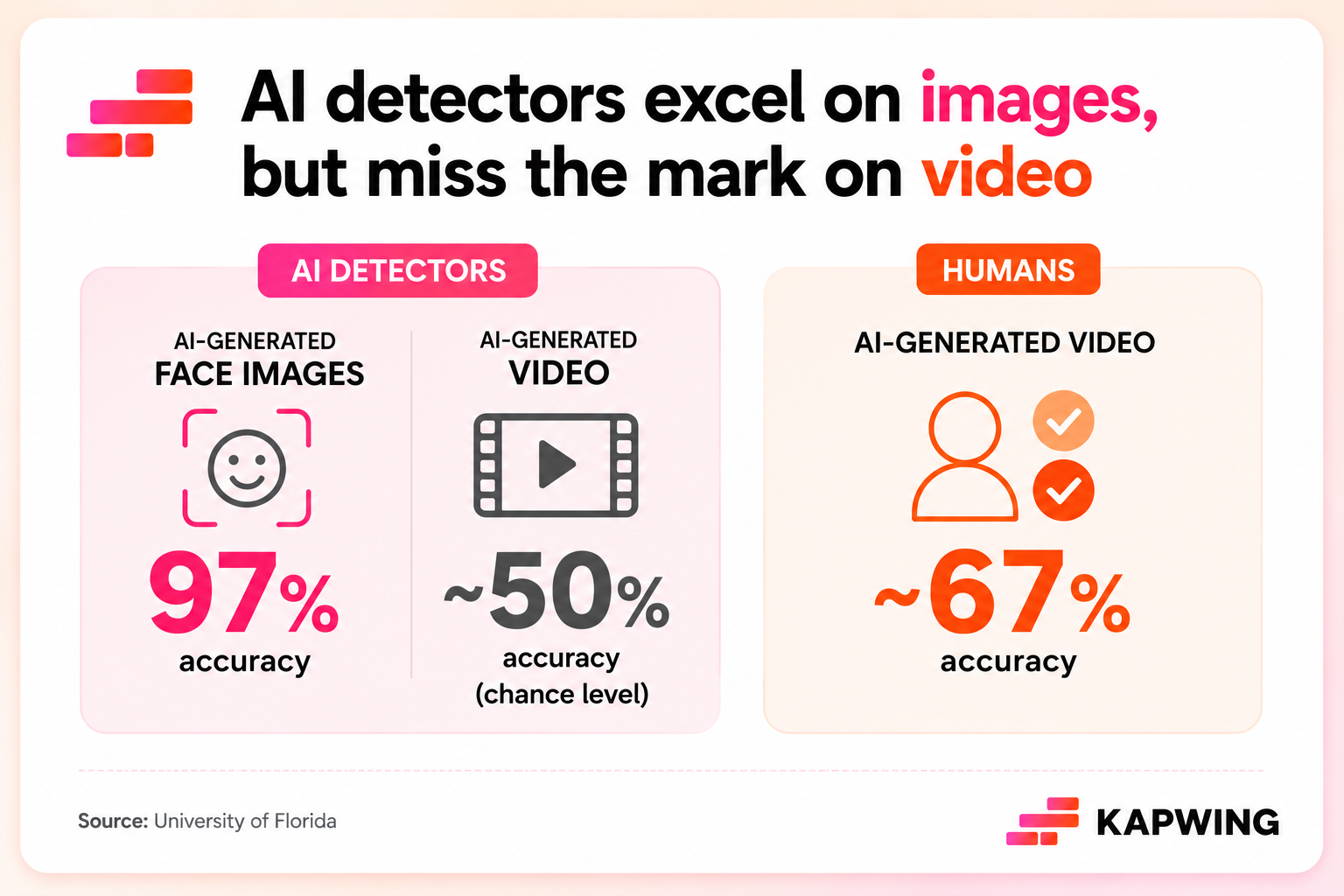
- University of Florida researchers found AI detectors reach up to 97% accuracy on AI-generated face images, but perform at chance levels on AI-generated video, while humans manage roughly two-thirds accuracy on video.
Sources: Genra AI / Runway Turing Reel, SQ Magazine, Bayelsa Watch / Amra & Elma, AutoFaceless / University of Florida, BrightDefense
Test yourself: Kapwing built an interactive AI Video Quiz that challenges you to tell real footage from AI-generated clips across 10 examples. It's a quick, first-hand demonstration of just how hard detection has become, and a reminder of why labeling matters.
What Audiences Actually Want
Even though viewers can't detect AI video on their own, they have clear, consistent expectations about transparency. Understanding these preferences is the foundation of any AI content strategy.
- Between 84% and 91% of consumers want AI-generated content labeling to be standard or required.
- 79% of consumers want AI-generated ads to be clearly labeled for transparency.
- 50% of US consumers say they prefer brands that don't use generative AI in customer-facing content, according to a 2026 Gartner survey, a reminder that disclosure must be paired with quality.
- 39% of consumers say they would trust a brand less for using AI-generated content, while 42% remain neutral.
- 52% of consumers report reduced engagement with content they believe is AI-generated.
- 51% of Gen Z audiences are open to AI-generated advertisements, a notably higher acceptance than older cohorts.
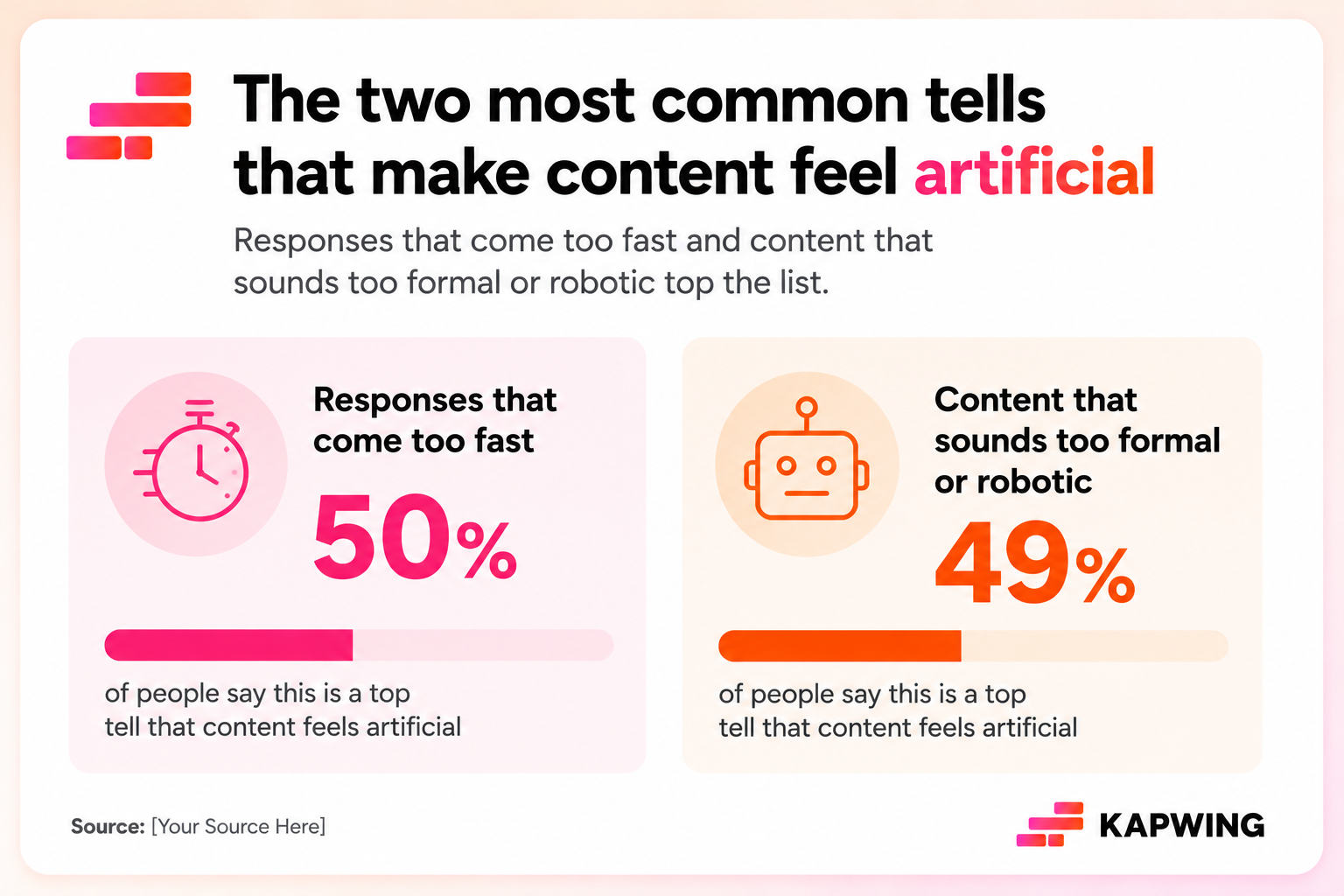
- The two most common tells that make content feel artificial are responses that come too fast (50%) and content that sounds too formal or robotic (49%).
Sources: Fractl AI Statistics, Bayelsa Watch / Amra & Elma, Klaviyo / Gartner Consumer Trust, SmythOS AI Content Trust Gap
The Disclosure Gap
Here is the central tension of the AI video era: audiences strongly want disclosure, but most creators and brands don't yet provide it. The gap persists largely because AI video performs well, so the short-term incentive to flag it is weak, even though the long-term trust math favors disclosure, and the reputational cost of getting caught now outweighs it.
The emerging best practice is to treat an AI label like the familiar "Sponsored" or "Ad" tag: a normal, expected signal rather than an admission.
- 33% of marketers say they never disclose AI use at all, set against the 84–91% of consumers who want labeling to be standard.
- TikTok removed 51,618 unlabeled synthetic-media videos in the second half of 2025 alone, a 340% increase over the same period in 2024, and permanently banned roughly 8,600 accounts for AI-related violations — a sign that the era of quietly skipping disclosure is closing.
- 91% of marketing leaders expect AI-generated visual content to be a standard part of their stack by the end of 2026, which means the disclosure question will soon apply to almost everyone.
- The volume of deepfake videos online jumped from roughly 500,000 in 2023 to an estimated 8 million by 2025, a 16x increase that makes consistent labeling harder to ignore.
- TikTok's automatic detection caught and labeled an estimated 35–45% of AI content by late 2025, up from about 18% in early 2024, meaning the share of undisclosed AI that platforms catch on their own is climbing fast.
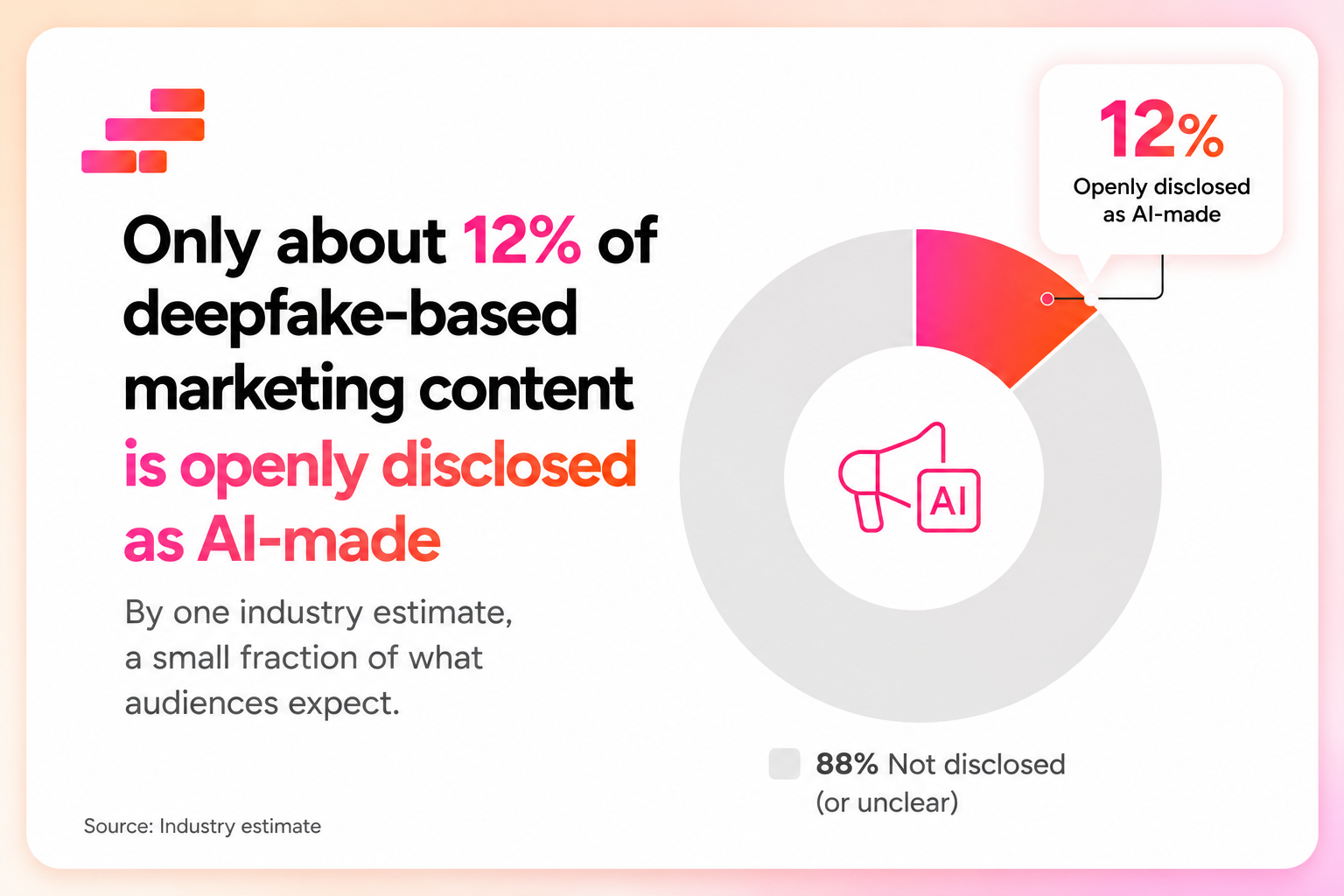
- Only about 12% of deepfake-based marketing content is openly disclosed as AI-made, by one industry estimate, a small fraction of what audiences expect.
Sources: Fractl AI Statistics, ElectroIQ Deepfake Statistics, Imagera / Salesforce State of Marketing, Storrito / TikTok Enforcement, Dynamoi TikTok AI Statistics, AutoFaceless / University of Florida
The Transparency Dividend: Does Disclosure Help or Hurt?
The fear that disclosure tanks performance is the biggest reason brands hide AI use. The research is genuinely mixed, but a consistent pattern emerges: disclosure paired with quality tends to preserve or build trust, while hidden AI that gets discovered does lasting damage.
- Peer-reviewed research shows high-quality AI-generated ads are appraised similarly to their non-AI counterparts. A Journal of Advertising Research study across three experiments found that well-made, disclosed synthetic ads produced purchase-intention outcomes comparable to original ads.
- Disclosure can actively build trust when done right. One 2026 analysis found that AI-generated ads carrying a clear notice saw a 73% increase in ad trustworthiness and a 96% increase in overall trust in the company.
- Timing and framing matter. The same academic research found that disclosing AI before a high-quality ad can trigger mild skepticism, but it also suppresses the stronger negative reaction that comes when audiences feel deceived after the fact.
- Low quality, not AI itself, is what audiences punish. The IAB's 2025–2026 research found that clearer communication, high creative standards, and consistent disclosure can improve consumer attitudes toward AI advertising and even lift attention and purchase likelihood.
- Just 20% of consumers say they trust AI itself, and 21% trust AI companies' promises, according to research from the Nuremberg Institute for Market Decisions, underlining why the source and framing of an AI label carry weight.
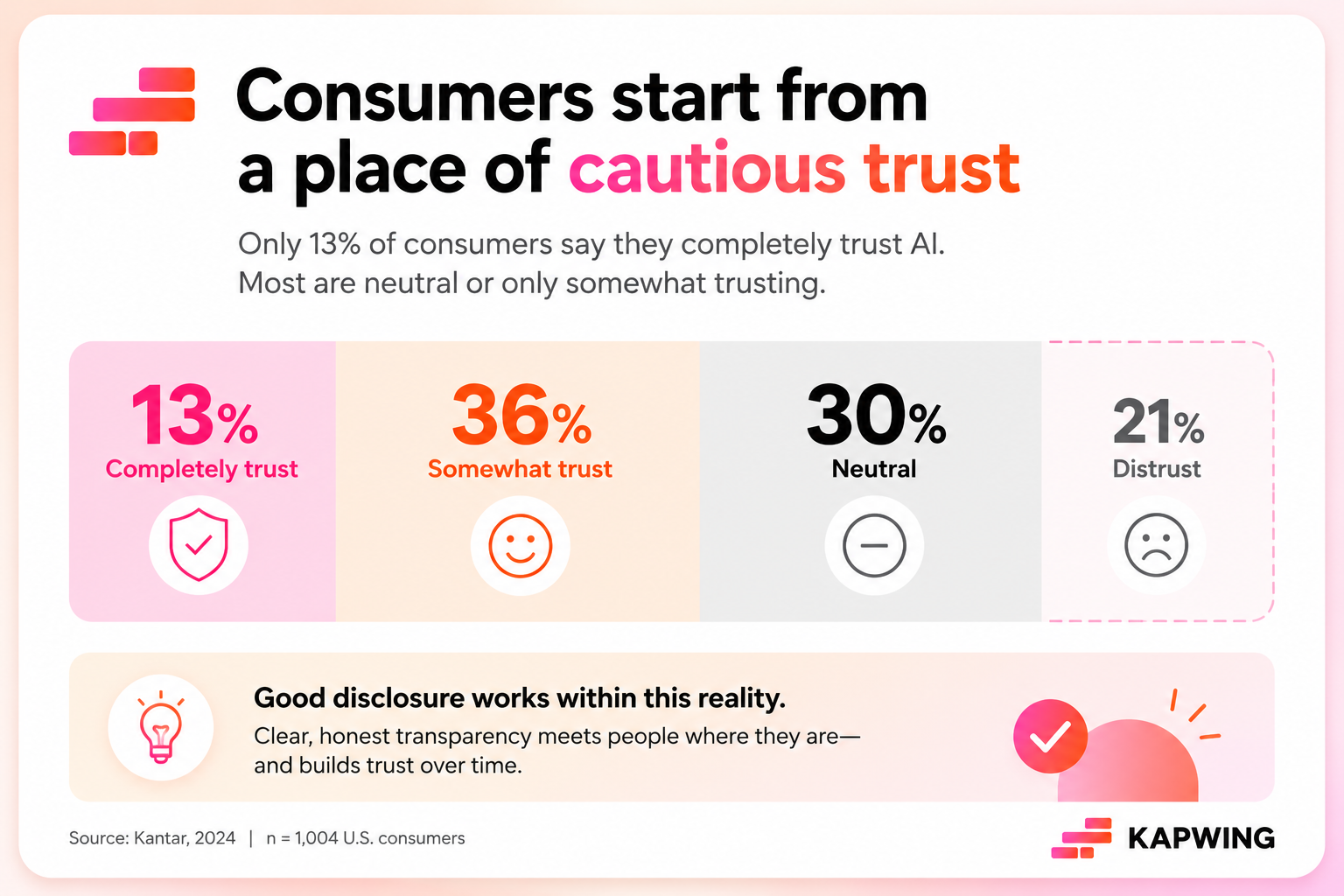
- Only 13% of consumers say they completely trust AI, with 36% expressing some trust and 30% neutral, a baseline of skepticism that good disclosure works within rather than against.
Sources: Journal of Advertising Research (Tandfonline), SmythOS AI Content Trust Gap, IAB The AI Ad Gap Widens, Klaviyo Consumer Trust in AI, NIM Transparency Without Trust
Bias and Quality: A Different Kind of Trust Problem
Trust in AI video isn't only about whether viewers can tell it's synthetic. It's also about whether the content fairly represents real people. To test this, Kapwing analyzed video output from Google's Veo 3, OpenAI's Sora 2, Kling, and Hailuo Minimax, recording the perceived gender and race of people the models generated for specific professions and family roles.
The results show measurable bias baked into the tools creators rely on, a bias that reflects industry-wide training data rather than any single tool, which is why human oversight and transparency from creators matter as much as the models' own safeguards.
- Asked for a CEO, the four leading AI video models returned a male figure 89.16% of the time. (Kapwing original research)
- For high-paying jobs, women showed up 8.67 percentage points less often than they do in the real-world workforce, and were underrepresented in nearly every profession tested. (Kapwing original research)
- White figures filled 77.30% of high-paying roles but only 53.73% of low-paying ones, so the models handed high-status work disproportionately to white people. (Kapwing original research)
- Only 22.7% of high-paid professionals generated by the models were depicted as non-white, and 67.1% of all people depicted were white. (Kapwing original research)
- Asian people turned up in low-paying roles about three times as often as in high-paying ones, and the models placed Latino people in low-paying roles 128% more often than in high-paying ones. (Kapwing original research)
- Women made up just 21.62% of the lawyers the models generated, against 41.2% of real lawyers — and one tool produced no female lawyers at all. (Kapwing original research)
- Individual tools skewed harder than the average: Hailuo Minimax cut women's share of teacher depictions by 61.21 percentage points, and Veo 3 returned only non-white people for cashier, fast-food-worker, and social-worker prompts. (Kapwing original research)
Source: Kapwing AI Diversity Report (Kapwing original research, data as of October 2025)
Platform Labeling Policies in 2026
Every major video platform now has an AI labeling policy, and knowing how they differ is practical knowledge for any creator publishing AI content.
Here's how the three biggest video platforms compare.
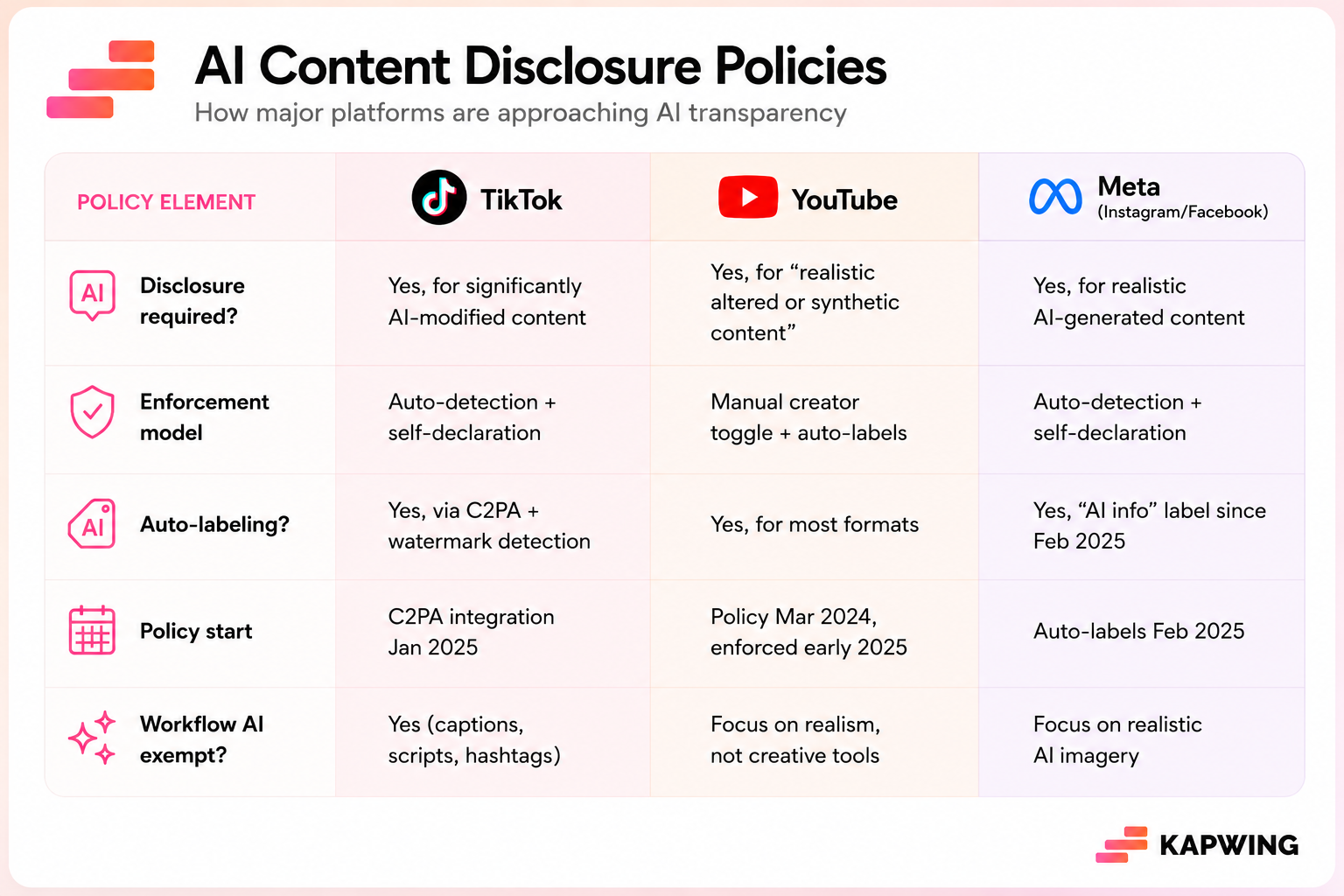
- TikTok integrated C2PA Content Credentials in January 2025, becoming the first major platform to automatically detect and label AI content through embedded metadata.
- TikTok has labeled over 1.3 billion AI-generated videos using Content Credentials, invisible watermarking, and detection models combined.
- TikTok states the AI label is "a disclosure mechanism, not a distribution signal." The AIGC flag is stored as metadata and is not directly weighted in For You Page ranking, so labeling shouldn't cost you reach.
- TikTok exempts workflow AI from labeling. AI-written captions, scripts, hashtags, and text overlays don't require disclosure; the rule targets the visual and audio media itself.
- YouTube introduced its AI disclosure policy in March 2024 and began enforcement in early 2025, requiring labels on videos, Shorts, and livestreams with realistic synthetic content, including AI-cloned voices.
- New York's Synthetic Performer Law, signed December 11, 2025, is the first state law to require disclosure for non-deceptive AI avatars in commercial advertising, effective mid-2026, directly relevant to anyone using AI presenters or virtual influencers.
Sources: Storrito TikTok AI Labeling Rules, Influencer Marketing Hub AI Disclosure Rules, VirVid AI Video Ad Disclosure
Watermarking, Provenance, and Regulation
Because visible labels can be stripped, the industry is building provenance systems that travel invisibly with the file, and regulators are turning disclosure into law. For creators, both are becoming part of the job.
- Google's SynthID has watermarked over 10 billion pieces of content with signals designed to survive compression, screenshots, and re-encoding, while C2PA Content Credentials (now ISO standard ISO/IEC 22144) record which model made a file and every edit applied to it.
- The EU AI Act's Article 50 takes effect August 2, 2026, requiring AI-generated content shown to EU audiences to be marked in a machine-readable format, with fines up to €15 million or 3% of global annual turnover. Its scope is extraterritorial, so it can apply to creators outside the EU whose content reaches EU viewers.
- 28 US states have enacted political deepfake disclosure laws as of 2026, while federal action (the TAKE IT DOWN Act and the DEFIANCE Act) targets harmful, non-consensual synthetic content, leaving legitimate AI video creation unaffected while setting clear boundaries around abuse.
Sources: BrightDefense / Google SynthID, Internet Pros C2PA Guide, EU AI Act Article 99 (official), Stack Cybersecurity Deepfake Laws, Wikipedia TAKE IT DOWN Act
What This Means for Creators and Brands
The data points to one clear conclusion: AI video is now a normal, mainstream part of how content gets made, and the creators who disclose it and sweat the quality are the ones positioned to win audience confidence. Detection has collapsed, so viewers and regulators lean on labels and provenance instead of their own eyes. Kapwing's research shows the stakes on both sides: synthetic content already floods social feeds, and the models themselves carry real bias. That is exactly why careful, openly labeled work stands out.
For creators using AI video tools, the practical playbook is straightforward: build disclosure into the workflow from the start, focus on quality so an AI label reads as confidence rather than corner-cutting, keep a human eye on how the tools represent real people, and welcome provenance standards like C2PA as they arrive rather than resisting them. Done that way, labeling stops being a tax on using AI and starts being part of what makes the work land.
Kapwing's AI tools are built for creators who want professional results they can stand behind. Whether you're using the AI video generator, AI avatars, AI dubbing, or text-to-speech, production is only half the job. Labeling your AI content clearly is what turns it into work an audience trusts.
For more original Kapwing research and data, explore Kapwing's Research Lab, including the full AI Diversity Report and AI Slop Report, plus our companion statistics pieces on video marketing, short-form video, UGC, and video translation.
Last updated: June 2026. This article is reviewed and refreshed periodically to reflect new platform policies, regulations, and research. Kapwing's original statistics are drawn from the AI Diversity Report (data as of October 2025) and the AI Slop Report (data as of October 2025).