
The TikTok AI Slop Report
New research from Kapwing reveals that nearly 60% of TikToks served to new users and children are AI slop. But which categories and tags are the worst affected — and what does this landscape look like to kids?
TikTok has a slop problem.
@kapwing How much AI content is on TikTok? Read the full report: kapwing.com/resources/the-tiktok-ai-slop-report/ #aislop #aivideos #brainrot
♬ original sound - Kapwing
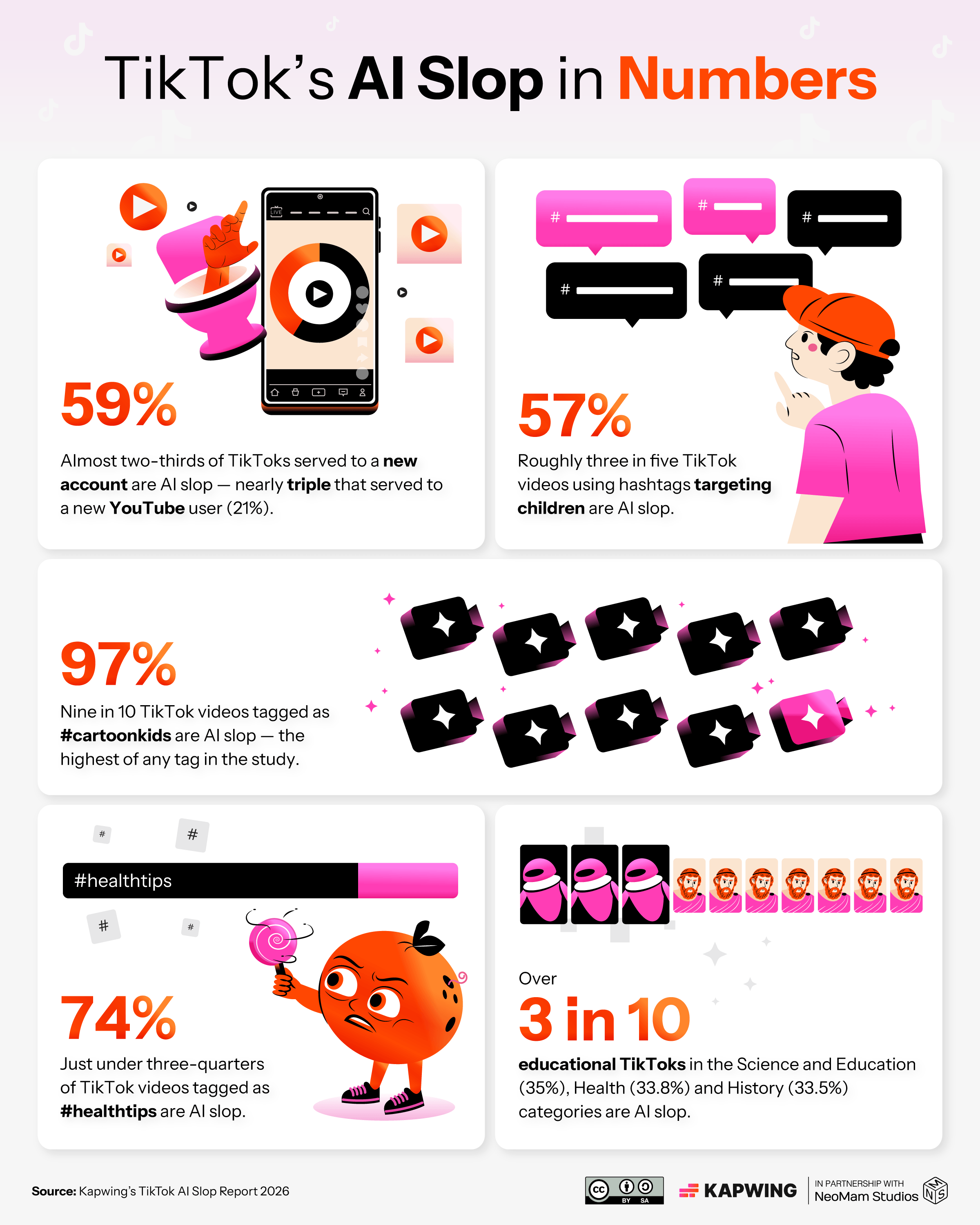
Some 59% of videos served to a new TikTok account’s “For You” page are AI slop, according to Kapwing’s research.
That’s three times as much slop as a new YouTube user encounters. And a similar share (57.4%) of all TikTok videos aimed at children are AI slop, too.
Back in 2025, TikTok announced a new tool to help users control the level of AI-generated content (AIGC) in their feeds, declaring that “many people enjoy content made with AI tools, from digital art to science explainers, and we want to give people the power to see more or less of that.”
But when it comes to slop, not only is it bad for kids but many adult users would rather see far less on social media. As the BBC’s Joe Tidy notes, often “the number of likes for the AI backlash comments far exceeds the original [AI-generated] post.”
To understand the depth of the problem, Kapwing analyzed thousands of videos across TikTok’s top categories and hashtags to measure the prevalence of AI slop. This was defined in our previous YouTube AI Slop Report as “careless, low-quality content generated using automatic computer applications and distributed to farm views and subscriptions or sway political opinion.”
One in Three TikToks a New User Sees Is AI Slop
TikTok adjusts its video feed for users based on “signals” including follows and likes, category preferences, and previous scrolling activity. So, to get a better idea of the ‘raw’ TikTok experience, we established a new account and recorded which of the first 500 videos were human-made and which were AI slop.
When you sign up for a new account, TikTok feeds you “popular content appropriate for a broad audience” and “content influenced by your location and language settings” until it figures out what you like. In our test run, the very first TikTok served to Kapwing’s dummy account was a low-quality AI-generated video that appears to have since been deleted.
Overall, 294 or 59% of the first 500 were AI slop.
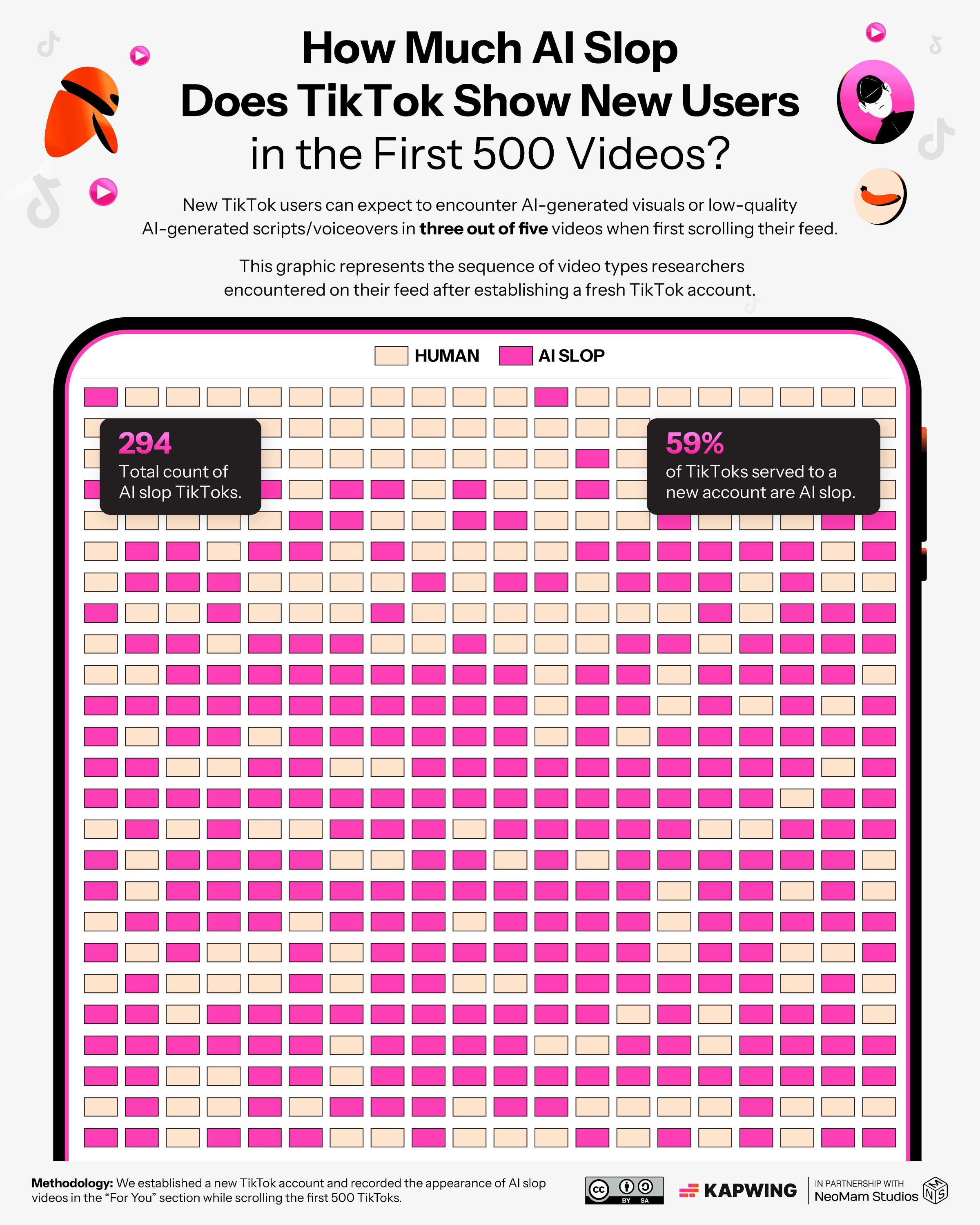
TikTok delivers nearly three times as many AI slop videos as we found when running the same experiment with a fresh YouTube account, where 104 (21%) of the first 500 videos on the YouTube Shorts feed were AI brainrot.
On TikTok, the prevalence of slop on a fresh feed may be a matter of sheer saturation — by November 2025, the company had already labeled a staggering 1.3 billion videos as AI-generated.
On the other hand, AI companies train the models that generate AI slop on existing footage, and their output represents a flattening or aggregation of the patterns found in human-made content (rather than in “reality”) — an effect that scholar Roland Meyer has labeled “platform realism.”
Filling a new user’s experience with slop videos optimizes the feed as a familiar space and acclimatizes them to the aesthetic and thematic norms of TikTok culture.
Kids, Science and Education, and Health TikTok Categories Are Most Clogged With AI Slop
Next, we checked a sample of 10,742 TikTok videos across the most popular tags in 20 categories, noting the number of AI slop and non-AI slop videos. The category with the highest slop density by far was Kids (57.4%) — more on that below.
Science and Education (35.0%), Health (33.8%), and History (33.5%) are the nearest contenders. In the top nine categories, more than one in ten videos were AI slop. But videos in the Fitness (1.6%), Music (1.5%), and Fashion (1.3%) categories are almost entirely human-made.
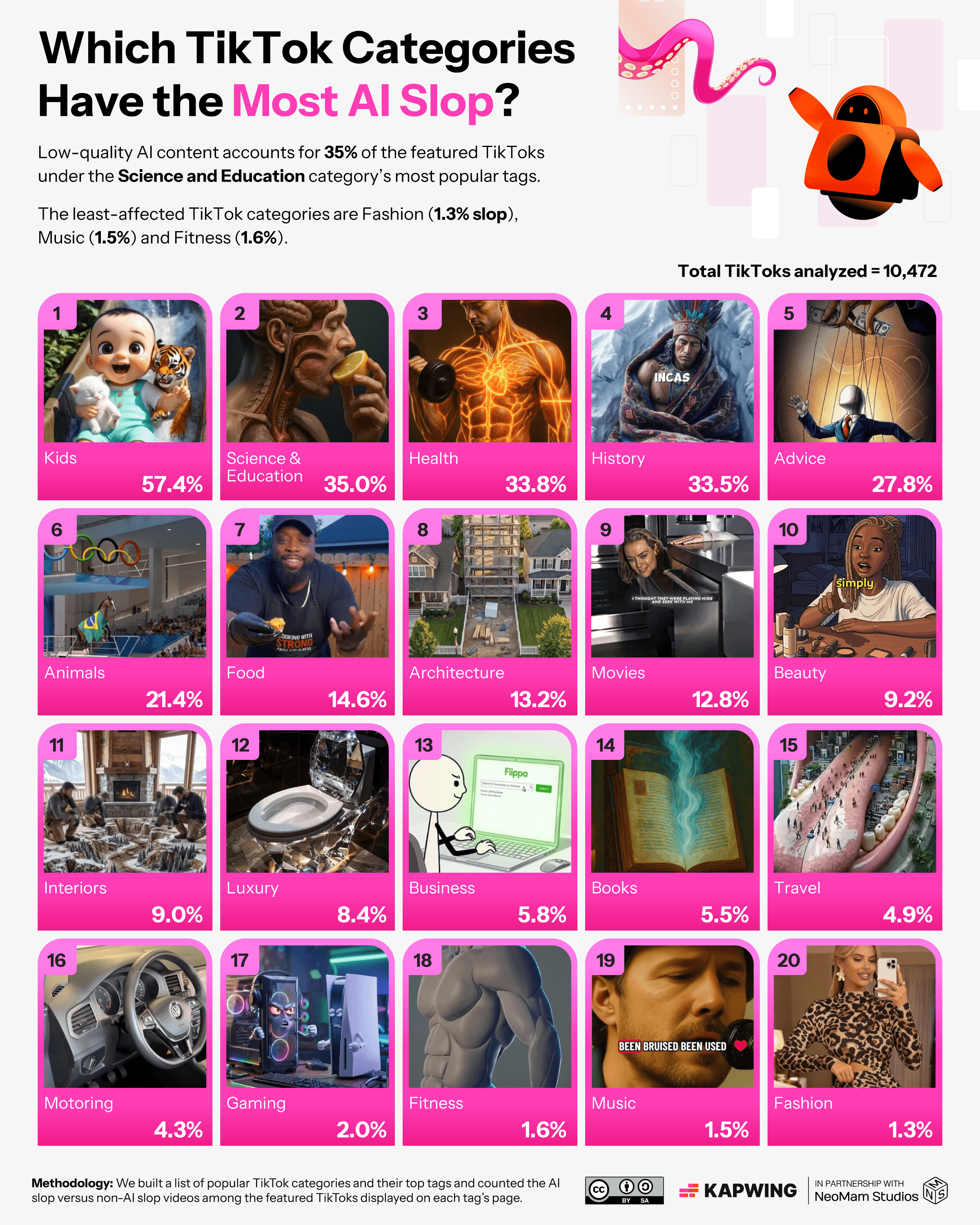
Scientific facts and concepts lend themselves to visual illustration through animation. But when such videos are generated with haste and sensationalism as their guiding principles, the potential for deeper value is compromised.
Researchers have warned that slop educational material clutters the platform and competes with more authoritative sources.
TikToks such as the baffling Eating Lemon video below rattle along at the turbo-TikTok pace the models seem to have learned and feature the misspelled words and misshapen lettering that have come to be associated with AI imagery.
@vitalverse1 Science in action. What happens while Eating Lemon in the human body?😱🤮😱#humanbody #anatomy #3danimation #sciencetok #viral
♬ original sound - Cute Babies
Meanwhile, creators such as Jonathan Laramy, the man behind Chloe VS History, see AI as a chance to bring educational topics to life, exploiting the technology rather than the viewer.
“Yes, there are people out there that obviously don't care about history,” he told Sky News, regarding his competitors, “because there are mistakes left, right, and center.”
Laramy’s content is hosted by an ultra-realistic AI presenter called Chloe, who is easily mistaken for a real person due to the “human emotion and non-verbal cues” facilitated by the latest video models.
However, the scripts are AI-generated, too, and viewers have criticized the channel for its historical inaccuracies.
Brendan Gillis, Director of Teaching and Learning at the American Historical Association, warns that AI-generated history is only as reliable as the source material it draws from. Because AI fills gaps using patterns from its training data, it can introduce inaccuracies, biases, and stereotypes.
97% of #CartoonKids TikToks Are AI Slop
Of the 2,000 featured videos we analyzed in TikTok’s Kids category, some 1,147 (57.4%) were AI slop.
The worst-affected tag, #cartoonkids, was almost entirely made up of slop, with only three of the 100 videos we checked being human-made. Around one-third or more of the videos for nearly all of the tags we checked were AI slop, and even #babytok — which had significantly less slop than other tags — featured one slop video out of every ten on its tag page.
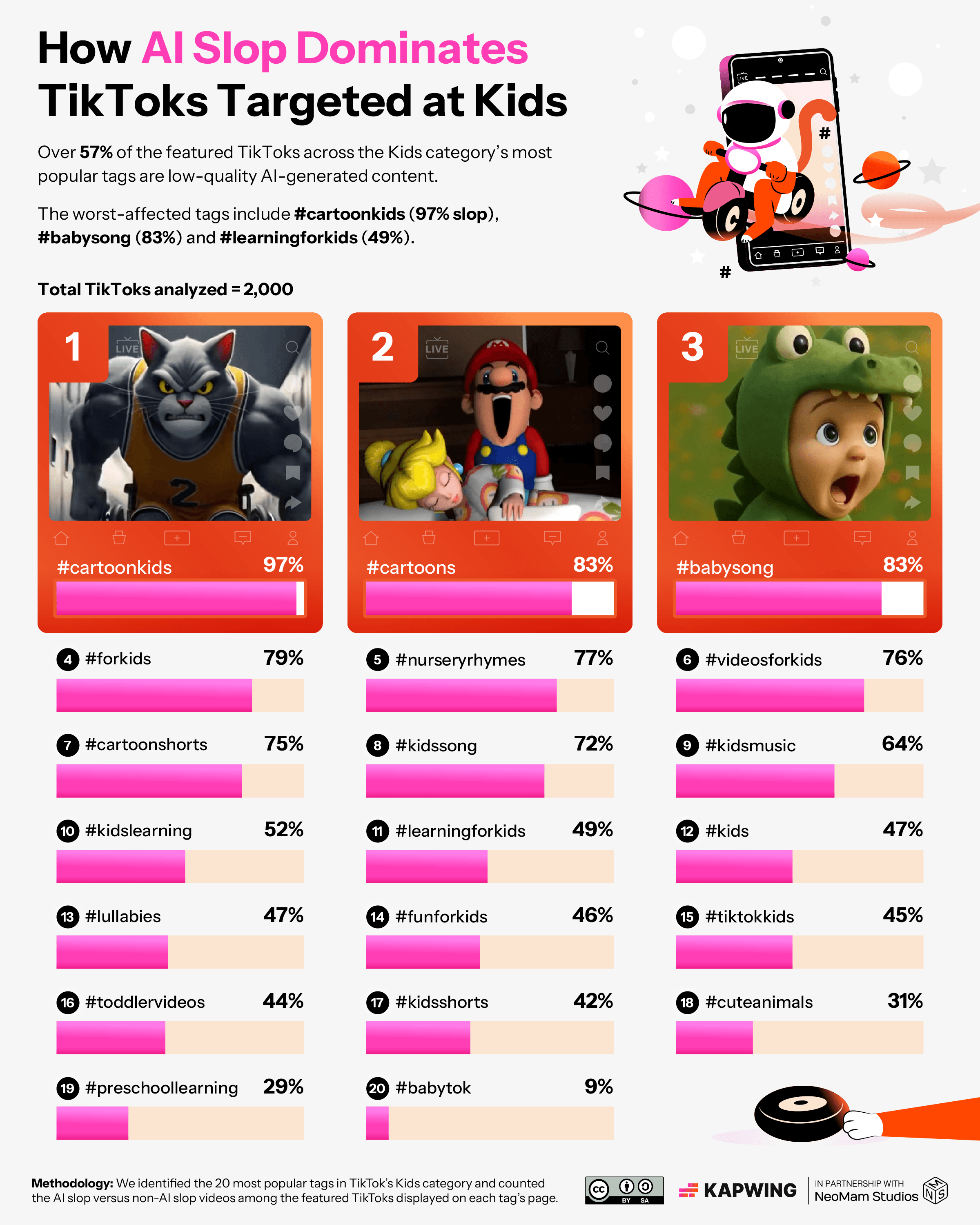
The dangers of automated content for children are not new, but the scale at which children are being targeted with slop — ranging from nonsense ‘brainrot’ to dangerously inaccurate songs and lessons — is staggering.
“I think of this as toddler AI misinformation at an industrial scale. It’s very risky for the developing brain,” says Dr. Dana Suskind, a professor of pediatrics at the University of Chicago, speaking to Mother Jones.
“Every experience is building a million new neural connections. You will be unintentionally wiring the brain in incorrect ways.”
One of the first videos to pop up under #preschoollearning appropriates Sesame Street characters to deliver a lesson about counting cookies. Not only do the numbers not match the cookies, but the animation is careless, and the voices are borderline terrifying. The comments section is stuffed with short, nonsensical sequences of letters that boost the video’s visibility.
@spongebob.uk1 Counting Cookies for Kids 🍪 Fun Learning Numbers with Cookie Monster Learn numbers in a fun way with Cookie Monster while counting delicious cookies! 🍪 Perfect for toddlers and preschool kids to practice counting, early math skills, and number recognition through a playful learning adventure. Great educational video for kids who love Sesame Street characters and fun learning! countingcookies, cookiemonster, learnnumbers, countingforkids, kidslearning, preschoollearning, toddlerlearning, numbersforkids, learncounting, educationalvideo, kidseducation, learningisfun, funlearning, earlylearning, preschoolactivities, toddleractivities, kidsvideos, learningnumbers, countinggame, numbersong, kidsmath, mathforkids, kidsfunlearning, educationalforkids, kidsyoutube, kidscontent, learningvideos, kidsteaching, homeschoolkids, preschoolkids, learnwithfun, smartkids, educationchannel, learningtime, kidsstudy, numberspractice, countingtime, learn123, numbers123, kidsnumberlearning, funforkids, kidslearningvideos, playandlearn, kidsbrain, learningathome, kidseducationvideos, childeducation, kidsedutainment, learningnumbers123, kidsactivityvideo, educationfun, learningforkids, countingactivity, kidsmathfun, preschoolmath, toddlermath, educationalcontent, funeducation, kidsknowledge, learningadventure,#animationviral #spongetherapy #underwateradventure #oceanfun #cartoonvideo #animationshorts #viralshorts #funnyanimation #cartoonforkids #seaadventure #oceanworld #cartoonfun #spongeasmr #viralvideo #youtubeviral #kidsentertainment #animatedshort #cartoonstory #oceanlife #kidsyoutube
♬ original sound - English - English
A recent survey from the Family Online Safety Institute found that only 51% of parents use parental controls on tablets and 47% on smartphones.
Meanwhile, over 70% of babies and under-twos use screens, and one in 10 babies regularly falls asleep with a screen, according to the UK’s 1001 Critical Days Foundation — so named because the 1,001 days from pregnancy to age two are critical for brain development, with up to one million neural connections forming every second.
The TikTok AI Slop Backlash
The people at TikTok are well aware of the AI slop backlash. In May, the company began to rein in its new AI-generated summaries, which users had noticed regularly produced bizarre mistakes, such as erroneously identifying dancer Charli D'Amelio as a “collection of various blueberries with different toppings.”
Alongside allowing users to reduce AI content in their feed, the company announced a $2 million educational fund for experts to develop content around AI literacy and safety.
But the stats reinforce the feeling that AI slop-clogged feeds are already the new normal. Meta’s Mark Zuckerberg has tagged this era of generative AI content the “third phase” of social media — following personal and then creator-based content.
This third AI phase itself has gone through different eras, from the comedic novelty of Will Smith spaghetti videos to the emotionally nuanced but factually inaccurate Chloe VS History.
But slop is likely to continue being slop, and children are sure to encounter damaging AI material as long as humans outsource the hard work of video production to robots without putting in the time and oversight to ensure higher standards are met.
This is because the training data contains mistakes. And most of all, it is because video is a mode of human communication, which is nuanced, dynamic and — well — human.
Our Full Methodology
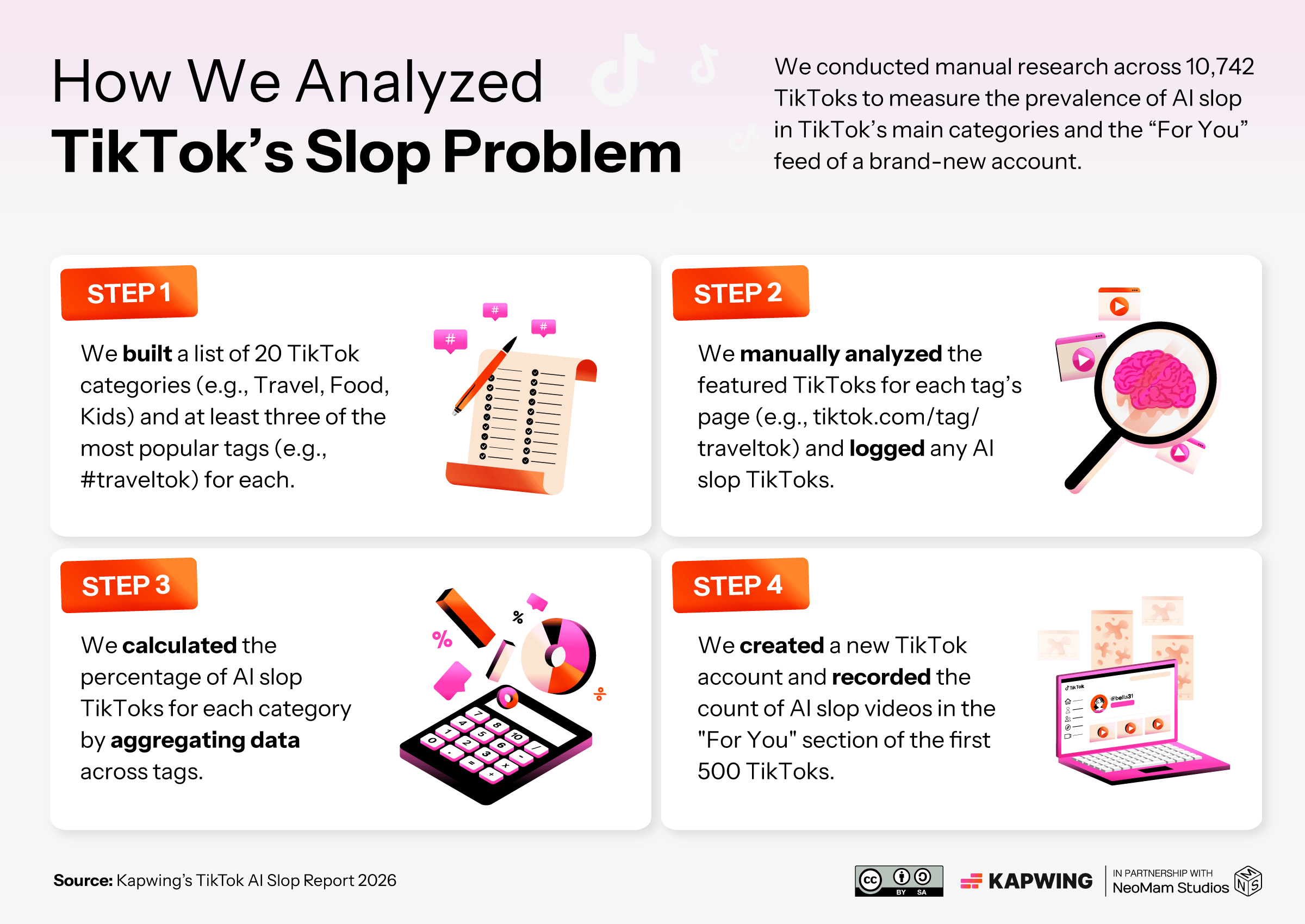
We manually analyzed 10,742 TikTok videos across 20 categories. We began by building a seed list of 20 popular TikTok categories (e.g., Food, Travel, Fitness, etc.) and at least three of the most popular tags for each category (e.g., #traveltok and #foodie).
Next, we manually analyzed the featured videos displayed on each tag's page (e.g., https://www.tiktok.com/tag/traveltok), recording the count of AI slop and non-AI slop videos. This allowed us to calculate the percentage of AI slop videos for each tag, which we then aggregated for each category.
To find the proportion of AI slop that is served to new users, we established a brand new TikTok account and recorded the appearance of AI slop videos in the “For You” section while scrolling the first 500 TikToks.
AI slop videos were defined as those with obvious use of AI-generated visuals, as well as low-quality clip/compilation-style videos with clearly AI-generated scripts and voiceovers.
Data is correct as of May 2026.