
AI ASMR: The Most Liked and Hated AI Sounds on Social Media
We surveyed thousands of participants and gauged their reactions to popular AI ASMR sounds on social media
Have you ever felt a tingling sensation from a certain sound? AI ASMR isn’t just a viral trend on social media but a studied sensory experience.
Researchers have found that ASMR can increase positive feelings and even lower heart rate. Since the term was first coined in 2009, millions of people have used ASMR to fall asleep, manage stress, or improve focus.
But ASMR doesn’t work for everyone. While some viewers experience a strong response, others feel little to nothing, or even find certain sounds uncomfortable. That variability becomes even more pronounced with AI-generated content.
As a new wave of AI ASMR videos spreads across TikTok, Instagram, and YouTube, the format itself has shifted. These clips feature surreal, hyper-detailed scenes. While these videos routinely rack up millions of views, reactions are far from consistent. Some AI sounds are immediately satisfying, while others feel uneasy, unnatural, or easy to scroll past.
So, which AI ASMR sounds actually work, and which don’t?
Our Methodology
To understand how humans interact with AI ASMR, we focused on AI sound formats that are already trending online.
We selected five popular formats from TikTok, Instagram, and YouTube, including AI glass fruit cutting, a TikTok trend with more than 57,000 posts under #glassfruit.
Most of these trends follow the same formula: they pair a familiar action, such as cutting, typing, or pressing, with an unexpected material. That’s what gives AI ASMR its distinctive appeal, whether it’s glass behaving like fruit, honey-like keyboards, or objects that don’t exist in real life.
How We Evaluated
To help interpret the results, we spoke with Karen Chan Barrett, PhD, an Assistant Professor at UCSF and an auditory cognitive neuroscientist whose research focuses on how humans perceive and respond to sound. Her work makes her uniquely positioned to explain why certain sounds feel satisfying, uncomfortable, or somewhere in between.
To evaluate performance across the five AI ASMR sounds, we used the average rating as the primary metric. Average rating captures the overall distribution of responses, incorporating both positive and negative evaluations.
This approach allows for a more comprehensive assessment than focusing on any single response segment. Rather than emphasizing extreme reactions, it reflects how a stimulus is received across the full sample.
AI Snow Bed Jumping Had The Highest Average Score
The AI Snow Bed Jumping clip shows someone jumping into a bed made entirely of snow. On impact, the surface compresses with a dry, textured sound. It’s a familiar interaction, but unusually clean: each jump produces a controlled, evenly packed response, without the mess or variability you’d expect in real snow.
AI Snow Bed Jumping had the highest average rating of 3.6. It received 34.19% 5-star ratings and 58% positive ratings (4–5) overall, with 21.57% of responses on the low end (1–2).
As such, while it doesn’t have the single highest share of 5-star ratings, a larger portion of users rated it favorably overall.
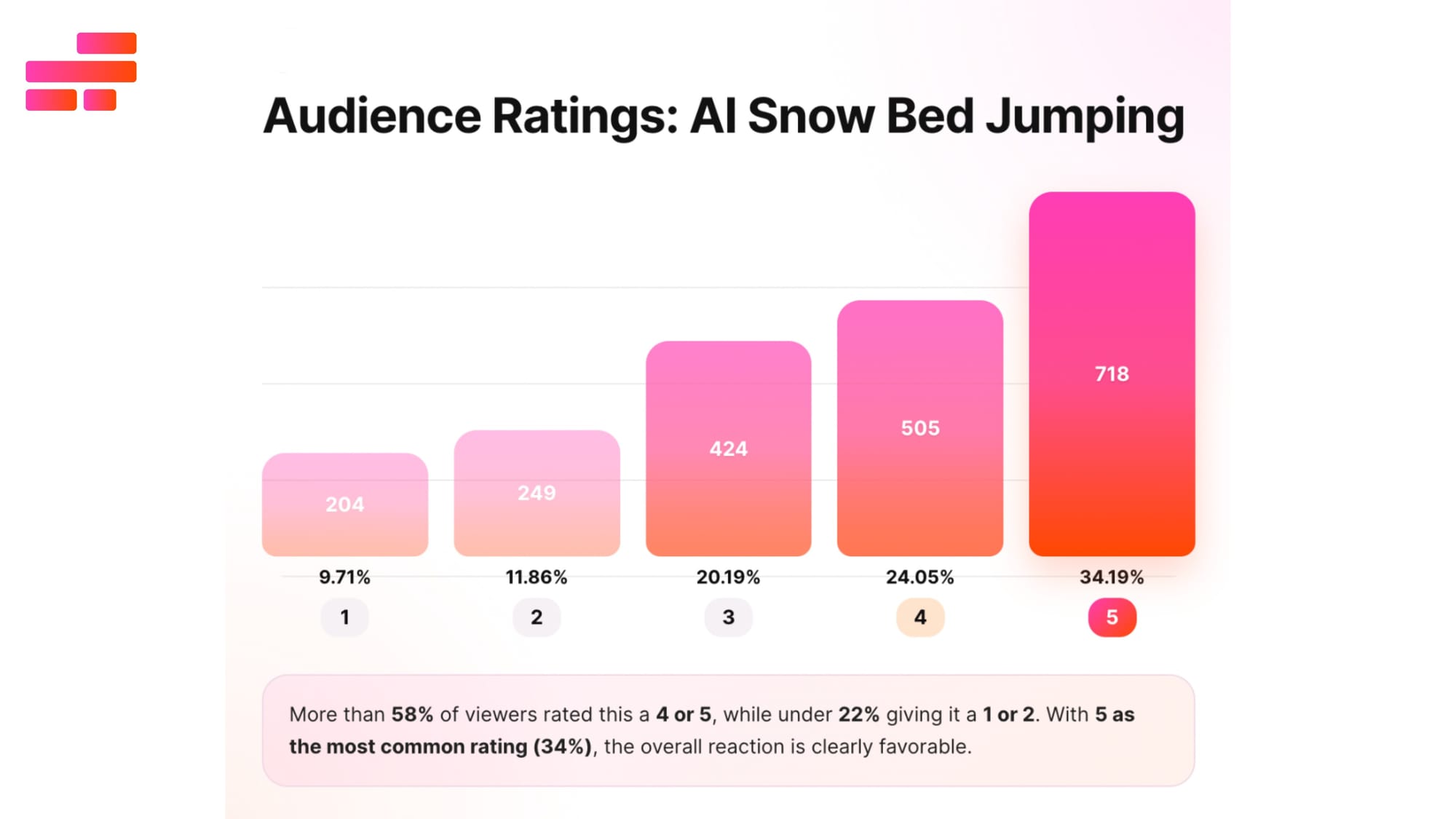
Compared to other stimuli, Snow Bed produces fewer extreme reactions and more agreement across participants, which is what ultimately drives its higher average. One reason for that consistency might be how easily the brain can recognize and predict the interaction. Jumping into compressed snow is something many people have experienced, or can at least imagine clearly. As Dr. Karen Barrett explains:
“When a sound maps onto something we already understand from real-world experience, it’s easier for the brain to process and predict.”
When a sound is easy to interpret, the brain can recognize and anticipate what comes next. In ASMR, that kind of low-friction processing could be tied to how pleasurable the experience feels. Instead of working to decode the stimulus, the brain can stay in a steady loop: an action happens, the outcome matches expectations, and the pattern repeats. The AI-generated version reinforces this by removing background noise and variation, leaving a more controlled signal.
The texture of the sound also plays a role. Snow Bed is soft, compressed, and avoids sharp, percussive spikes. Dr. Karen Barrett points to broader research in sound perception:
“There’s work by David Huron showing that different sound qualities—like pitch and timbre—are associated with different emotional responses."
While that research comes from music, the underlying principle still applies.
Snow Bed sits on the softer end of the spectrum. It doesn’t have sharp attacks or high-intensity spikes, which makes it less likely to trigger negative reactions, such as the AI ASMR glass fruit cutting trend below.
AI Glass Fruit Cutting ranked second in our survey. Its average rating was lower due to more 1-star reviews.
Many participants loved the sound. Each cut is perfectly clean, the motion is smooth, and every action produces a sharp, well-defined sound that aligns tightly with what’s shown on screen.
As Dr. Karen Barrett explains: "Visual stimuli have a real impact on how we perceive sound.”
Even though the material itself is unrealistic, the interaction is easy to follow. Each action leads to a clear and immediate result. At the same time, the visuals are highly controlled: symmetrical, refined, and free of the mess or imperfection you’d expect in real life.
That combination creates a different kind of experience. Instead of relying on something familiar, it offers a version of the interaction that is more precise and fully resolved. In some cases, that level of control may even feel more satisfying than the real-world equivalent, where outcomes are less consistent.
Nonetheless, the precise sound of a cutting motion divided audiences far more than scrunching snow, as one of our respondents added:
Nonetheless, the sound of cutting proved far more polarizing than the sound of scrunching snow, as one respondent explained:
“The glass-cutting sound felt far too invasive for me. I couldn’t listen to the AI sound effect for more than a second. The moment it started, I felt uncomfortable and turned it off”
AI Pearl Jam Spreading Was the Most Disliked Overall
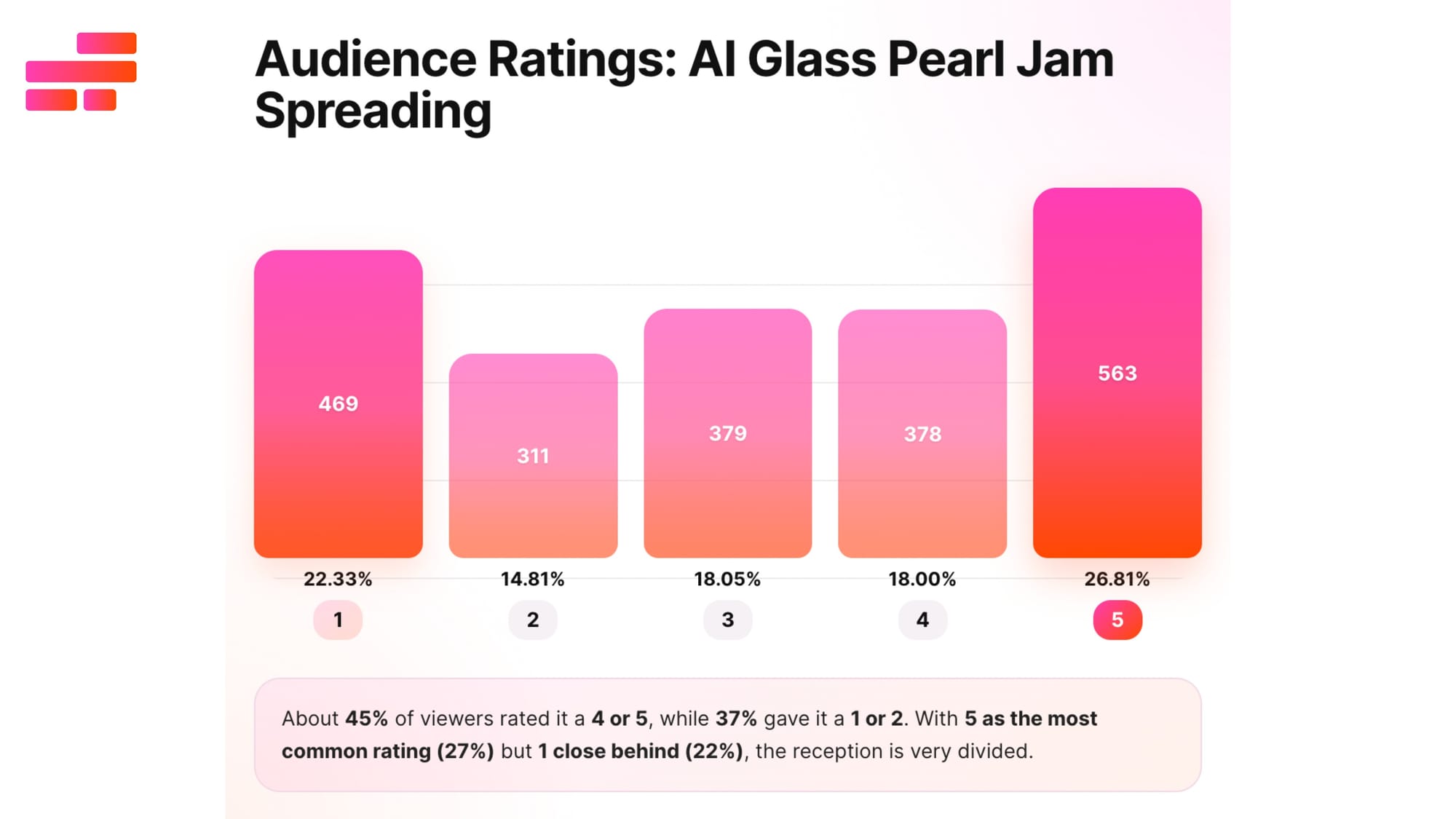
Pearl Jam Spreading received the lowest average rating (~3.12) across all five sounds, indicating the weakest overall performance.
While 44.81% of participants rated it a 4 or 5, 37.18% rated it a 1 or 2.
It received almost as many 1-star ratings (22%) as it did 5-star ratings (26%)
Sounds like AI Snow Bed, and even AI glass cutting, allow audiences to imagine what the action would feel like.
That makes it easier to form an expectation and have it confirmed. With Pearl Jam Spreading, that process is less stable. The material is thick and gelatinous, but it’s unclear how it should feel, whether smooth, sticky, resistant, or messy.
AI Balloon Staircase and AI Honey Keyboard Typing Were the Most Polarizing Sounds
Unlike the top and bottom performers, some sounds didn’t produce a clear consensus. Instead, they split audiences, drawing strong positive and negative reactions at the same time.
In our survey, the two most polarizing sounds were AI Honey Keyboard Typing and AI Balloon Staircase.
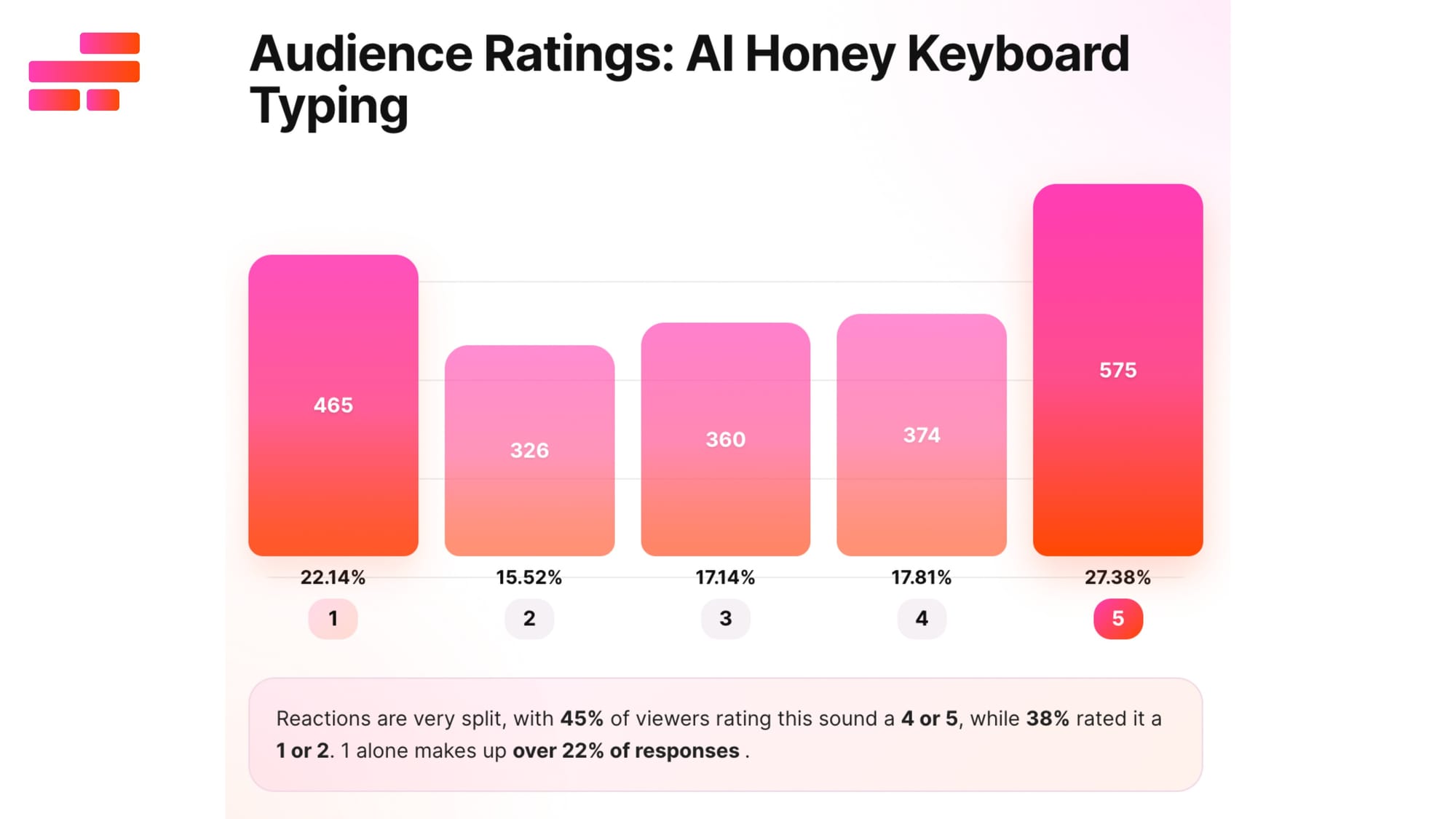
Honey Keyboard Typing received 27.38% 5-star ratings, while roughly 38% of participants rated it a 1 or 2, making it one of the most split responses in the study.
This is interesting because typing is rhythmic, discrete, and predictable, with each input producing a clear output. Under normal conditions, that kind of consistency supports a strong sensory loop.
However, the introduction of honey disrupts that loop, not by changing the action itself, but by changing what the action implies.
Viewers are not just hearing keystrokes. They are imagining what it would feel like to perform the action. Instead of clean, precise inputs, the interaction suggests stickiness, resistance, and residue. For some viewers, that shift may feel novel or exaggerated. For others, it immediately creates discomfort because the action itself becomes something they would not want to do.
Dr. Karen Barrett frames this in terms of how people respond to observed actions:
“People respond most positively when they’re watching or hearing an action they themselves find relaxing.”
This is where the split occurs. The underlying structure of typing continues to support a predictable pattern, but whether the experience works depends on whether that version of the action feels desirable.
Barrett also points to a more direct source of negative reactions, noting:
“The low ratings (of AI typing) could be due to aversions to the task itself, such as not wanting to get honey on a keyboard.”
AI Balloon Staircase produced the highest share of 1-star ratings (~17%) and a meaningful portion of positive responses.
Unlike Honey Keyboard Typing, where the structure remains stable but the experience varies, the tension here comes from how the pattern itself is processed over time.
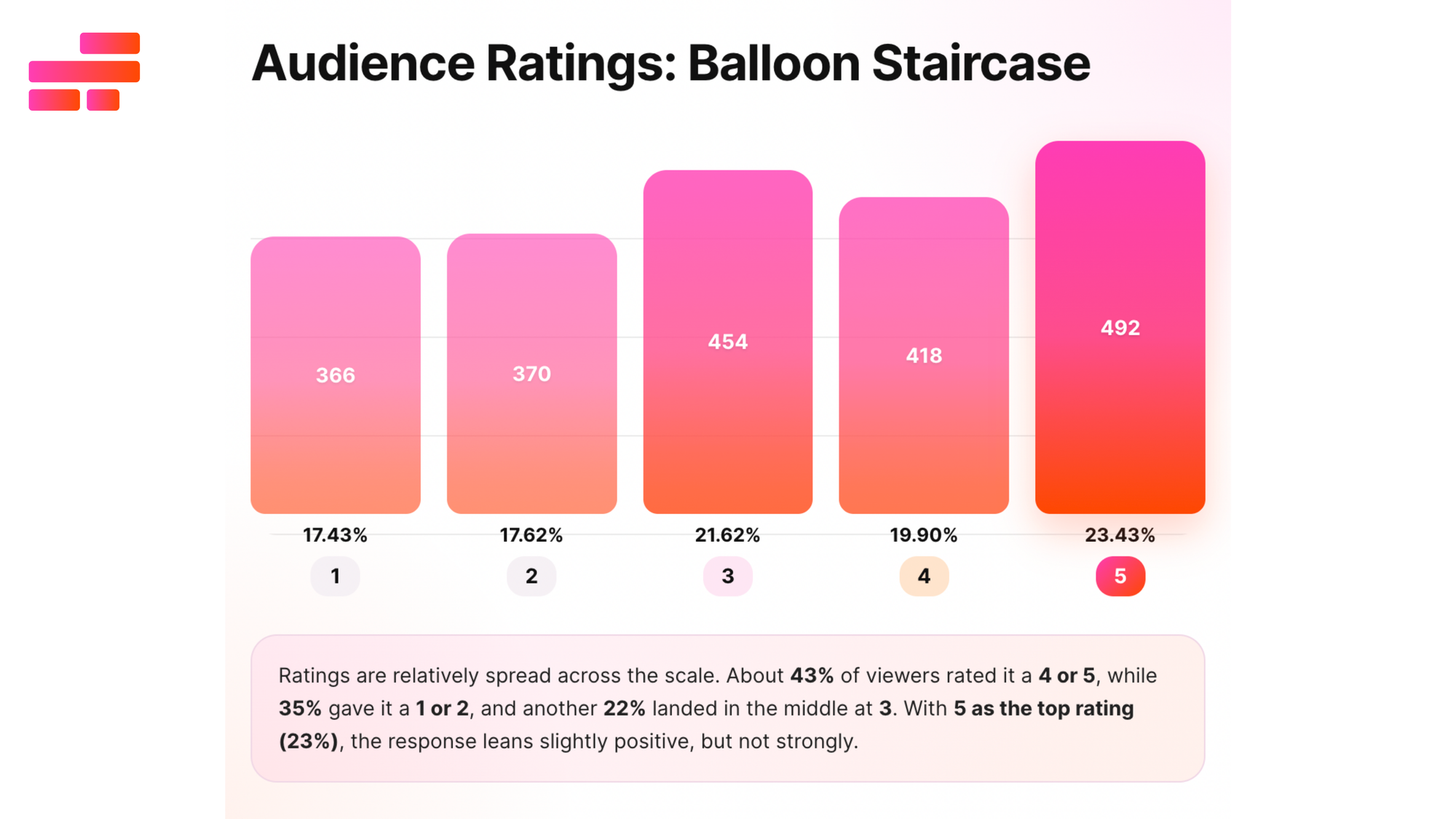
At a surface level, the interaction appears simple. Each step produces a similar compressed, elastic sound, suggesting a repeatable and predictable sequence. In most ASMR contexts, that kind of repetition allows the brain to settle into a stable loop, where each action leads to a clear and expected outcome. However, the material — balloons — introduces a complication.
Balloons are inherently unstable objects. They compress and rebound, but they also carry the constant possibility of rupture. That possibility changes how each step is perceived. Instead of being treated as a fully resolved action, each interaction remains slightly open-ended, because the outcome is not entirely guaranteed. The pattern is present, but it is never fully secure.
Karen Barrett frames this in terms of expectation, noting that “manipulating expectations is central to the meaning of music.”
In music, tension can build and release in a way that feels rewarding. In ASMR, however, she points out that:
“Surprises are generally undesirable because they can be jarring and disrupt the relaxing state.”
The Balloon Staircase sits between these two dynamics. It introduces tension through the possibility of disruption, but does not provide a clear release.
AI ASMR: The Most Liked and Disliked AI Sounds on the Internet — What the Data Shows
Taken together, the findings point to a clear pattern: AI ASMR is not judged on novelty alone, but on how easily the brain can organize, interpret, and stay engaged with the sensory input over time. Across all five sounds, performance consistently tracked along three underlying dimensions.
1. High-Performing Sounds Minimize Cognitive Effort
Sounds perform best when they are easy to interpret, consistent, and low in ambiguity. In practical terms, this means the listener can quickly understand what is happening, predict what will happen next, and process each interaction without needing to resolve uncertainty.
This reduces cognitive effort. When a sound is grounded in real-world experience (like snow) or is highly structured (like glass cutting), the brain can immediately map the input to an expected outcome.
As Dr. Karen Barrett explains, AI-generated audio can reinforce this effect because it is often very clean:
"AI sounds often lack the background atmospheric noise and recording artifacts present in natural recordings.”
That clarity removes competing signals, making each interaction easier to follow and more predictable over time.
2. Low-Performing Sounds Break the Interpretive Model
Sounds perform poorly when they introduce unclear textures or conflicting interpretations, forcing the brain to continuously resolve what it is hearing.
The issue here is not just unfamiliarity, but instability in how the sound is interpreted. If listeners cannot agree on what something should feel like, the experience becomes inconsistent at a perceptual level.
Barrett emphasizes that sound perception is deeply tied to experience and meaning, noting that:
“Personal history significantly ties into sound preference… emotional content matters in how sounds are perceived. People may feel relaxed if they are watching or listening to someone doing something that they personally find relaxing (...) context is crucial in dictating how sound is perceived.”
3. Polarizing Sounds Contain Competing Signals
The most revealing category is not the best or worst performers, but the ones in between. Sounds become polarizing when they combine structure with instability or discomfort, creating competing signals within the same experience.
These sounds often contain elements that support engagement, but introduce a second factor that disrupts them. That disruption may come from an implied texture, a lack of resolution, or a mismatch between expectation and outcome.
Polarizing sounds sit directly between these two dynamics. They introduce tension or ambiguity without fully resolving it. As a result, some listeners interpret the experience as engaging or novel, while others experience it as uncomfortable.
What This Means for AI ASMR
The key takeaway is that AI ASMR operates less like traditional media and more like a perceptual system to be optimized. The goal is not just to create something novel, but to align three layers of the experience:
- Clarity of the action (Can the viewer understand what’s happening?)
- Stability of the outcome (Does each interaction resolve predictably?)
- Desirability of the experience (Does it feel good to imagine?)
When these elements align, the result is intuitive and satisfying. When one breaks, the experience weakens. When multiple conflict, the response becomes polarized.
Ultimately, the most successful sounds are not just novel or visually interesting. They are the ones that create a clear, stable, and rewarding sensory experience from start to finish.
All videos were created using Kapwing AI, Kai.