The Most Streamed and Top-Earning AI Music Artists
AI music is most definitely a thing now — even if questions over the artistry behind it linger. Kapwing identified the AI-powered artists who are making the biggest impact on the charts while making six- or seven-figure sums from streaming.
While the major music labels make deals and big promises to protect human musicians and songwriters, independent users are filling the platforms and charts with AI-generated and AI-manipulated tracks.
By May 2025, AI-generated material featured in every video of four of the 10 most subscribed YouTube channels. In November 2025, AI music platform Suno boasted that its (mostly male, aged 25-34) users were generating enough tracks to completely repopulate the Spotify catalog every two weeks. Meanwhile, the share of AI tracks uploaded to Deezer quadrupled to 40% between January 2025 and May 2026.
But how significant is the popularity of these “artists”? And are they making a buck doing what they’re doing? Kapwing analyzed streaming and follower figures for the most popular AI artists to find out.
What We Did
We used Songstats to retrieve the total streams, followers, playlists and chart entries from the most popular and notable AI music artists listed on the AiMCharts database. Then, we used the total Spotify stream count and YouTube views for each artist to calculate their estimated earnings, using the default SocialBlade RPM midpoint ($2.12 per 1,000 streams) and the industry-average Spotify earning rate ($0.004 per stream).
Key Findings
- Spotify’s highest-earning AI music artist is “1950s style” vocalist Enlly Blue, who has earned an estimated $380,800 from 95.2 million streams.
- The top-earning AI music YouTuber is Cherry 葵 Nightcore, with an estimated $2.0 million from 941 million views.
- King Willonius, a comedian who generates songs using AI, has had 500 chart entries across all platforms — the most of any AI musician.
- AI synth rock act Masters of Prophecy has the most followers (36.1 million) across all platforms, with estimated earnings of $652,375 from YouTube alone.
- Don Bnnr, a producer using AI to make music, has the largest playlist reach of any AI music artist, with tracks on 1,852 playlists and a total follower count of 46.7 million listeners.
AI ‘50s-style blues singer Enlly Blue earns $380K on Spotify
First, we used AiMCharts to identify popular AI music acts, whose Spotify profiles we then analyzed to see who is earning the most money.
We identified 15 AI-flavored acts making an estimated six-figure sum from Spotify streams and over 100 more earning a five-figure income. With nearly 100 million streams at an industry-average rate of $0.004 per stream, Enlly Blue is the biggest earner. She has earned an estimated $380,800 to date on the platform.
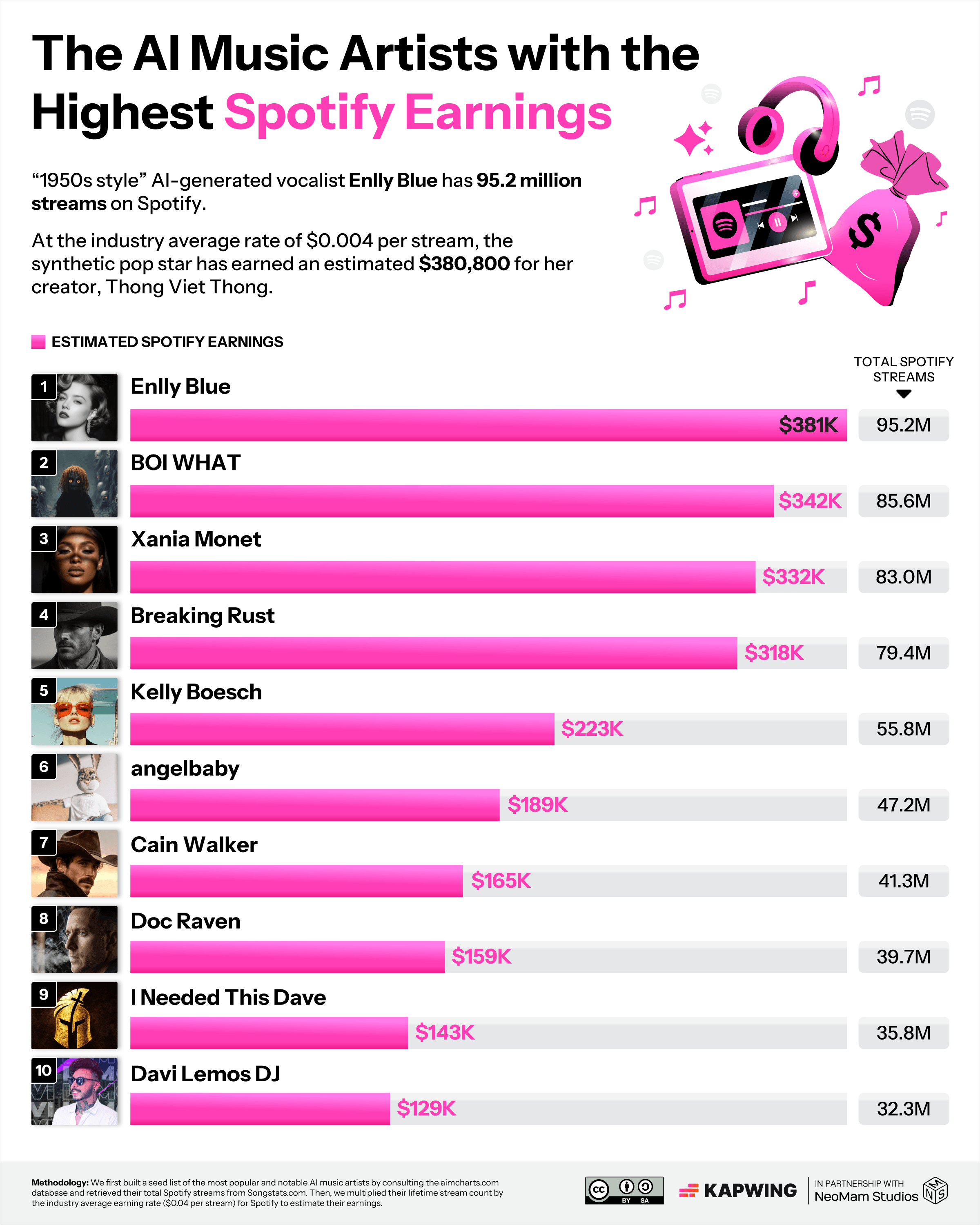
Described as “an independent blues artist from the US… Blending acoustic music, production, recording, and AI-powered creativity,” Enlly Blue is in fact a “synthetic persona” apparently created by Thong Viet. It appears that the vocals, lyrics and still images (there is no Hatsune Miku-style “being” associated with the act — yet) are AI-generated, while the composition and production may be a mix. The tracks are generic but competent and easily mistaken for human music.
Other top ten Spotify earners use different “blends” of AI. Davi Lemos DJ appears to use AI to create “montagem”-style remixes of existing tracks and AI-generated cover versions. BOI WHAT uses AI to add SpongeBob SquarePants character vocals and visuals to recordings of the artist’s own metalcore compositions and performances. BOI WHAT’s mastermind, Eli Stroback, has earned an estimated $342,400 from 85.6 million Spotify streams.
Synth rock AI act Masters of Prophecy may have a six-figure YouTube income
Next, we looked to YouTube’s top earners. Way out ahead is Cherry 葵 Nightcore, who has 36.1 million subscribers and is approaching one billion plays. We estimate the channel's earnings at $1,999,625, based on a default SocialBlade RPM midpoint of $2.12 per 1,000 streams.
Cherry 葵, a pseudonymous anime persona, primarily shares and remixes music in the Nightcore style. AiMChart may have flagged Cherry 葵 due to AI being used in the underlying tracks, as she claims to use a more traditional digital audio workstation (DAW) to make her mixes.
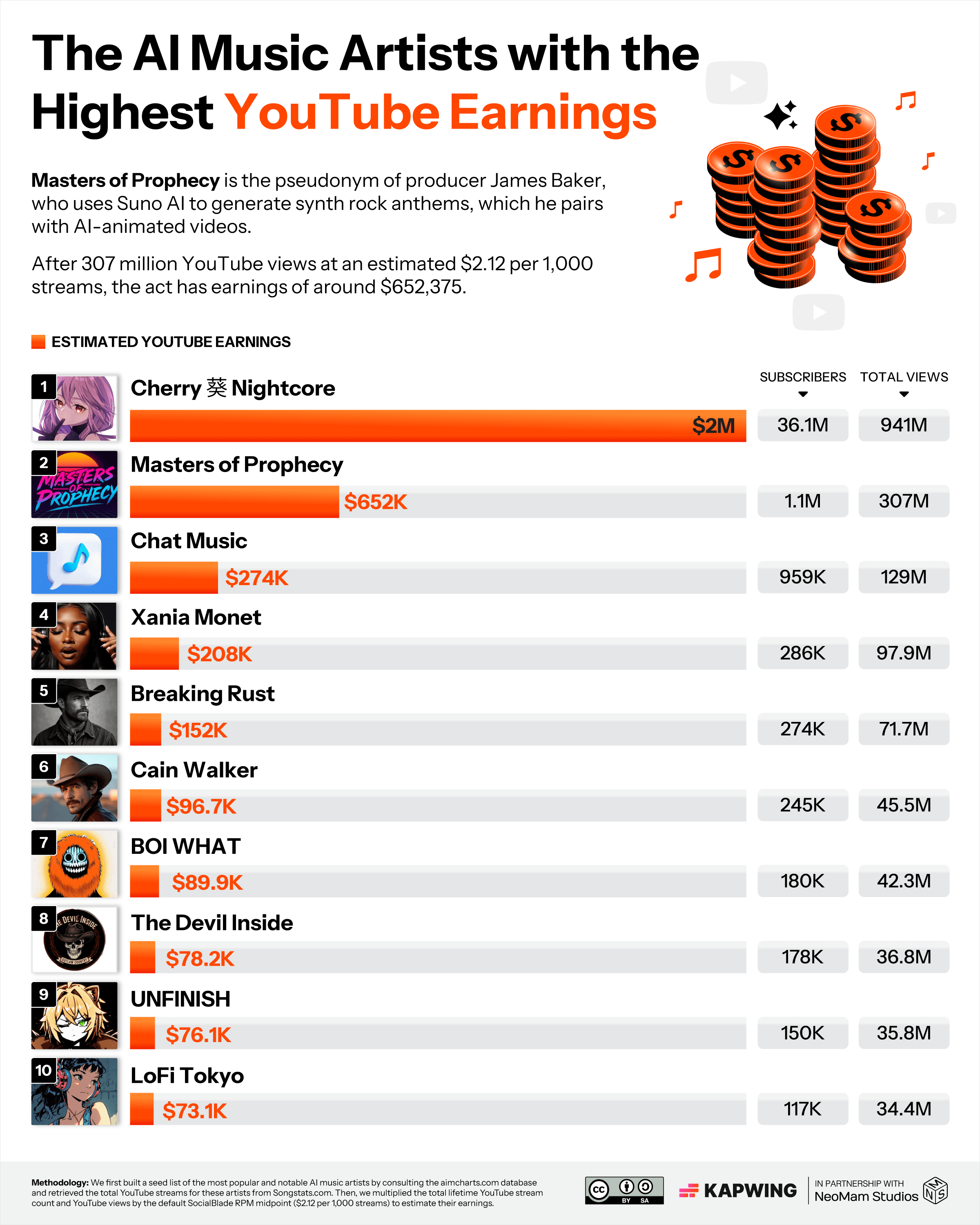
YouTube’s second-highest earning AI music act — and the one with the most followers across all platforms (see next section) — is synth rock act Masters of Prophecy. The Suno AI-powered project of producer James Baker has estimated YouTube earnings of $652,375.
Masters of Prophecy gained 30 million YouTube subscribers between February and June 2026, according to research by Garbage Day’s Ryan Broderick and Adam Bumas.
“[T]hat growth looks suspicious, especially looking at how it began by going from less than 300 subscribers to more than 100,000 in a single day without any new videos, Shorts, or comments in that time,” write Broderick and Bumas. “But again, on a platform increasingly powered — and populated — by AI, what does inauthentic growth even mean?”
For his part, “each vocal song is a combination between hours of human work on the lyrics, videos, and more in combination with performance by Suno,” says Baker.
Retired teacher gains four million followers on all platforms with AI music pastiches
Masters of Prophecy has 36.1 million followers across all platforms, with the lion’s share on YouTube (see previous section). This is nearly ten times as many as any other AI music artist.
But in second place — and significantly ahead of the pack — is “retired teacher turned content creator” The Professor Nick Harrison. Harrison has just shy of four million followers, mostly divided between TikTok and Instagram, with 50,000 on Spotify and just a handful on YouTube and Twitch.
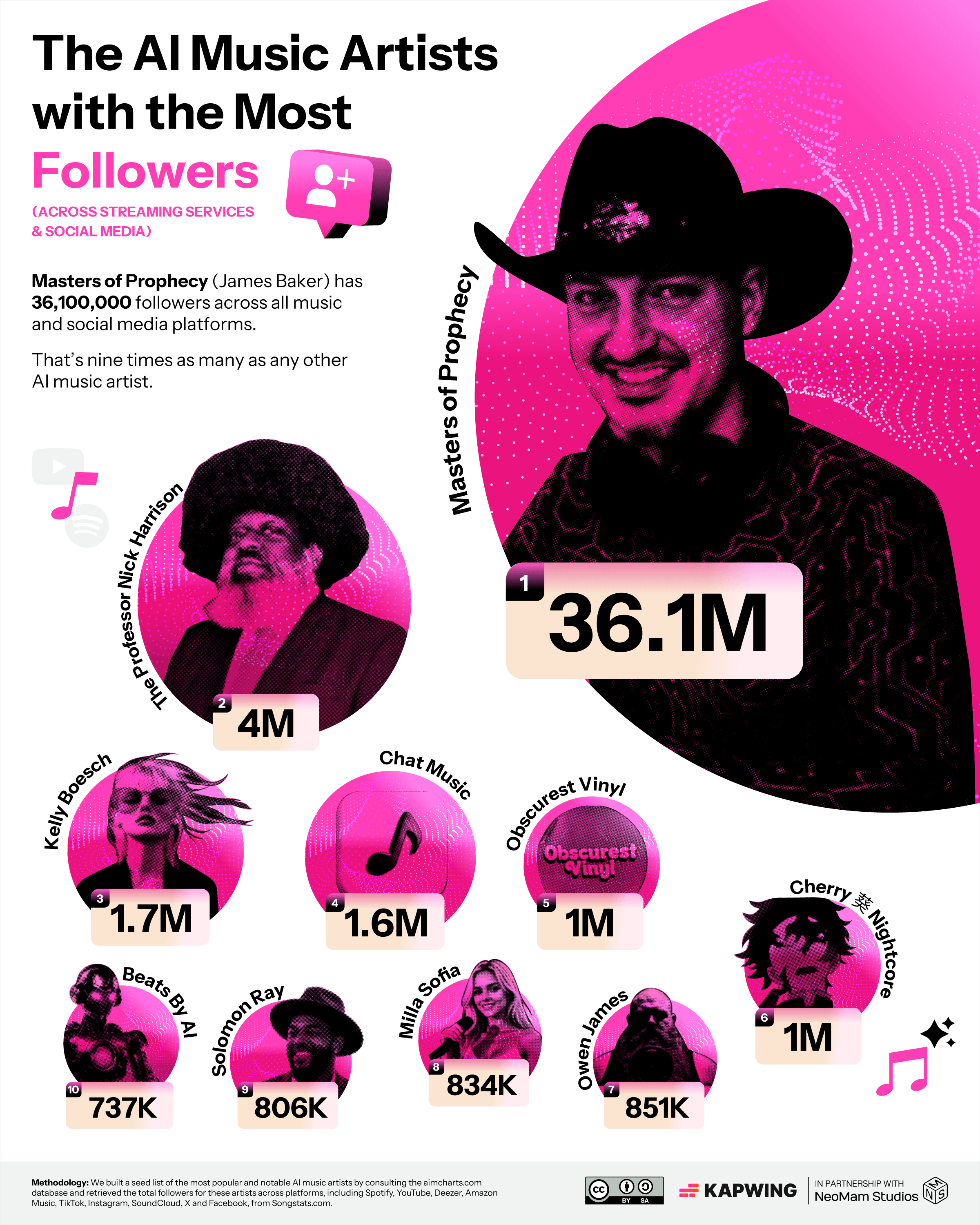
Vice describes Harrison’s work as “AI-generated mashups of popular rock songs rendered into different genres,” and there is much online debate as to how he achieves such pleasing and realistic results.
Regardless, Harrison’s presence as the human face of the act seems pivotal to winning fan loyalty; he already enjoyed traditional media coverage while making organic content in the early 2020s, all while still working as a teacher.
Controversial AI ‘70s band The Velvet Sundown reaches 5.6 million playlist listeners
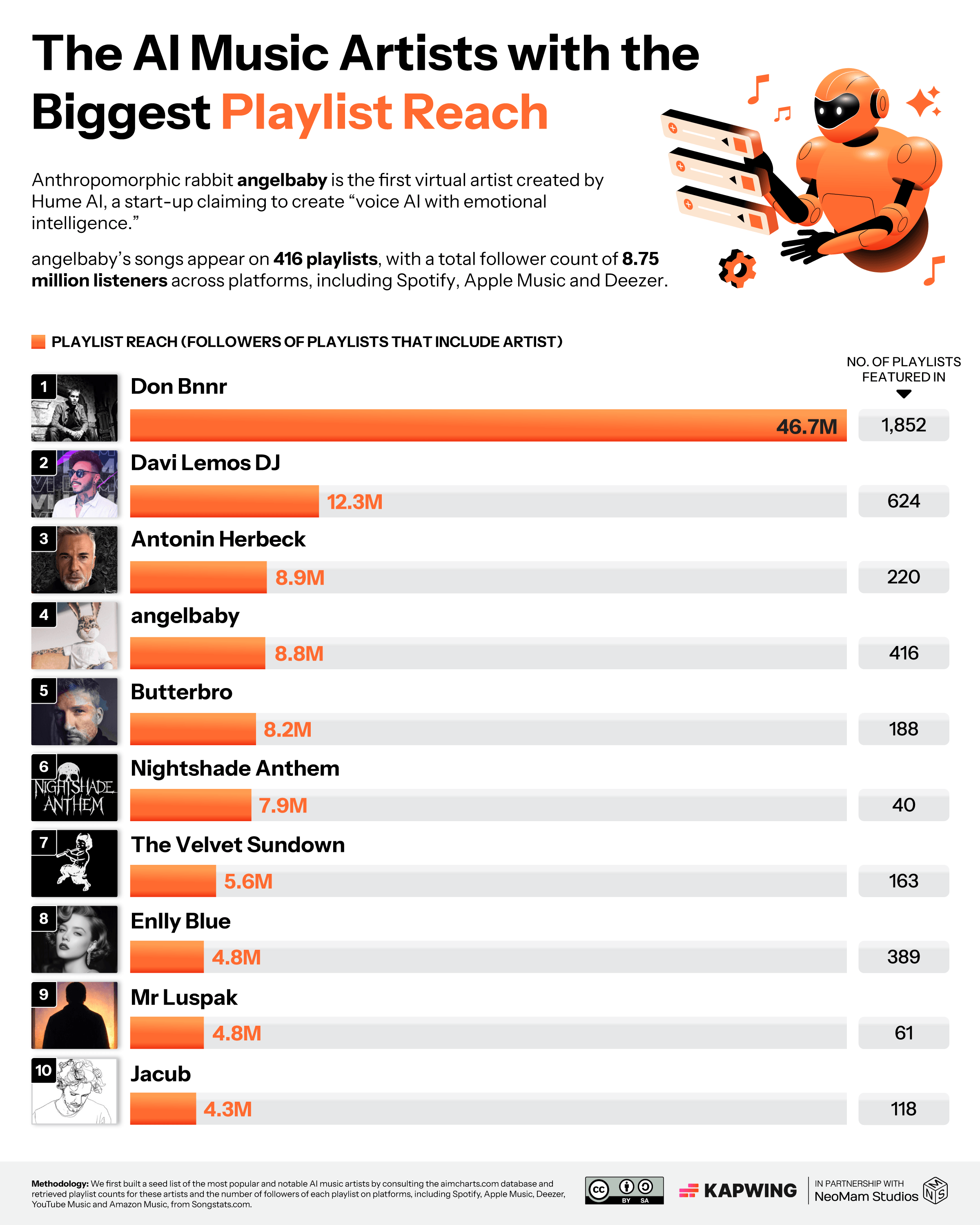
Next, we found the follower counts of playlists featuring music by the top AI music artists and calculated the combined number of playlist followers for each act.
We found that The Velvet Sundown — who hit the headlines in 2025 upon releasing two albums of comfortingly familiar “Seventies psychedelic… alt-pop and dreamy analog soul” — have since featured on 163 playlists with a combined count of over 5.6 million followers.
While Rolling Stone magazine recognized The Velvet Sundown as “an obviously fictional “band,” the magazine was double-duped when The Velvet Sundown’s would-be spokesman, Andrew Frelon, appeared to confirm the band as an AI fabrication.
Frelon himself turned out to be a (human) hoaxer with no actual connection to The Velvet Sundown, who, all the same, subsequently announced that they are, indeed, a “synthetic music project guided by human creative direction, and composed, voiced, and visualized with the support of artificial intelligence.” Buoyed by the controversy, The Velvet Sundown continues to entertain 123,007 monthly listeners on Spotify.
Meanwhile, Don Bnnr — the recording name of producer Benedikt Wellmann — has tracks on 1,852 playlists with a potential reach of 46.7 million playlist followers. While it’s not clear why AiMCharts has flagged the producer as an AI musician, Don Bnnr’s prolific work with other artists and on his own tracks has proven to be very playlist-friendly. He is the most playlisted artist using AI in music.
Million-dollar AI signing Xania Monet boasts in 420 chart listings
Finally, we identified the AI music acts with the most chart entries across the major music platforms, including Spotify, Apple Music, Deezer, YouTube Music and Amazon Music.
King Willonius — aka Willonius Hatcher — wins this “chart of charts” with 500 entries. The comedian broke through with his Drake/Kendrick beef pastiche “BBL Drizzy” in April 2024, feeding his own lyrics into an AI music-generating app (reportedly Udio).
“I have a really great ear,” Willonius told Vulture, “so it’s just listening to the music once it’s done and being like, I don’t like this, then just keep reiterating the track until it’s something that I feel that people would enjoy. Then just keep tweaking it until you find what actually works.”
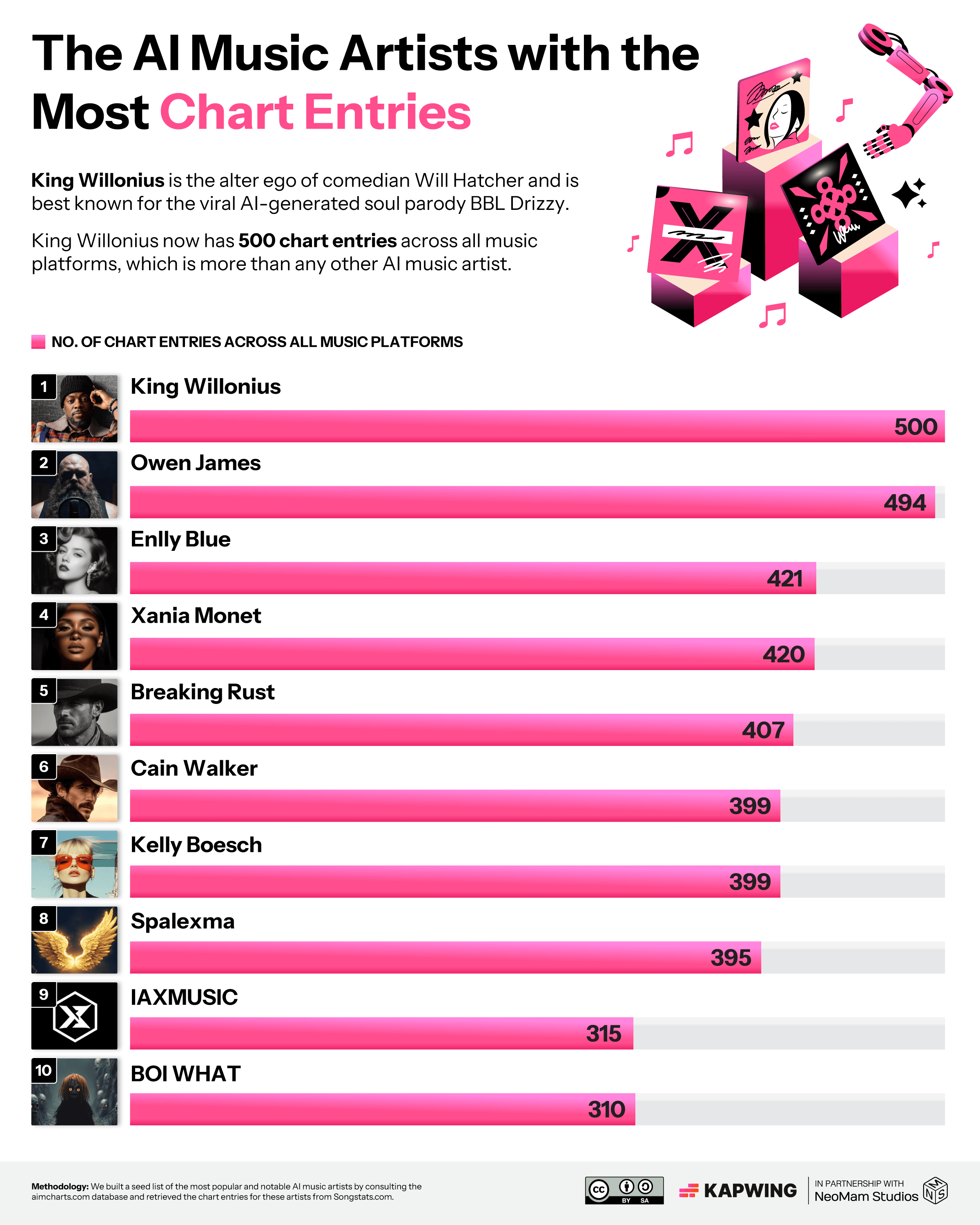
Xania Monet, who became the first AI artist to debut on an airplay chart in September 2025, is the fourth top-ranked AI chart artist, with 420 appearances.
Her chart success prompted a rush by labels to sign her, which muted a little when it became clear the rights to her music were potentially compromised by Jones’ use of Suno. Still, she signed with Hallwood Media in a multimillion-dollar deal following reports of bids in the range of $3 million.
The “lyrics are 100% me,” says Telisha "Nikki" Jones, the Mississippi poet behind the Monet character. After choosing which poem to zap, Jones says she puts the lyrics into an AI app and prompts for an R&B tempo, soulful female vocals and her instrumental preferences. While the music lacks life and invention, the compellingly overwrought vocals and poetry are clearly connecting with the masses.
“Nothing and no one on Earth will ever be able to justify AI to me,” responded Grammy-winning R&B artist and America’s Got Talent graduate Kehlani in a now-deleted TikTok post. “Especially not AI in the creative arts, in which people have worked hard for, trained for, slept on the floor for, f—king got injuries for, worked for their entire lives. I’m sorry, I don’t respect it.”
From the bone flute to AI-powered bands and superstars
Music and technology have been intertwined since our Paleolithic ancestors experimented with rattles, beaters and bone flutes. And more recently, even when purists (and dads) questioned the musicality involved in programming drum machines, plugging in patch cords or “knob twiddling,” the human agency and engagement with the spirit and mechanics of music eventually won such artistry broad respect.
But when it comes to making money from Spotify or YouTube, streams count more than respect — and so far, AI musicians are more successful in the former than the latter. In the interactive below, you can search and sort our data in full to see how the streams, followers, chart appearances and estimated income of the top-earning AI music acts add up.
So, is AI just an extension of the technological leaps of the 20th-century music industry? The ability to record, manipulate and play back musical sounds fundamentally changed humanity’s relationship with music in the last century, while tape machines, synthesizers and digital audio workstations remapped our concept of what can be considered a musical source.
And like AI, the new portability of music and the freedom to create (or define) had to weather widespread backlashes. Criticisms against everything from jazz (it’s not Irish enough!) to disco (it’s too Black/gay/electronic!) to non-live movie soundtracks and the “ghetto blaster” followed the record industry from its birth.
But such previous backlashes focused on controlling marginalized groups and protecting revenue. Conversely, critics of AI music flag the non-consensual extraction of value from existing musicians and the knock-on effects for future generations of home hobbyists and would-be professionals. Meanwhile, the big music corporations have leveraged the outrage to cut a deal and profit from the technology: “We’ve seen this before – everyone talks about ‘partnership,’ but artists end up on the sidelines with scraps,” says Irving Azoff, artist manager and founder of the Music Artists Coalition.
In embracing artificial intelligence to make music, everybody has a stake in ensuring both the material and the deals retain an essence of humanity.
Full Methodology
We first built a seed list of the most popular and notable AI music artists by consulting the aimcharts.com database and retrieved the total streams, followers, playlists and chart entries for these artists from Songstats.com. Then, we used the total lifetime Spotify stream count and YouTube views for each artist to calculate their estimated earnings, using the default SocialBlade RPM midpoint ($2.12 per 1,000 streams) and industry average earning rate ($0.004 per stream) for Spotify.