Which AI Accents Sound the Most Trustworthy & Credible?
New AI tools allow you to sample your voice and generate longer speeches automatically. We tested AI-generated voices in 15 American accents to see which ones survey respondents would rate the highest.
Creators who use AI tools to record their voiceovers face an interesting new creative choice.
The best of these tools allow you to sample your own voice and reproduce it in different accents and languages: so which accent should you choose to win the trust of a broad — and multi-accented — audience?
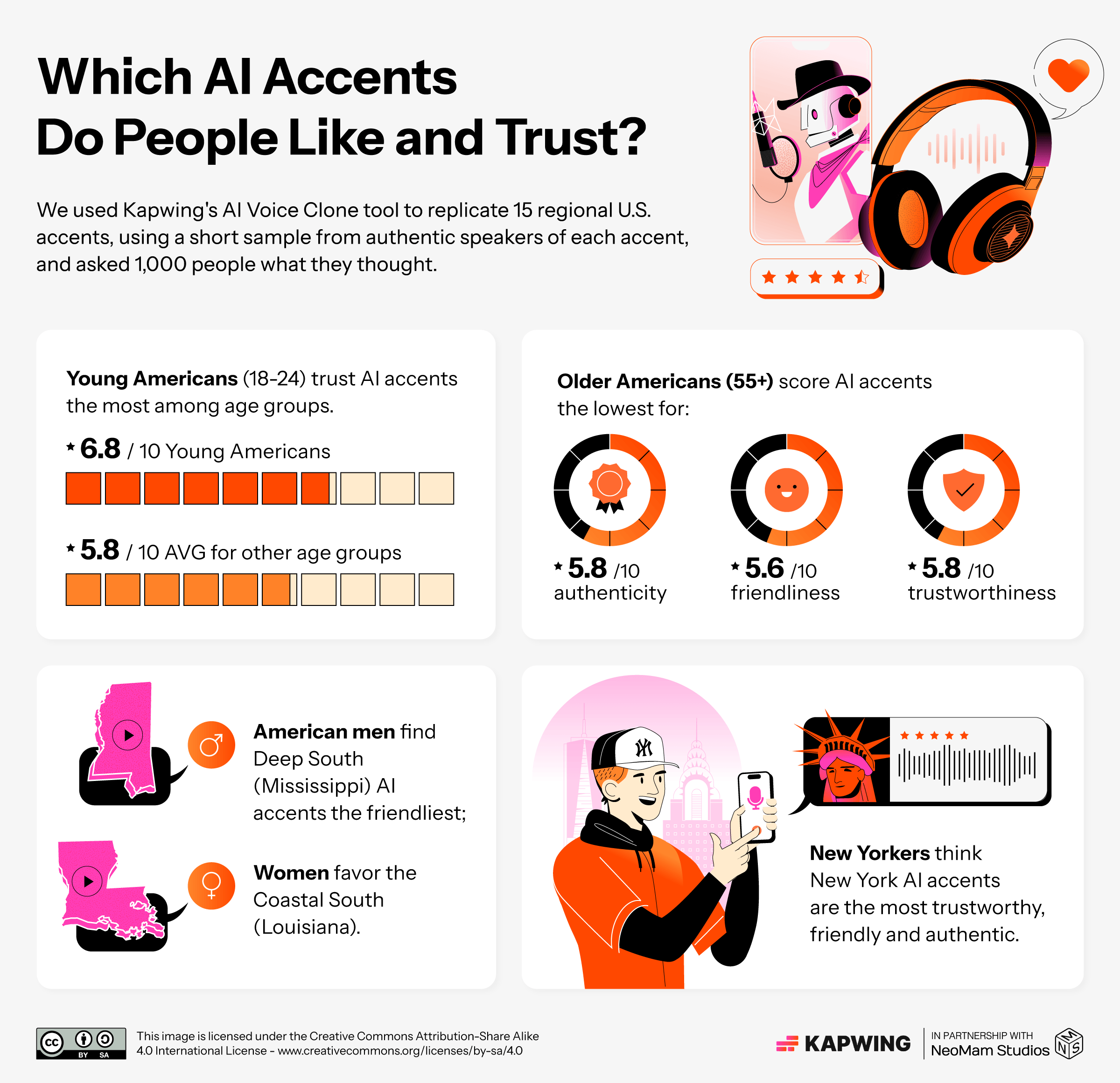
We used Kapwing’s AI Voice Cloning tool to clone the voices of 15 speakers with different regional U.S. accents and generate snippets of artificial voiceover for each one. We then played these back to a nationally representative sample of 1,000 U.S. adults and asked them to rate the accents for trustworthiness, friendliness, and authenticity.
Read on to explore our findings in more detail.
AI’s Deep South (Mississippi) Accent is Most Trustworthy (and Friendliest and Most “Authentic”)
First, we recorded two- to three-minute samples of authentic speakers of 15 U.S. accents. We then used these to generate 10-second snippets of the same voice and accent with Kapwing’s AI voice clone tool.
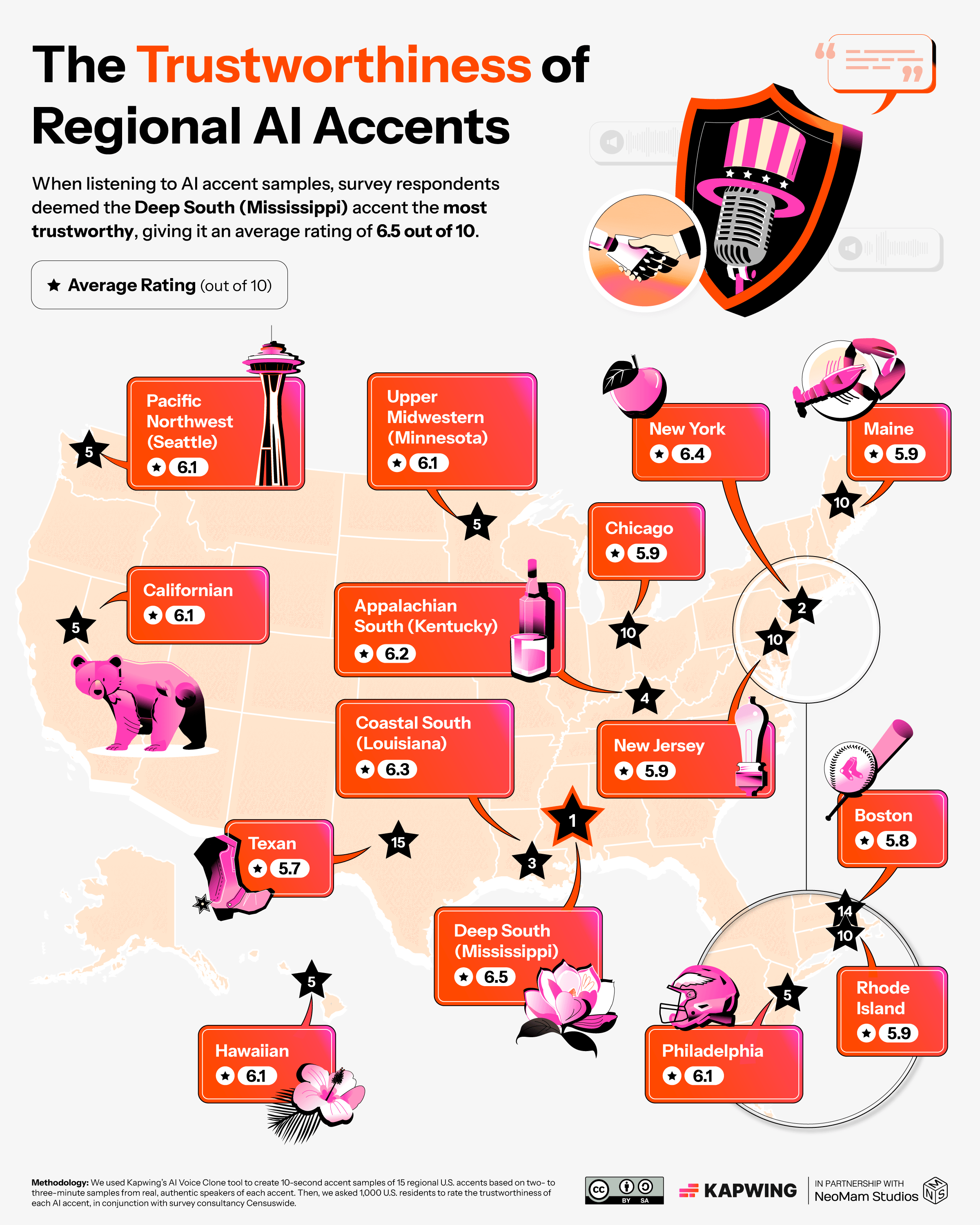
When asked, a representative group of 1,000 U.S. adults gave the resultant Deep South (Mississippi) accent an average rating of 6.5 out of 10 for trustworthiness — making it the most trustworthy of any accent we tested. The survey respondents also gave our Deep South accent a 6.5 for friendliness and 6.8 for authenticity, putting it at the top of those categories, too (see sections below).
Deep South accents have long been associated with trustworthiness, and scholars speculate that this could be due to the “imperfections” that listeners note in such a voice. Compared to more standardized forms of American English, Deep South accents convey relaxed warmth and a “based” sense of local pride (and thus authenticity) rather than calculated formality.
Such accents may be increasingly rare, adding to the sense of uniqueness and character:
“The kids are not very Southern these days because they’ve been inundated by people from elsewhere,” says linguist Walt Wolfram, addressing the heavy Southern accents in the latest series of “The White Lotus.” “I have grandkids, for example, who have grown up here and are now in their 20s, and they don’t sound Southern at all even though this is where they were raised. That’s just the norm for cities like Durham and Raleigh.”
AI-Generated New York Accent is America’s Third Friendliest Voice
Next, we asked our survey respondents to rate the same AI voices on friendliness.
In this instance, Coastal South (Louisiana) joined Deep South (Mississippi) at the top of the table, with the two Southern accents rated 6.4 and 6.5 out of ten, respectively. This is notable as it shows the Coastal South accent leapfrogging the New York accent, which ranks second for trustworthiness and authenticity but falls into third place for friendliness.
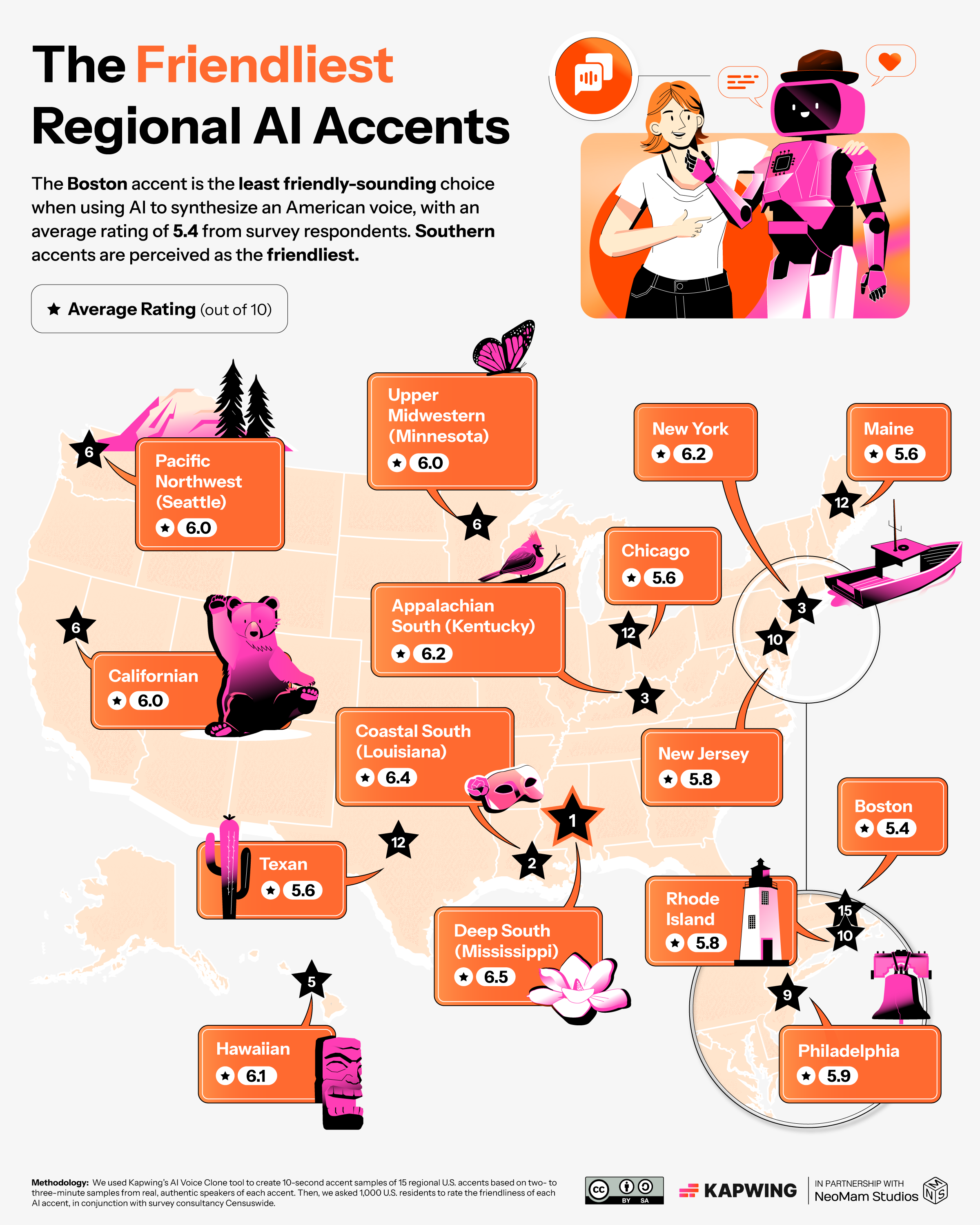
But third place is still a good showing for the New York accent, which researchers have historically noted for coming across as “rude,” “crude,” or “dissonant.”
This apparent contradiction reveals how New York means a lot of things to a lot of people: welcoming or dangerous, elite, or earthy. For international audiences, the New York accent may be received as “the official and most prestigious accent of the nation” — though again, how friendly that makes it sound may depend on their perception of the U.S.
So what is the key takeaway for creators? That overall, an AI-reproduced New York accent is likely to be found trustworthy by audiences — but that when using a New York accent, it is important to think carefully about what their word choice, voice quality, and intonation add to the effect.
Boston and Texan AI Accents Ranked Lowest for Authenticity
Finally, we asked respondents to rate the same 15 accents based on their authenticity.
Deep South (Mississippi) (6.8) and New York (6.3) ranked the highest. The Texan, New Jersey, and Boston accents were deemed the least authentic, with each one rated 5.8 on average.
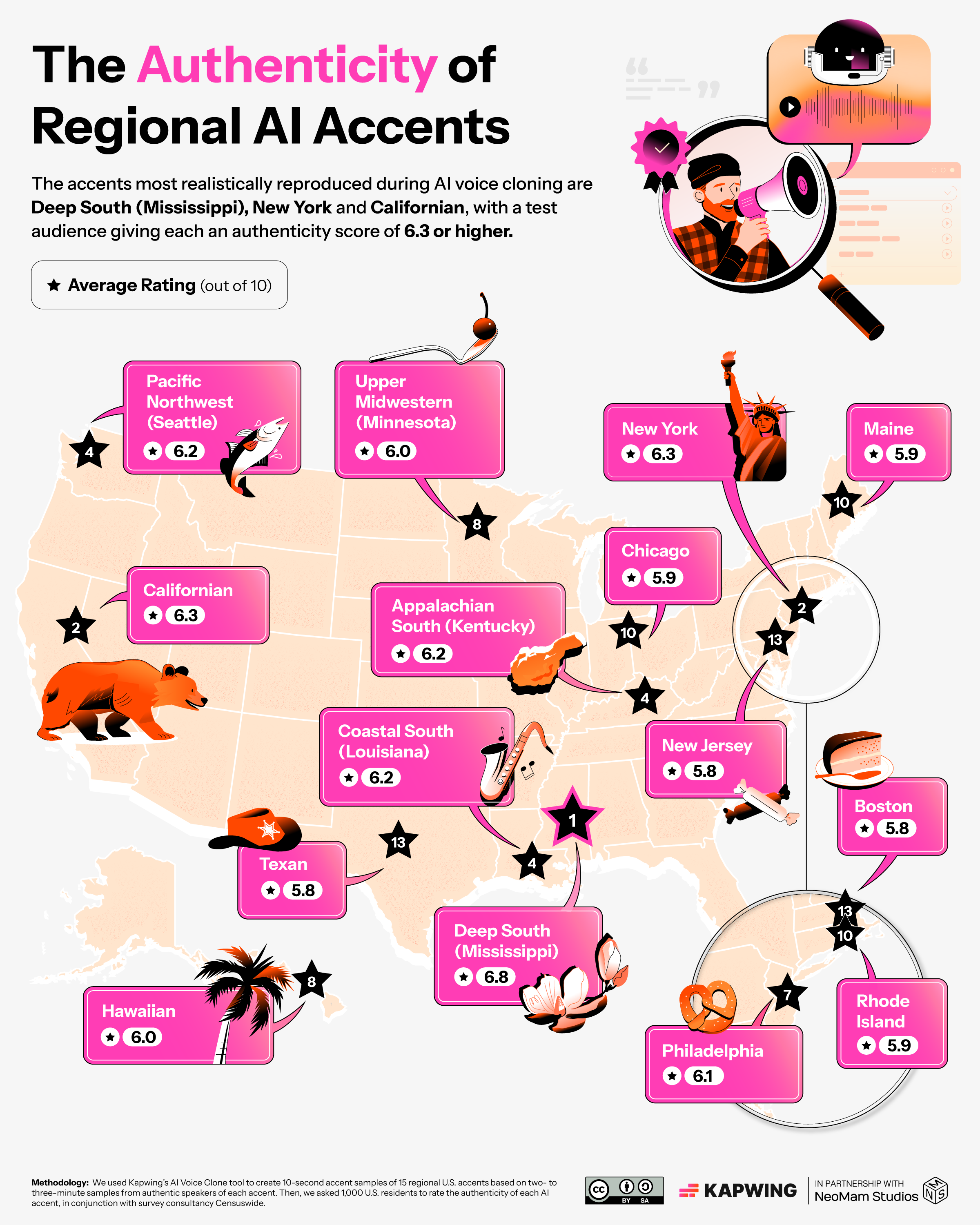
Indeed, the Boston and Texan accents ranked lowest for all three of our test categories — trustworthiness, friendliness, and authenticity.
Does that mean you shouldn’t use them in your voiceover? If it’s authenticity that you’re looking for, it makes sense to train your voice cloning tool on your own accent — whatever it might be.
The Best Accent is Your Accent
When face-to-face with a real-life robot, there’s one accent that’s more trustworthy to hear than the rest, according to research from Frontiers in Robotics and AI — and that’s the accent that the listener speaks with.
That might be workable when working one-on-one with physical robots in the field, but content creators are usually making work for audiences of various backgrounds. In this case, the accent listeners might reliably trust most is the one that genuinely belongs to the speaker.
If you find recording long voiceovers troublesome or you want a quick way to fix audio errors, voice cloning can be an efficient tool. For example, you might want to record your voice “at its best” for your vocal sample so that mistakes or dwindling energy no longer creep into a long or complicated speech and your AI voice remains clear throughout.
But beware of overdoing it. So-called “accent-softening” — removing the unique features of your voice — can create an uncanny valley effect where the “words and structures being used don’t match the accent,” write linguistic experts Molly Babel and Amanda Cardoso in The Conversation.
Audiences can be quick to sense when something isn’t quite right — so unless you have a legitimate creative reason for altering the accents of your voice clones, you risk alienating the trust of your listeners, particularly when sound and voice are such intimate elements of audiovisual content. Accent-softening may also have broader effects on society, similar to how ChatGPT is flattening human language use.
So before smoothing out the idiosyncrasies in your voice, take a moment to be proud of your accent, the bumps and rivets in the way you talk. Be proud of your vowels and consonants, your melody, emphases, and rhoticity. These are what the human ear loves to hear.
Methodology
In conjunction with Censuswide, we surveyed a nationally representative sample of 1,000 U.S. residents (aged 18+) on their perception of AI accent samples.
We asked all respondents to rate the trustworthiness, friendliness and authenticity of 15 regional U.S. accents: Deep South (Mississippi), New York, Appalachian South (Kentucky), Hawaiian, Pacific Northwest (Seattle), Californian, Coastal South (Louisiana), Upper Midwestern (Minnesota), Philadelphia, Rhode Island, Chicago, Maine, New Jersey, Boston, and Texan.
These 10-second accent samples were created with Kapwing AI, using a two- to three-minute sample from authentic speakers of each accent.
Data is correct as of July 2026.