Best AI Video Models for Realistic Animals
Videos featuring wildlife content have been watched over 4 billion times on YouTube alone.
As AI-generated video becomes more accessible, creators, filmmakers, educators, and marketers are exploring its potential to produce high-quality, realistic animal content. From endangered species in their natural habitats to common animals in perfect lighting conditions, AI tools allow for instant video creation without the need for cameras, travel, or the challenges faced when filming live wildlife.
But among the many AI tools available, which ones actually deliver lifelike animal visuals with accurate motion, texture, and environment blending?
To find out, this article reviews and compares the best AI video models for generating realistic animals, including tools from OpenAI, Google, Bytedance, and more. Whether you're creating wildlife content, educational videos, or just exploring the capabilities of AI generation, this will identify the best tools for you.
Table of Contents:
- What Makes an AI Video Model Good for Realistic Animals?
- AI Models Tested
- Testing Method
- Results
- Top AI Video Models for Realistic Animal Generation
What Makes an AI Video Model Good for Realistic Animals?
Realism in AI-generated animals isn’t just about surface-level accuracy. It’s about how convincingly the animal moves, behaves, and exists within a scene. Audiences intuitively recognize when something feels off, whether it's an unnatural gait, frozen fur, or a disjointed interaction with the environment. To produce believable results rather than AI slop, an AI video model must replicate the visual, physical, and behavioral logic of real animals.
Here are the core traits that define a strong model for realistic animal generation:
1. Responsive, Layered Surface Textures
Fur, feathers, and skin carry motion, weight, and light. High-quality models render texture with depth and allow it to react dynamically to movement and environmental factors.
Flattened or blurry textures, static fur, or feathers that don’t shift with motion are immediate giveaways of artificiality.
2. Anatomical Accuracy and Species-Specific Proportions
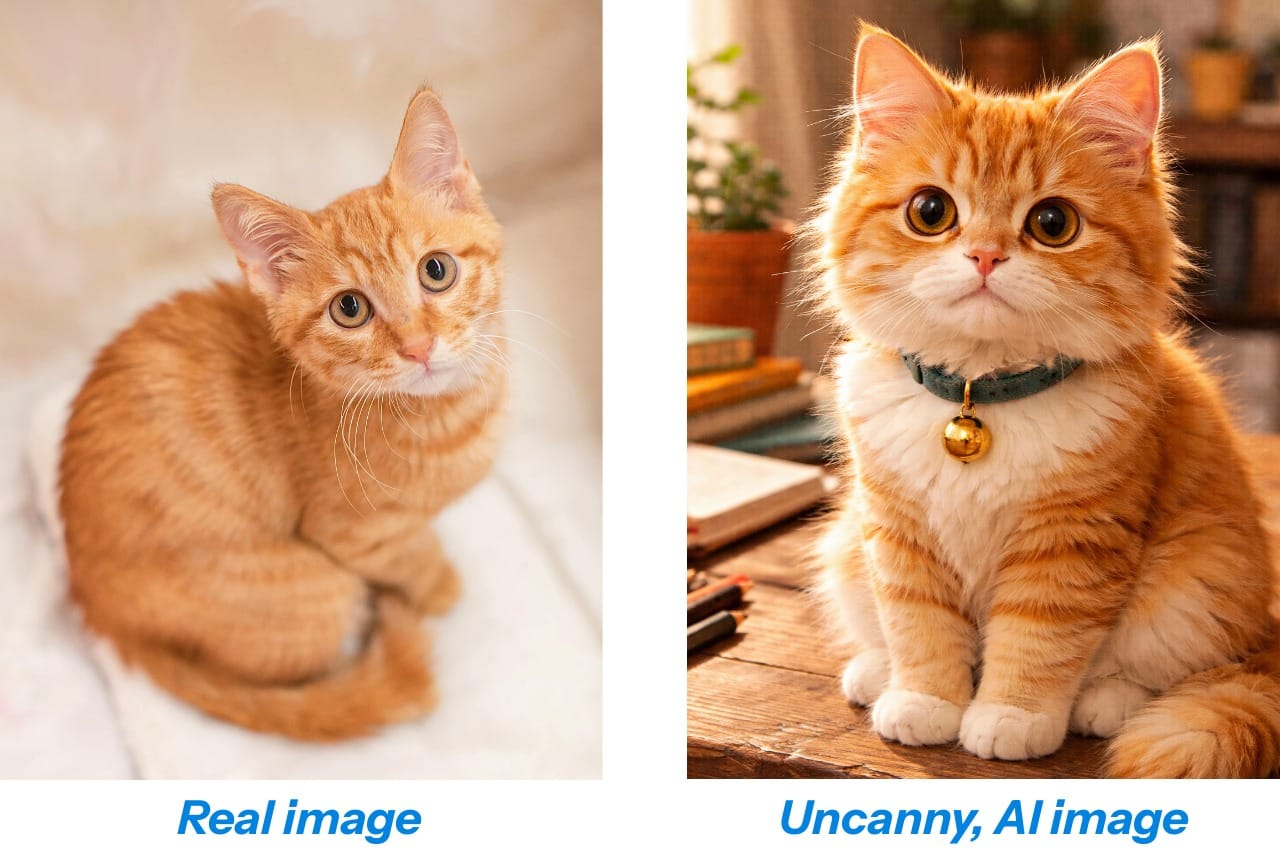
Every animal has a distinct body structure. A model must replicate key anatomical markers to avoid generic or uncanny outputs. Realistic results depend on skeletal proportion, joint placement, and species-aware silhouette.
In the example above, the AI-generated image of a cat lacks realistic facial proportions — the eyes are too large, the muzzle is underdefined, and the symmetry is exaggerated. As a result, the cat appears more like a cartoon or plush toy than a real animal, breaking the sense of realism despite surface-level texture.
3. Behavioral and Contextual Understanding
Animals act with specific behavioral context. Realistic models interpret these actions accurately and adapt them to match the prompt’s style and tone, whether cinematic, comedic, slow-motion, or dramatic.
This also includes camera framing, timing, and atmosphere: details like lighting angle or scene pacing should reinforce the intended emotional or visual effect.
4. Environmental Cohesion and Interaction
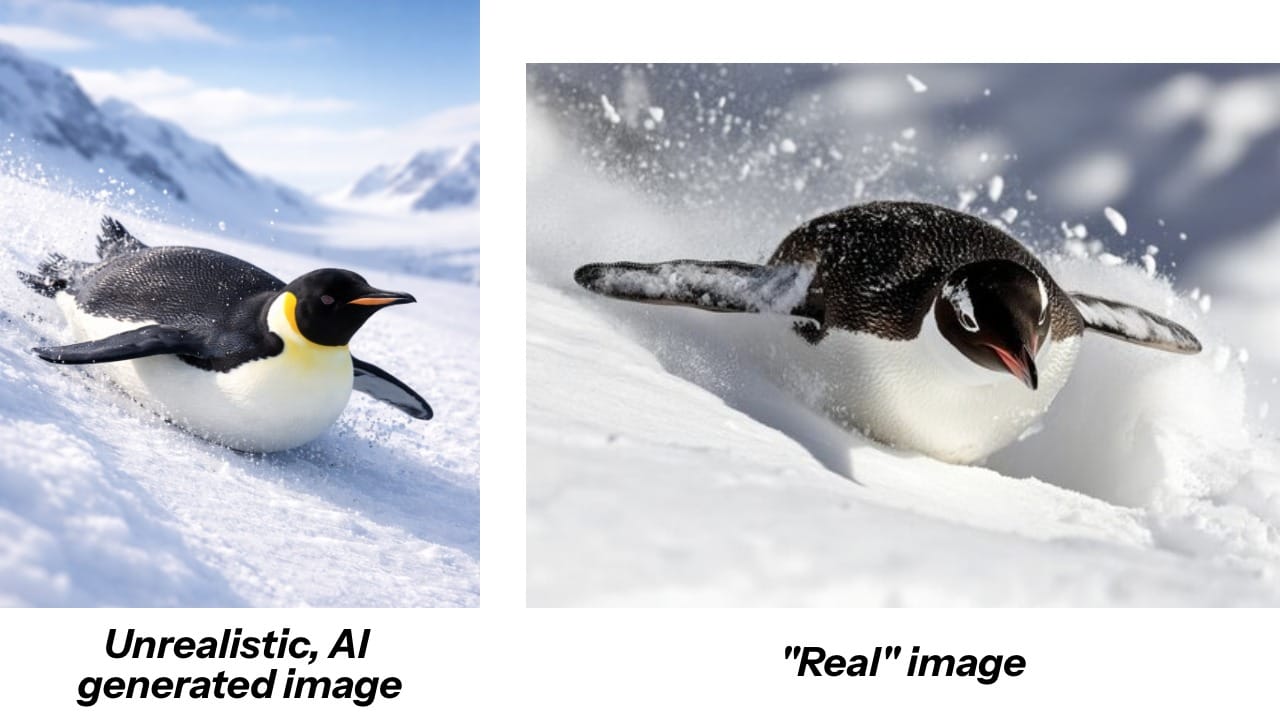
Real animals affect, and are affected by, their surroundings. The best AI models reflect this through realistic shadows, ground contact, reflected light, and physical interaction. The animal should appear as if it truly exists in the scene: grass bends under its feet, snow accumulates on its body, water ripples as it moves.
In the examples below, in the AI-generated image of the penguin, the surface remains largely undisturbed, aside from a few scattered flakes. In contrast, the real image captures a more dynamic interaction: snow is visibly displaced and pushed up around the penguin's body, emphasizing both its weight and momentum.
5. Biologically Believable Movement
Animal motion must reflect correct pacing, timing, and coordination. Viewers expect to see weight transfer, joint articulation, and motion curves that match the animal’s form and size. Even subtle inaccuracies, like unnatural limb stiffness or delayed follow-through, can break the illusion.
AI Models Tested
This experiment evaluated six leading AI video models to determine which tools are best at generating realistic animals across a variety of prompts and settings.
AI Video Models Included:
- Adobe Firefly – Adobe’s video-focused AI tool, built for creative control and scene design
- Kling 2.6 – A video generation model with a focus on motion realism and temporal coherence
- Seedance 2 – Byte Plus' video model, known for dynamic motion
- Sora 2 – The latest iteration of OpenAI’s video model, designed for high-quality scene rendering
- Veo 3 – Google cinematic AI video model, with advanced prompt understanding and visual fidelity
Testing Method
To accurately assess the best AI video models for realistic animals, each tool was tested using five text-to-video prompts. The prompts were written to cover both everyday and cinematic scenarios, with an emphasis on how models handle animal motion and varied environments. These were the prompts used:
- A golden retriever playing with an orange tabby cat in a living room
(tests: multi-animal interaction, domestic realism) - A close-up of a snowy owl turning its head on a pine tree branch in slow motion
(tests: subtle motion, feather detail, slow-motion realism) - A blue whale swimming in the deep ocean, wide-angle shot
(tests: underwater depth, aquatic motion physics, scale rendering) - A tortoise slowly walking across a sunlit garden path
(tests: slow movement accuracy, lighting, criteria, and texture realism) - A dragon flying over mountains during sunset, cinematic lighting
(tests: fantasy realism, winged flight, aerial perspective)
To quantify results, each video output was assessed on four criteria:
- Prompt Adherence
- Did the output match the request in species, action, and environment?
- How were scene elements like lighting and perspective interpreted?
- Animal Visual Realism
- Did the animal’s form and anatomy resemble a real-world counterpart?
- How detailed was the animal? Does it seem realistic?
- Animal Movement Realism
- Did the animals move in a believable, biologically correct way?
- Were gaits, wingbeats, turns, or interactions fluid and natural?
- Environmental Setting Integration
- Was the animal properly lit, shadowed, and scaled to match the scene?
- Did the background respond appropriately to movement (e.g., water ripples, lighting shifts)?
Results
Adobe Firefly
Adobe Firefly video generation results with the prompt "A golden retriever playing with an orange tabby cat in a living room"
Adobe Firefly
Adobe Firefly video generation results with the prompt "A close up of a snowy owl turning its head on a pine tree branch in slow motion"
Adobe Firefly
Adobe Firefly video generation results with the prompt "A blue whale swimming in the deep ocean, wide-angle shot"
Adobe Firefly
Adobe Firefly video generation results with the prompt "A tortoise slowly walking across a sunlit garden path"
Adobe Firefly
Adobe Firefly video generation results with the prompt "A dragon flying over mountains during sunset, cinematic lighting"
Top AI Video Models for Realistic Animal Generation
| Model | Prompt Adherence | Animal Realism | Movement | Environment | Total Score (20) |
|---|---|---|---|---|---|
| Kling 2.6 |
5
Faithfully executes modifiers like "slow motion" and "cinematic" across all prompts
|
5
Most convincing creature fidelity with excellent anatomy, texture, and shading
|
5
Best in test - natural weight shifts, realistic pacing and joint behavior
|
5
Clean, logical environments with almost no hallucinations
|
20 |
| Seedance 2 |
4
Good understanding of scene setup and modifiers
|
3
Owl was realistic, but others lacked convincing anatomical detail
|
4
Generally smooth movement, though tortoise had slightly strange walking rhythm
|
3
No major hallucinations, but overall feel was artificial or under-textured
|
14 |
| Sora 2 |
5
Very responsive to nuanced language and modifiers, handles tone variation well
|
3
Strong with cats, dogs, whales; tortoise and dragon less believable
|
2
Hit or miss - dragon and tortoise lacked realistic movement physics
|
3
Good composition but inconsistencies in fine details like snow or grass
|
13 |
| Veo 3 |
4
Generally good but slightly loose with interactions (e.g., abstract "play")
|
4
Strong single-animal shots, multi-animal scenes had some hallucinations
|
2
Noticeable issues in pet interactions with unrealistic, glitchy animations
|
3
Strong scene construction creates grounded, cinematic feel despite some distortion
|
13 |
| Adobe Firefly |
2
Attempts to follow lighting/scene direction, but execution quality is low
|
1
Weakest of all tested - cats/dogs look clearly artificial, even owl is flawed
|
1
Poor - dragon doesn't move, tortoise has highly unnatural motion
|
2
Some hallucinations, flat lighting, and textures that feel AI-generated
|
6 |
Kling 2.6
- Prompt Adherence: Strong across all prompts — modifiers like “slow motion” and “cinematic” are faithfully executed.
- Animal Realism: Excellent anatomy, texture, and shading. The most convincing outputs in terms of creature fidelity.
- Movement: Best in test. Natural weight shifts, pacing, and joint behavior — especially for slower animals like the tortoise.
- Environment: Clean, logical, and realistic, with almost no hallucinations.
Sora 2
- Prompt Adherence: Very responsive to language-based prompts, including nuanced modifiers. The only model that handles humor or tone variation.
- Animal Realism: Strong with cats, dogs, and whales. Tortoise and dragon are less believable. Owl looks decent until zoomed in.
- Movement: Hit or miss — dragon and tortoise lacked realistic movement physics.
- Environment: Good composition and integration, but some inconsistencies in fine detail (e.g., falling snow speed, moving grass).
Veo 3
- Prompt Adherence: Generally good, but slightly looser in interpreting interactions (e.g., dog + cat “play” felt abstract).
- Animal Realism: Strong single-animal shots, but multi-animal hallucinations hurt realism.
- Movement: Noticeable issues in pet interactions — unrealistic, glitchy animations.
- Environment: Scene construction is strong; even with some distortion, it creates a grounded and cinematic feel.
Seedance
- Prompt Adherence: Good understanding of scene setup and modifiers.
- Animal Realism: Owl stood out as realistic; others lacked convincing anatomical detail.
- Movement: Generally smooth — tortoise was the only exception, with a slightly strange walking rhythm.
- Environment: No glaring hallucinations, but the overall feel was still artificial or under-textured.
Adobe Firefly
- Prompt Adherence: Partial. It does attempt to follow lighting or scene direction, but execution quality is low.
- Animal Realism: Weakest of all tested models — cats and dogs look clearly artificial; owl is the most convincing, but still flawed.
- Movement: Poor. Dragon doesn’t move, and the tortoise has highly unnatural motion.
- Environment: Average — some scene hallucinations, flat lighting, and textures that feel “AI-generated.”
Final Verdict: Which AI Video Model Is Best For Realistic Animals?
After testing across a range of prompts, motion types, species, and environments, Kling stands out as the most capable AI video model for generating realistic animals. It consistently delivered outputs with high anatomical accuracy, nuanced motion physics, and strong visual cohesion, especially in scenes requiring grounded weight, complex gait, or multi-layer environmental interaction. Where other models showed breakdowns in fur detail, eye placement, or behavioral logic, Kling maintained fidelity even in close-ups and slow-motion playback.
Kling’s biggest advantage lies in its ability to simulate biological motion. In our tests, it was the only model that could accurately reflect how different animals distribute weight, initiate movement, and maintain realistic pacing over time. Its environmental integration was also best-in-class.
These strengths make Kling uniquely well-suited for creators working in wildlife simulation, cinematic storytelling, educational content, or fantasy worldbuilding, where believability and immersion are non-negotiable. While other models like Sora 2 excel in stylistic or expressive outputs, and Veo 3 shines in lighting and composition, Kling is the model that gets the science and physics of animals right.
For creators looking to access Kling without a complex setup, Kapwing's AI assistant offers direct integration. This means you can generate photorealistic animal video using Kling’s capabilities through a simple, browser-based workflow — with support for both text-to-video and image-to-video inputs.