Virtual Influencers: The Most Followed and Top-Earning AI Celebrities
Synthetic characters are promoting everything from high street retail to Hollywood movies on their timelines. But which ones demand the highest fees from sponsors?
The era of the virtual influencer is upon us.
Computer-generated and AI-powered Instagram celebrities are earning millions of dollars while changing the way consumers think about culture and commerce. And behind every virtual influencer is an artist or team embracing this inspiring creative opportunity at the convergence of art and technology.
If you get the design right, your virtual influencer can be just as effective as a living celebrity. A virtual influencer is untiring, amoral, highly portable, and never aging. And, of course, your virtual influencer is bound by neither the laws of physics nor human form — we found that the second-highest-paid influencer is… a virtual sausage.
To survey the success and the potential of virtual influencers, Kapwing analyzed the follower counts and potential ad rates of the top social media stars of today and calculated which ones are earning the most money.
What We Did
We compiled a list of virtual influencers using the VirtualHumans.org website’s directory. Then, we used the average cost per follower that real-life influencers charge for sponsored posts (using Hopper HQ's Instagram Rich List) and multiplied this by each virtual influencer's follower count to calculate an estimated charge per sponsored post. Finally, we multiplied the estimated cost per sponsored post for each influencer by the number of sponsored posts they made in the past 12 months to calculate their estimated Instagram earnings.
Key Findings
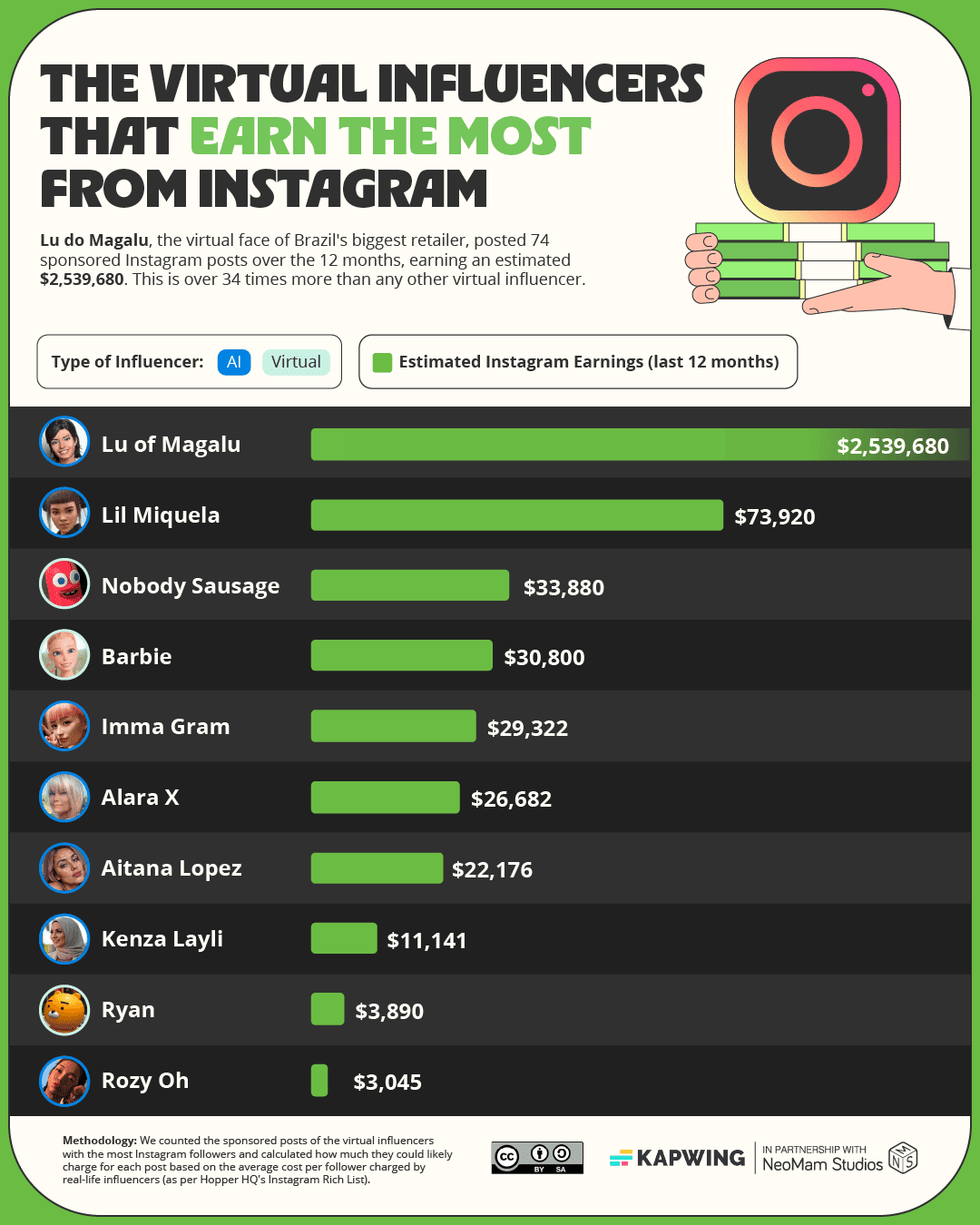
- Brazilian supermarket mascot Lu of Magalu is the highest-paid virtual influencer, earning an estimated $2,539,680 last year.
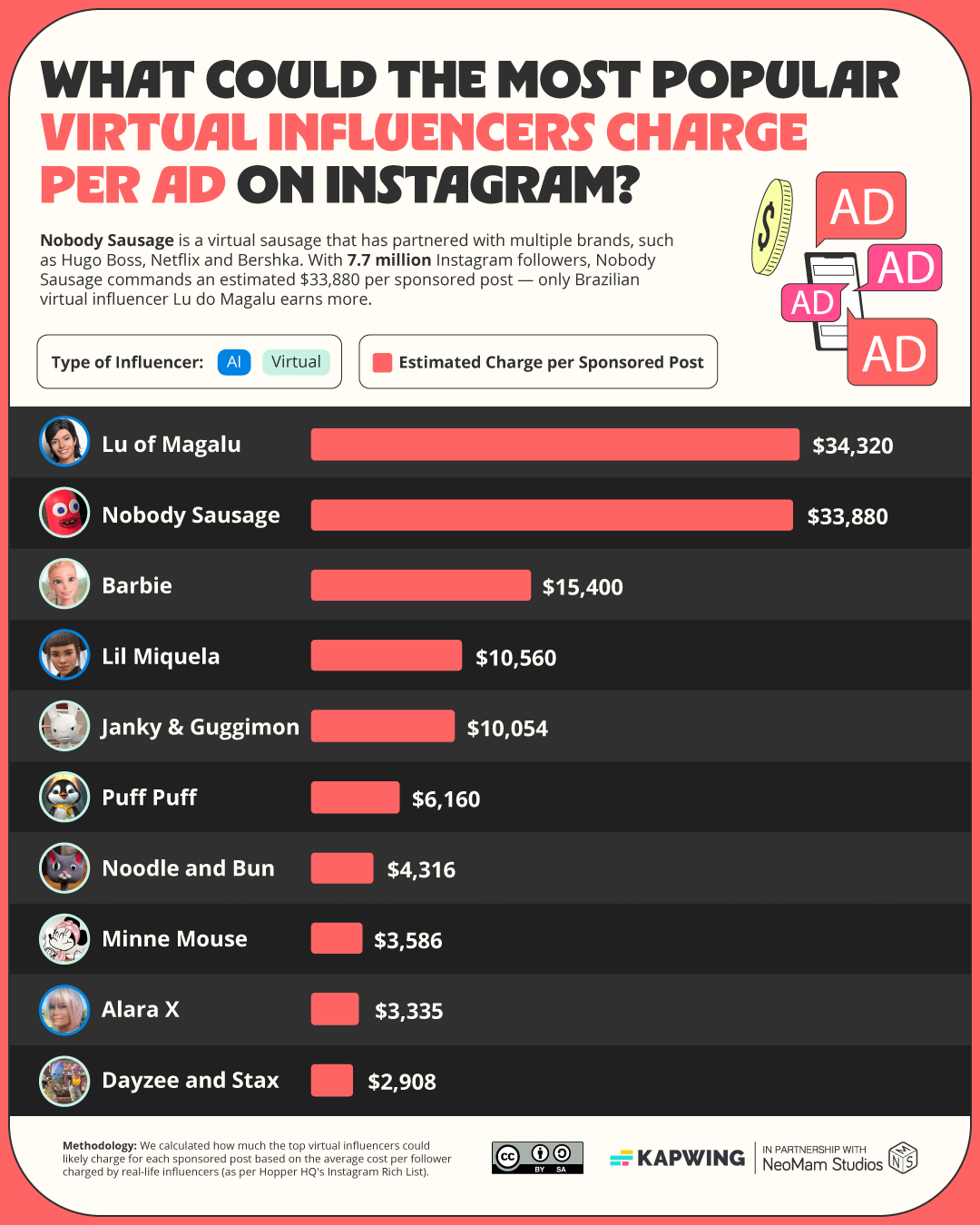
- Barbie has 3.5 million Instagram followers and earns an estimated $15,400 per sponsored post.
- The biggest AI influencer on TikTok is Nobody Sausage, with 22.1 million followers.
Top-paid Virtual Influencer Lu of Magalu Shows How It’s Done
First, we used the cost-per-post of top human influencers to figure out how much Instagram’s leading virtual influencers might charge, given their follower count. We found that two virtual influencers, Lu of Magalu ($34,320 per post) and Nobody Sausage ($33,880), are way ahead of the pack, thanks to their Instagram reach. Lu of Magalu has 7.8 million followers, and for Nobody Sausage, it’s 7.7 million.
Lu of Magalu is a veteran by virtual influencer standards and a textbook example from which creators might learn. Lu emerged in 2003 as the online voice of Brazilian retailer Magalu and gained a visual presence via YouTube in 2009, delivering unboxing videos and reviews.
A partnership with celebrated PR agency Ogilvy in 2022 has propelled Lu to next-level stardom, and when she appeared in a music video with human pop star Anitta, every outfit worn onscreen sold out on Magula’s app. The supermarket mascot has become so influential in Brazil that third-party brands have paid to attach her to their campaigns.
Driven by a team of 3D artists, programmers and marketers, Lu of Magalu has posted 74 sponsored posts over the past 12 months, earning an estimated $2,539,680. This is more than four times as many sponsored posts as any other virtual influencer among the top ten earners we identified (below). And since Lu has such a high potential fee per ad, her total earnings are 34 times as high as the second-highest earner, Lil Miquela ($73,920).
“It’s no use just having a virtual doll. You need to have a heart and a brain,” says Pedro Alvim, Magalu’s senior content and social media manager. “Lu’s virtual influence began with her humanization. Behind every image of her, there is a story that builds the story of the character herself. For example, she travels internationally, but she doesn’t just show up in another country and take a photo at the airport before the trip. She also makes her own smoothies and takes a dip in the pool.”
However, it cuts both ways. Lu’s realistic portrayal has also attracted harassment on her social media profiles and in her incarnation as a Magalu’s virtual assistant, where she was re-programmed to respond more forcefully to such abuse.
Barbie and Janky & Guggimon Among Most Followed Virtual Influencers
While Lu of Magalu is way ahead in earnings, five virtual influencers join her in the seven-figure follower count club — including Barbie, who has 3.5 million Instagram followers. However, Barbie rarely makes a sponsored ad, with her posts instead optimized to broaden the sales and soft influence of the eponymous brand.
Although Barbie has been around since 1959, her virtual presence stretches back over a similar period to Lu’s, beginning with video game appearances and moving onto vlogs on YouTube. Today, kids can have a conversation with Barbie on Alexa. While her Vlogs are digitally animated, Barbie’s Instagram reels are filmed with real dolls and often in real locations. Virtual Barbie is managed by a large creative team with roles ranging from wardrobe stylist to stop frame animator — a job which Vanity Fair notes is essentially “playing house with Barbie at the highest level.”
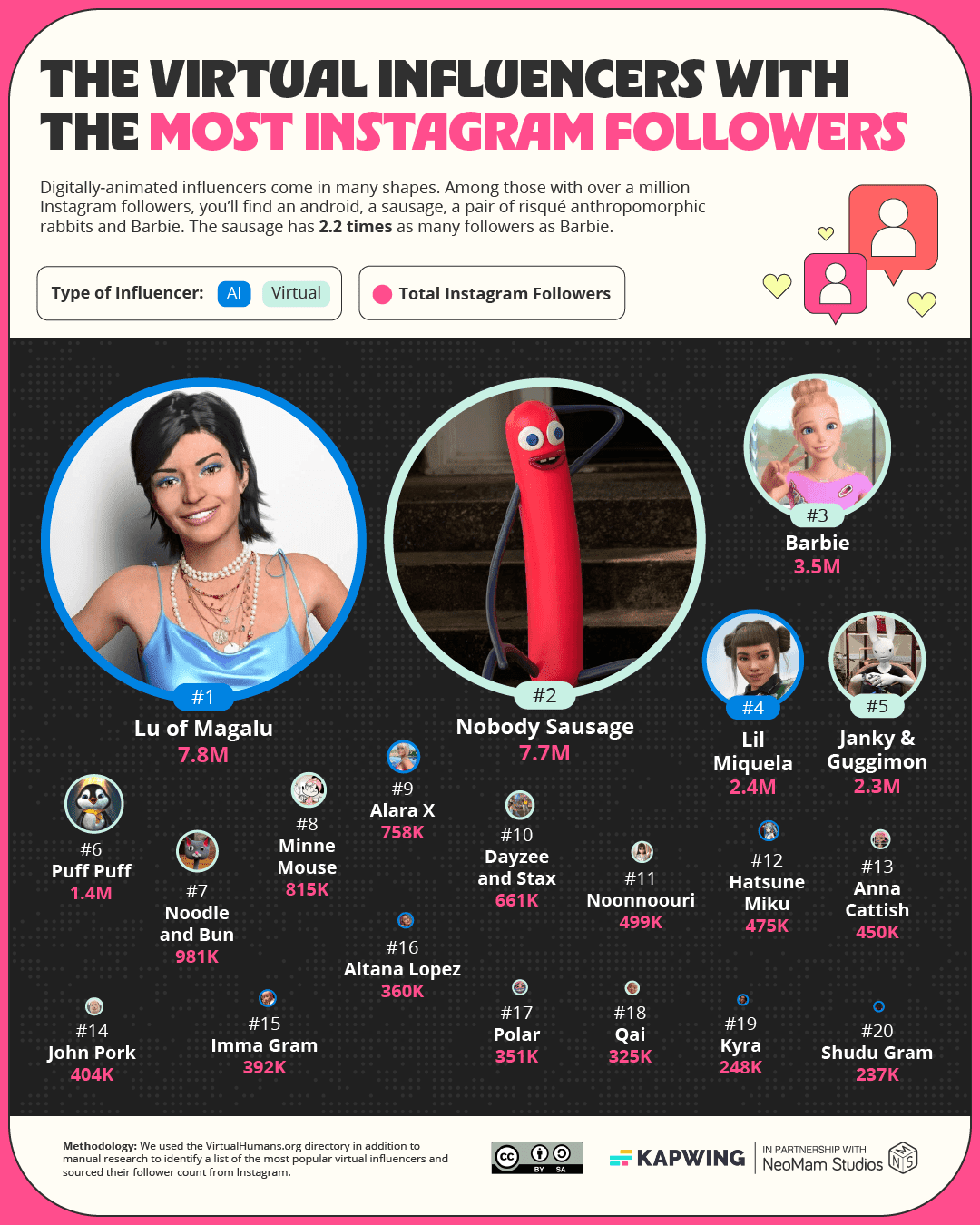
Occupying a space somewhere beyond the photorealism of Lu and the fantastic plastic of Barbie are the animated anthropomorphic toys Janky & Guggimon, with 2.285 million Instagram followers. These “synthetic superstars” are highly stylized cat and rabbit creatures who built a quick following on Instagram and TikTok before appearing in Fortnite and inking a deal for an Amazon Prime Video original series.
“I don’t know what isn’t virtual nowadays,” says the character’s boss, Superplastic founder Paul Budnitz. “I’ve met a bunch of celebrities, and most of them aren’t any more real than Guggimon is. So from my perspective, he’s the next obvious evolution of media — only way more fun, because he can do shit a human can’t even think of.”
Nobody Sausage is Virtual King of TikTok
Finally, we looked at the TikTok following of top virtual influencers and found that the balance of influence is somewhat different from Instagram. Here, Janky & Guggimon command 11.6 million followers, which is 56.8% more than Lu of Magalu (7.4 million) and more than four times the followership of Barbie (2.2 million).
The speed and edginess of TikTok may be a more natural home for Janky & Guggimon: “Our goal is to disrupt or break the feed,” says Superplastic’s chief creative officer Galen McKamy. “We always try and have something really loud and over the top happen right away. That all happens under a few seconds.”
The team of four writers also responds to TikTok’s trends: “I think the biggest thing for me with using trends is really how do you express the trends through our characters?” continues McKamy. “How does Janky perceive this TikTok sound or how does Guggimon perceive this TikTok action?”
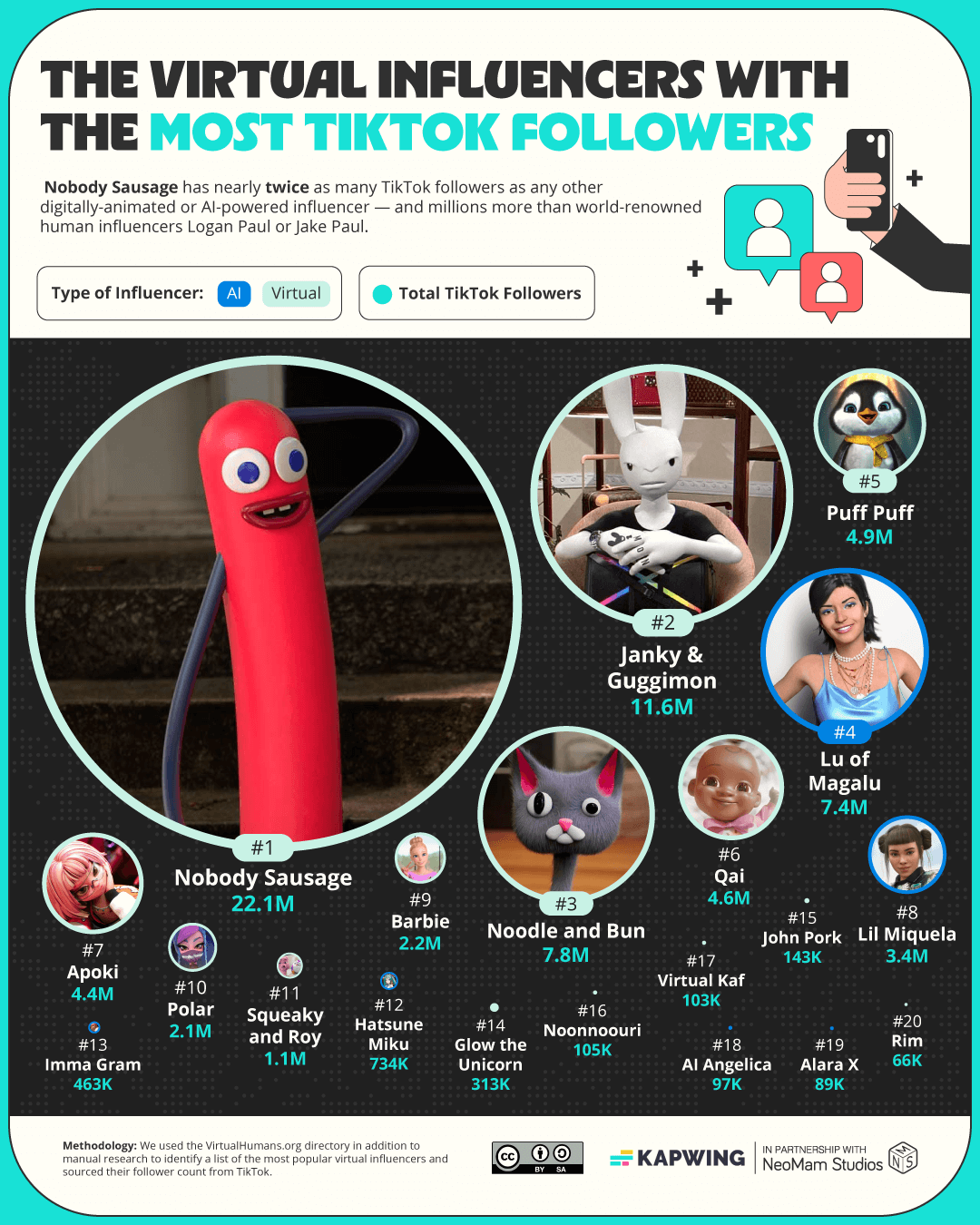
However, TikTok’s biggest virtual influencer is Nobody Sausage, with 22.1 million followers. The animated sausage (and his friends) is also the third-highest earner on Instagram, commanding an estimated $33,880 to post an ad to 7.7 million followers, though the brand only delivered one Instagram ad over the past 12 months.
Nobody Sausage is an independent project but has partnered with leading brands over the years, including when the team recreated the trailer of the Netflix movie Red Notice in 2021, getting more views than the real trailer.
Virtual Influencers vs. Human Celebrities
The ROI on engineering a virtual influencer is still up for debate. While you can design, manipulate, and narrativize a virtual influencer in precise detail, these strengths must make up for the lack of human charisma you get with a flesh-and-blood superstar.
“An avatar is basically a mannequin in a shop window,” says Goat Agency co-founder Nick Cooke. “A genuine influencer can offer peer-to-peer recommendations.” Likewise, an academic study found that “Virtual influencers’ messages are more useful, especially for utilitarian products [but] Consumer-influencer identification is greater when the influencer is human,” — making human influencers more effective when selling products connected to pleasure.
However, as the widespread appeal of Barbie and Janky & Guggimon demonstrates, the landscape between virtual characters and real-life pleasure is possible to conquer with imagination and skill. As AI influencers become more common, their creators will need to fine-tune their strategy, improving their storytelling and use of technology to stand out.
Methodology & Sources
To start, we built a seed list using the VirtualHumans.org website, a comprehensive directory of past and present virtual influencers.
We further defined some virtual influencers as AI influencers based on their regular use of AI in character art/animations.
To calculate the estimated amount each virtual influencer could charge per sponsored post, we used the average cost per follower that real-life influencers charge per sponsored post (using Hopper HQ's Instagram Rich List) and multiplied this value by each influencer's follower count.
We then manually analyzed every post each virtual influencer had published in the last 12 months to isolate the sponsored posts. We defined sponsored posts as those that were clearly part of a paid partnership (either clearly hashtagged or not) and not those that were promoting the influencer's own products.
Multiplying the estimated cost per sponsored post by the recorded number of sponsored posts allowed us to calculate the estimated Instagram earnings (in the last 12 months) for each influencer.
The data is correct as of May 2025.