
Apple's Inadequate Response to App Store Trademark Fraud
Apple is failing to protect customers from brand impersonation, a growing attack vector in 2026 and the age of AI. Here's our experience with app copycats and the impact on consumers.
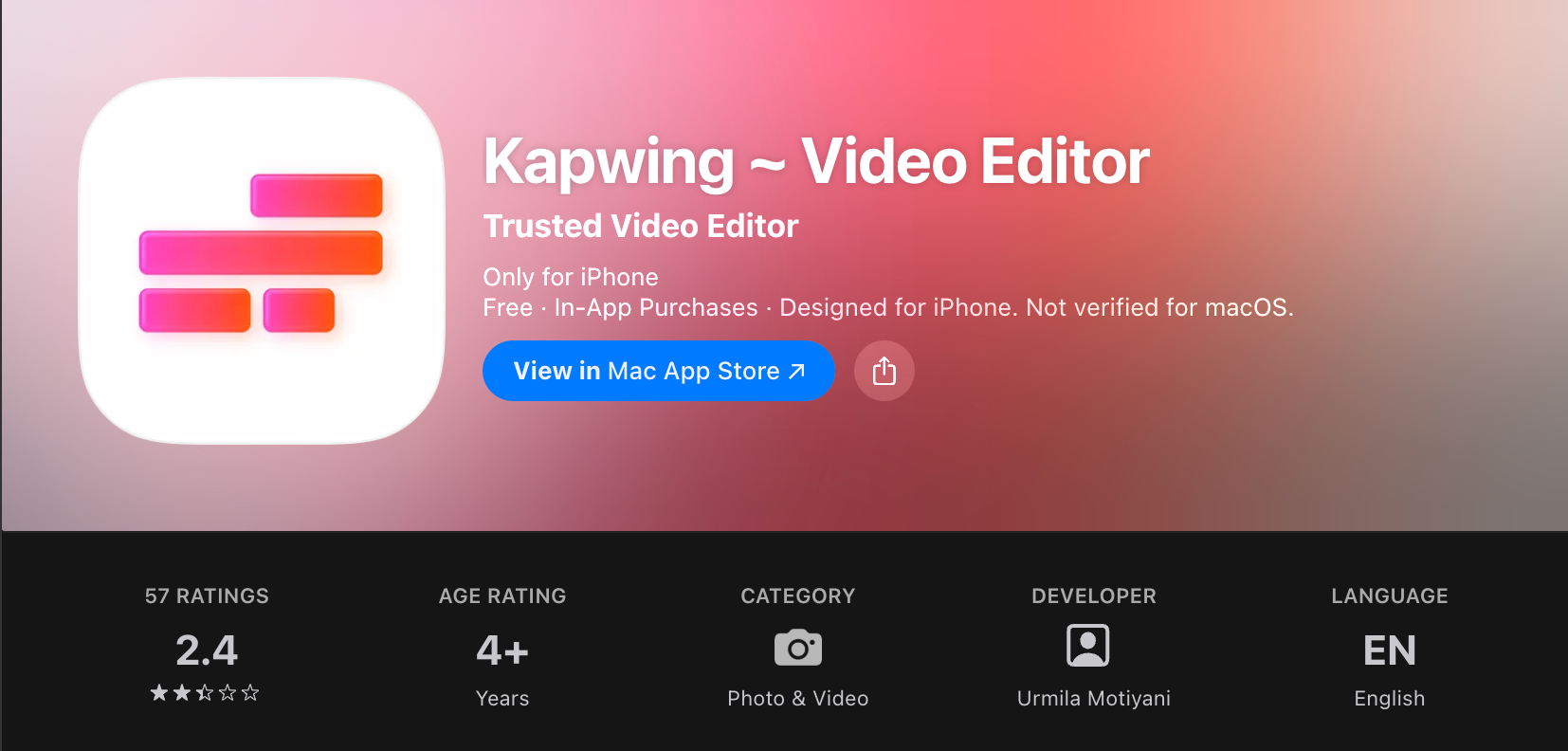
In the last nine months, my company's brand has been the subject of impersonation attacks. Several unknown developers have published apps in the App Store using our trademarked brand name and logo. We frequently get emails from consumers who have been scammed out of subscription revenue for a barely-functional copycat:
Hi, I purchased Kapwing Pro via the iOS app, but I’d like to use my Pro plan on Kapwing.com as well. Could you please link my Pro purchase to my email? - Fraud victim, Oct 16, 2025
Yet despite nearly daily emails to the developer involved and Apple's content moderation team, Apple has not taken action to remove these impersonating app from the App Store. They still show up in the App Store and on Search if you search for our brand name.
This attack cost consumers thousands of dollars and tarnished our reputation. In the era of AI, more and more businesses are suffering from brand impersonation tactics. In this article, I call on Apple to strengthen their policies and content moderation technologies to remove brand copycats from the iOS App Store.
Reporting Trademark Infringement: Why are there so many fake apps with our brand name?
Our support team noticed some doppelgänger apps when people started writing emails to our support team about the Kapwing iOS app subscription they had purchased. Since we don't have an iOS app – Kapwing works on mobile and desktop web – our support agents searched for and found the fake app, listed by an unknown developer, in the App Store.
Kapwing, Inc. has a registered trademark on the mark "Kapwing" and the logo in the context of video editing and video generation, so it is illegal for another developer to sell video editing services under this name or logo.
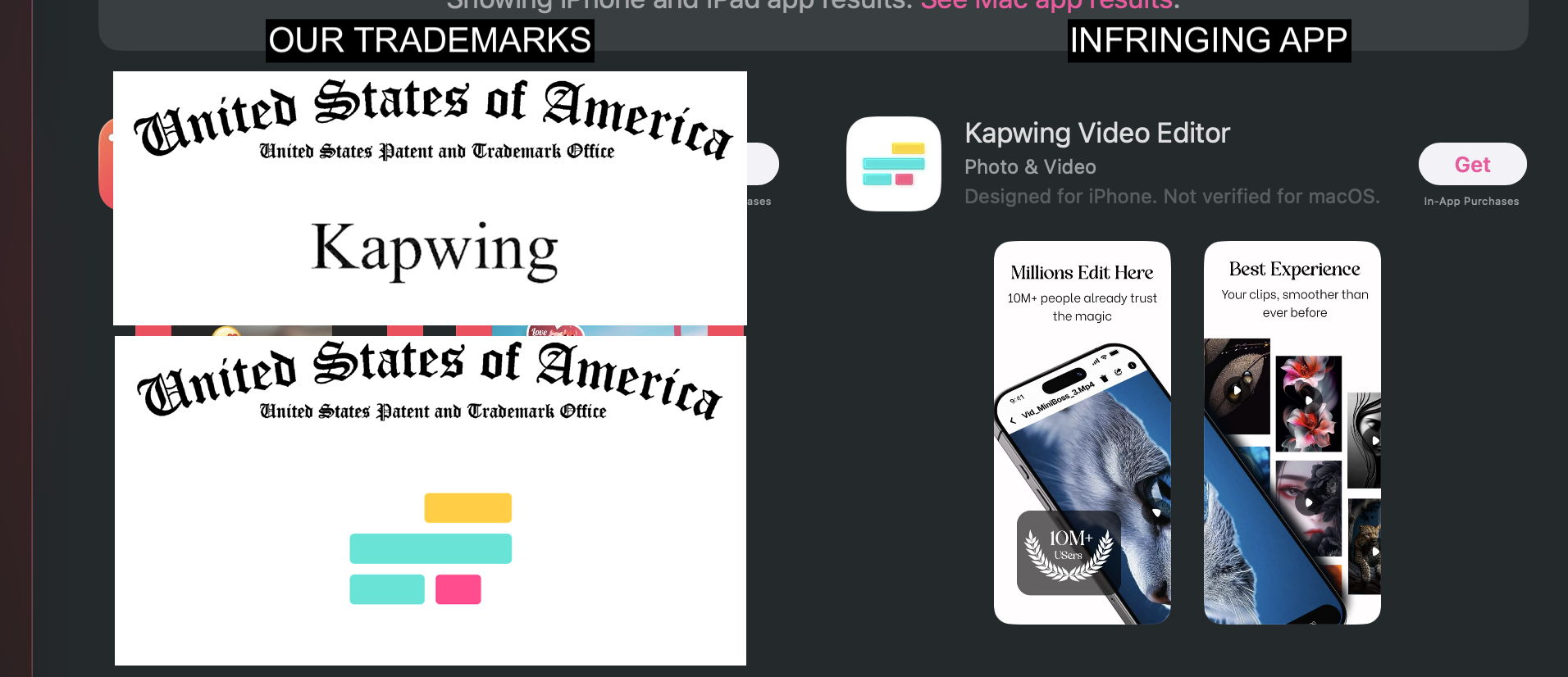
For this fraudulent app and others, employees on our team have filed dozens of takedown requests with Apple. The complaints include Kapwing's trademark registration details, evidence of infringement from the listing, and user confusion evidence. Each time, Apple has responded in the same way: with an email notifying the developer of our claim, with us cc'ed, asking us to resolve the issue. See next section...
I'm surprised that we even need to file these takedown requests, given that a cursory logo and name search, crosschecked with the developer name, would reveal the impersonation. Kapwing, Inc. has an active Apple Developer account, so Apple knows us, the developers who own the corporation and brand domain "Kapwing.com."
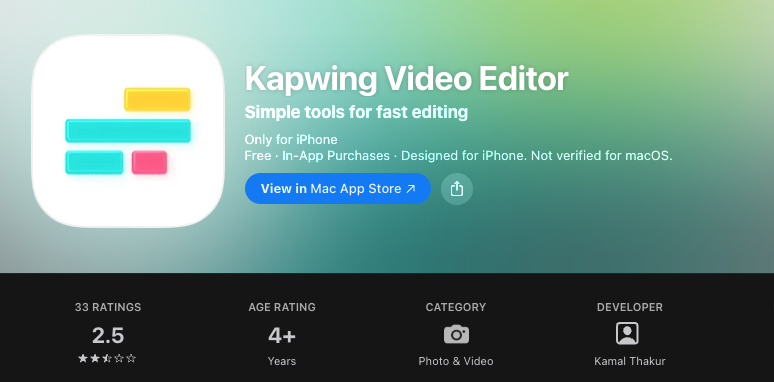
These impersonations pop up in the app store so frequently (~6-9 times annually) that we have internal documentation about how to file takedown requests.
Apple's Insufficient Response to Trademark Infringement
Since researching Apple's takedown processes, I have learned that "asking nicely" is Apple's go-to policy when it comes to handling trademark impersonation in the App Store. They include us and a developer on the email thread, where we've included all of the details about our active trademark registration, ending with this:
We look forward to receiving written assurance that your application does not infringe Claimant's rights, or that the parties are taking steps to promptly resolve the matter. Please keep us apprised of your progress.
In other words, Apple's moderators ask a fraudulent developer to provide "written assurance" that they're not infringing on an active trademark and to "keep us apprised."
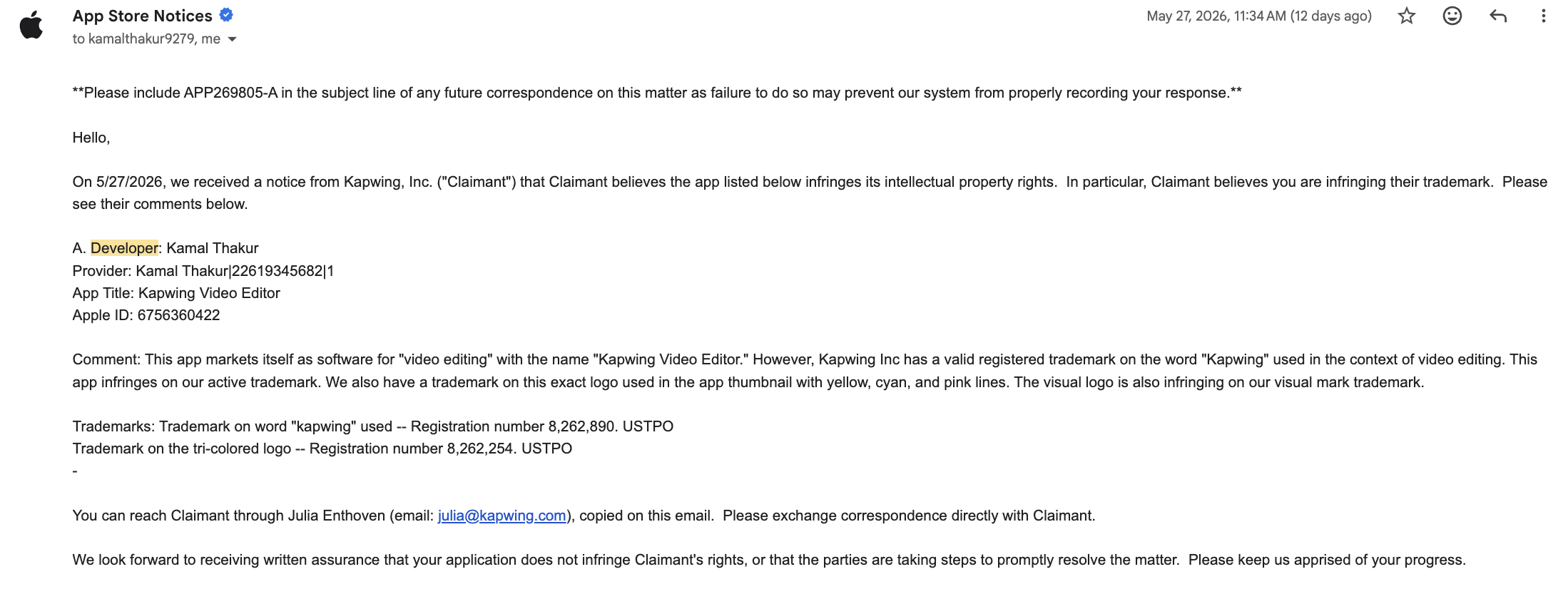
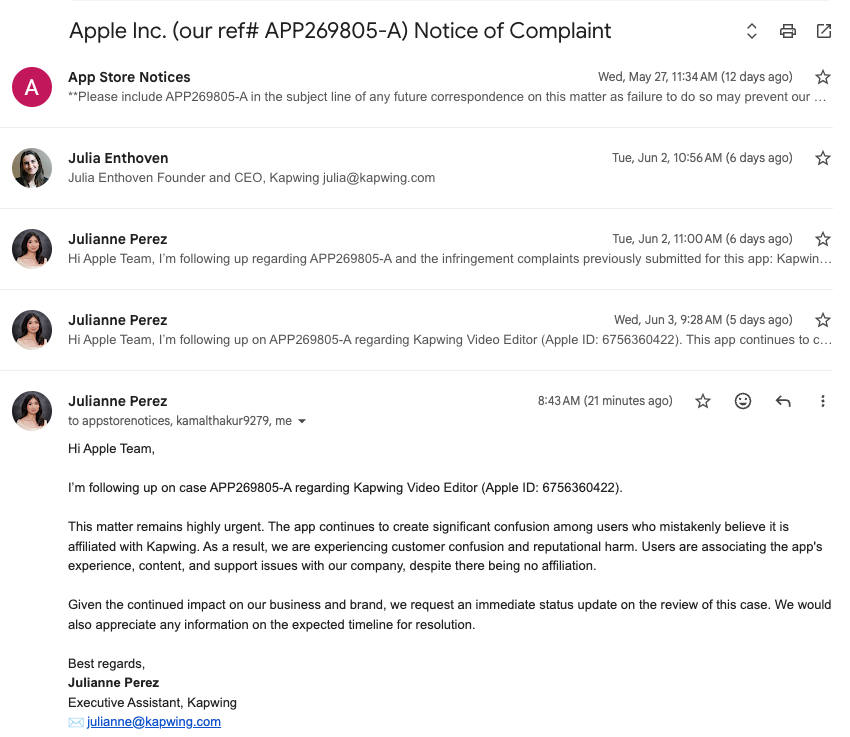
We follow up on these emails threads every day or every other day. Yet Apple never responds or takes action.
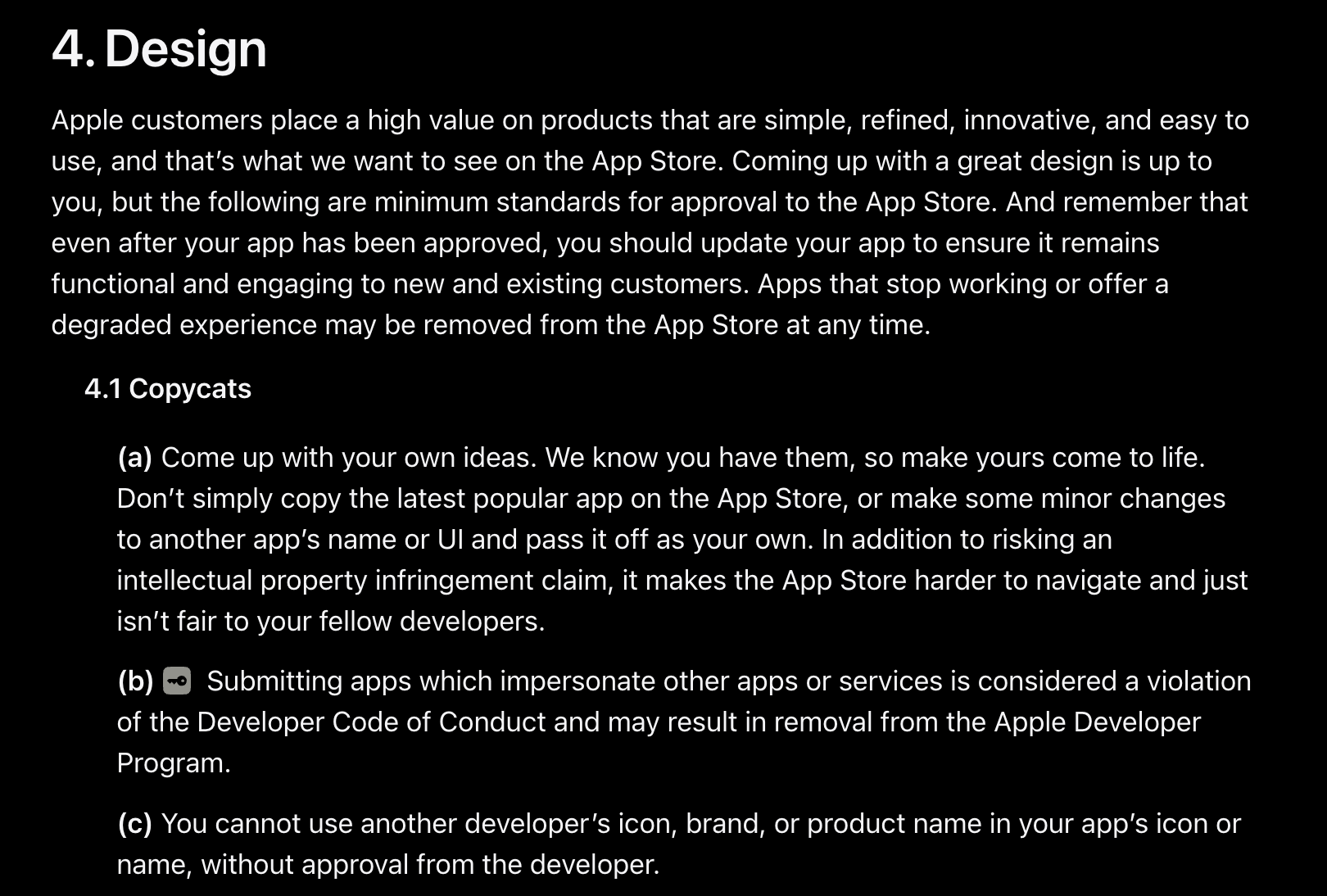
This is their official policy. For App Store Trademark infringement cases, Apple says "in most cases, we will contact the provider of the disputed app(s) regarding your claim and ask that they work with you directly to resolve the issue." In other words, Apple relies on bad actors to take down and change app listings through good will.
Apple’s EU DSA transparency report from February 2025 said that they only "took action" on 16% of takedown notices, although most of the notices in the report allege violations of intellectual property rights.
Even if the developer decides to take down or rename the app, the app is still listed in Google Search. Apple should de-index apps which are found to violate its policies.
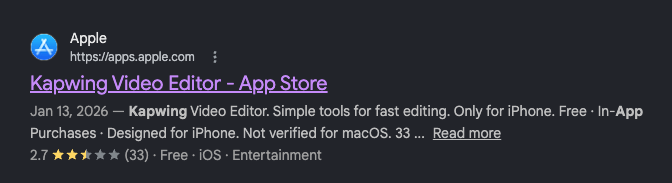
For a brand notorious for taking action against its brand copycats, this passivity is stunning.
Failing to Block Repeat Offenders
Once, the same developer published two different video editing apps with the name "Kapwing" in the title a few months apart. When we initially filed the complaint in October 2025 against the first copycat, the developer mostly ignored our notices and the emails from Apple. Finally, 3 months after our first complaint, the developer took down the app.
However, I was horrified to find that the same developer published a new copycat in the beginning of May 2026, less than 5 months after they'd taken down the first one. It took 20 days before the developer conceded and removed the second app from all territories.
Apple should have systems to detect repeat offenses by app developers who infringe on a valid trademark, especially if they do it twice for the same brand.
Google Play Addresses Copycats Immediately
In contrast, Google has responded immediately to our requests when we have seen infringing Android apps in Google Play. They respond with same-day emails informing us that the scamming apps have been removed. The corresponding pages are also un-listed from Google Search, so that customers looking up our brand do not get confused.
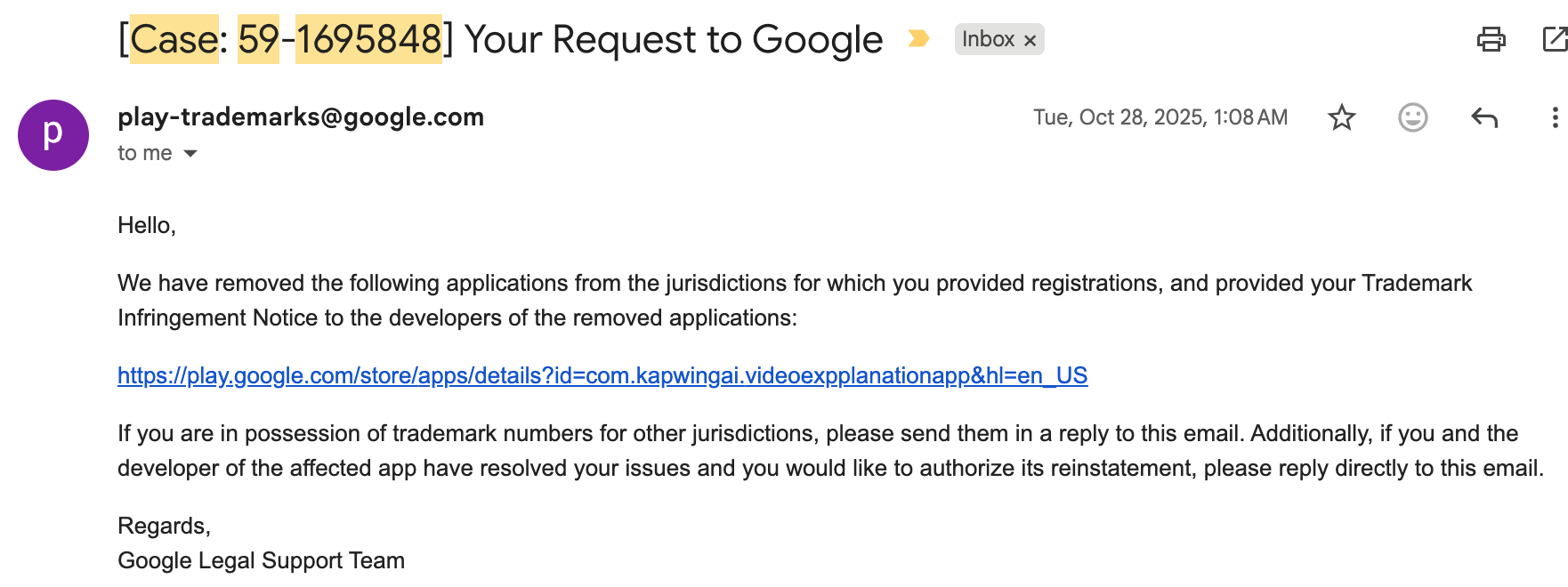
In addition to faster retroactive action, Google seems to be more proactive as there are fewer fake apps that get listed. At the time of writing, there are 2 fake "video editor" apps with our brand in the App store and 0 on Google Play.
In its November 2025 fraud-and-scams advisory, Google said threat actors were creating malicious apps that impersonated popular AI services. They noted that its fraud-protection pilots shielded 10 million devices from 36 million risky installation attempts involving more than 200,000 unique apps.
Apple Needs to Take Action Against the Rising Tide of Brand Impersonation
As app creation, re-skinning, and launch workflows get cheaper and faster, trademark and brand-impersonation abuse is becoming easier to execute and harder for startups to police. Bad actors can combine copycat apps with fake websites, social accounts, ads, and payment flows, fooling customers into a paid subscription.
In the last two years, many consumers have been victims of fake apps which leech subscription revenue off of legitimate brands. Businesses have published blog posts warning customers not to download copycat apps called "LastPass" and "Open AI"
In October 2025, Apple approved over a dozen apps called "Sora" that launched the same day as OpenAI's official Sora launch, as reported by TechCrunch. These impersonating apps earned more than $160,000 despite listing in clear violation of Apple's policies.
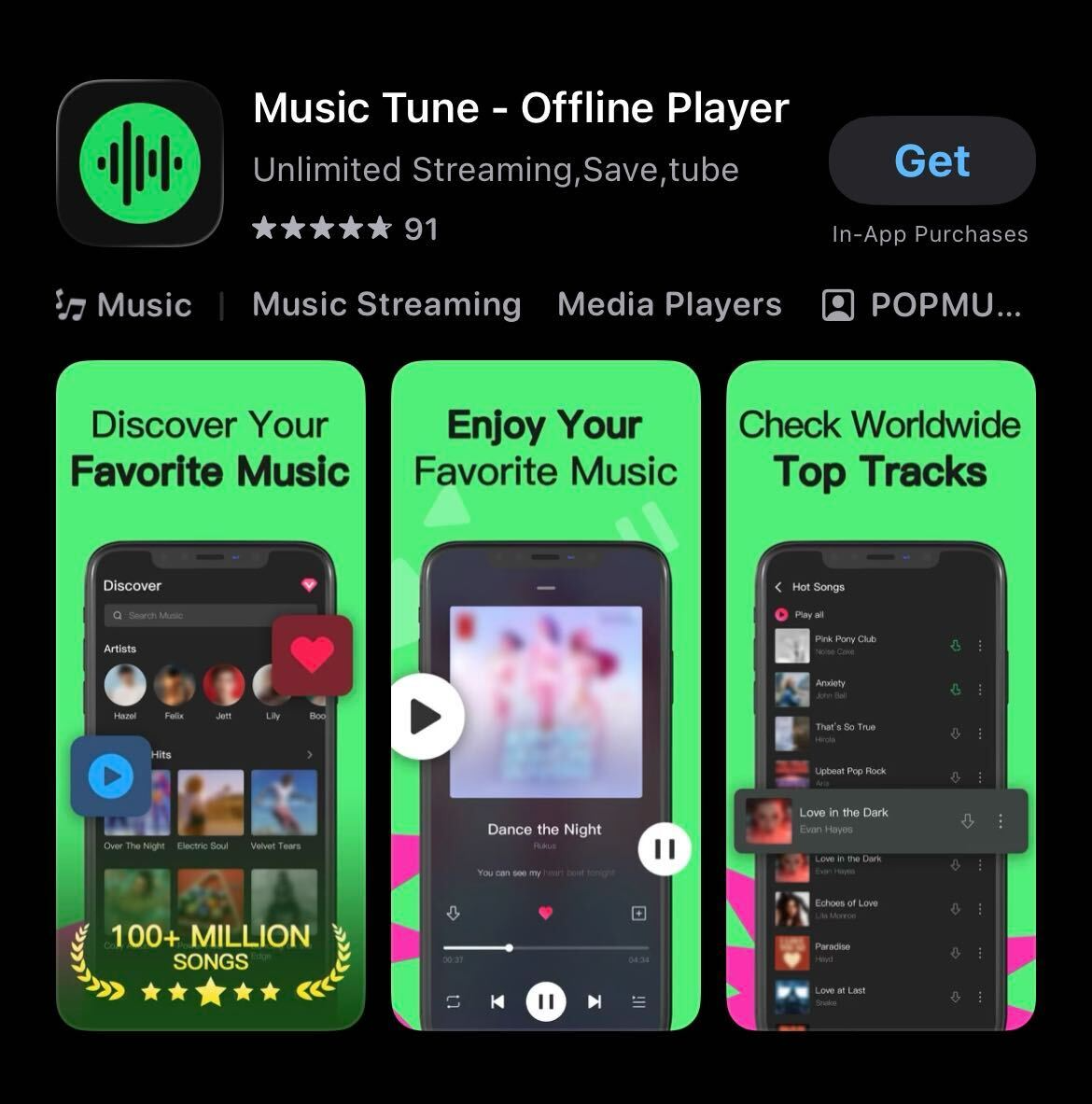
I am calling on Apple to develop better takedown processes and automated detection systems to remove trademark impersonators from the App Store ASAP. This policy should include:
- Automatic detection and training for content moderators on trademark infringement and brand impersonation
- Faster response and takedown policies for infringing apps. Take more action against bad actors.
- Deterrence systems to ban bad actors from their stores or add penalties on developers who are issued takedown requests found to be valid.
How to Report Trademark Infringement to Take Down Copy Cats: A Guide for Startups
Is there an app impersonating your brand in the app store? Here's how to request takedown from trademark infringing apps on various surfaces:
- On Google Play: If you find an infringing app on the play store, navigate to Google's Legal Takedown link and click “Create a request." Once you have created a new request, you will have to choose a Google product. Select “Google Play: Apps.” Google has a few different options for Legal Removal Requests - the “Copyright Infringement” report was handled the quickest. For this form, you will need to include the Google Play link to the fake app and your valid Trademark registration number.
- On Apple's App Store: Apple has a process for reporting Copyright and Trademark infringement. Claims can be filed against entities in the App Store, iTunes, and Apple Books. To report an infringing app, fill out Apple's Legal Dispute form. In the complaint, include information about what exactly infringes in the app that you’re requesting takedown from. You can provide additional specific information that shows the developer has violated apple’s rules against impersonation. Apple will create an email thread between you and the developer urging them to change or takedown their app.
- From the open web: What if you're an app developer who notices a website out there, you need to file a legal takedown request to take action against these websites. We have not yet done this, so I cannot provide first-hand guidance.
The Impact of Brand Impersonation in the AI Age
It used to be that the barriers to entry for making an app – coming up with a professional logo, privacy policy, description, and app screenshots – was enough of a barrier to keep fraudulent developers from publishing impersonation apps for a short-lived profit. It wasn't worth it to go through the trouble of making the app just to cash in before receiving a takedown request from the brand or facing legal action. Also, it was harder to produce something high quality enough that consumers would actually fall for it.
With generative AI, it's a different story. The business of putting up impersonation apps is thriving, and it's gotten a lot easier to pretend to be someone you're not.
Beyond business cost of brand impersonation and legal fees associated with takedown, this issue is hitting consumers hard. The Identity Theft Resource Center reported that impersonation scams grew 148% year over year, becoming the top scam type in its dataset (source). WIPO reported it's highest year yet for Trademark Disputes on domain names in 2025 (source). According to the FCC, impersonation scams cost consumers $2.95 billion in losses in 2024 (source). We need platforms to stand up to protect against these massive costs of fraud.