
We Reimagined 12 Iconic Rock Album Covers as Videos
Decades after its release, Abbey Road remains etched in memory: 48% of people instantly recognized the crosswalk shot.
When the Beatles posed on the Abbey Road crosswalk in 1969, they unknowingly created one of the most iconic album covers of all time. To this day, the Abbey Road crosswalk is a tourist landmark, visited by hundreds of thousands of fans each year who line up to recreate the scene.
This wasn’t an isolated phenomenon. Throughout the golden age of rock, many musicians created album art that defined generations. From Pink Floyd’s Dark Side of the Moon to Nirvana’s Nevermind, these visuals became instantly recognizable, even to people who have never listened to the albums.
Far from being relics of the past, these covers are now being given a new life. Using the latest AI technology, we’re transforming album art images into videos.
Each generation reveals the backstories behind the albums themselves: the breakups, reinventions, and cultural shifts captured in a single frame. This twist takes some of rock’s most recognizable visuals and introduces them to a new generation of fans.
The 12 Iconic Rock Album Covers We Reimagined as Videos
- Abbey Road, the Beatles
- Nevermind, Nirvana
- Wish You Were Here, Pink Floyd
- Rumours, Fleetwood Mac
- Queen II, Queen
- Born in the USA, Bruce Springsteen
- The Rise and Fall of Ziggy Stardust, David Bowie
- Aladdin Sane, David Bowie
- Horses, Patti Smith
- Enema of the State, Blink-182
- Purple Rain, Prince
- Highway to Hell, ACDC
Process & Tools
For this project, we focused on rock albums whose album covers have become touchstones. To trace the backstories of the albums, we drew on a range of sources: artist interviews, biographies, press archives, and retrospectives from major music publications. Where possible, we included the voices of the photographers, designers, and musicians who created the artwork.
The AI reimaginings were created with Kapwing’s Image to Video tool. The reference-based generation allowed us to anchor the animations to the original photos, so the results feel faithful rather than abstract.
Abbey Road – The Beatles (1969)
Abbey Road captured the Beatles at the height of their fame, and just before their breakup. Photographer Iain MacMillan climbed a stepladder outside EMI Studios in London while a policeman held up traffic. He had ten minutes to get the shot that would become one of the most famous images in popular culture.
But behind the camera, the band was coming apart. Weeks after the sessions, John Lennon told the others he was leaving. Paul McCartney was focused on his own projects. George Harrison was frustrated by the limited space for his songs. Ringo Starr, tired of the tension, drifted away. Abbey Road was the last album they recorded, and also the most iconic.
Nevermind – Nirvana (1991)
Kurt Cobain first imagined the Nevermind cover after seeing a documentary on water births. Photographer Kirk Weddle staged the shoot in a Pasadena pool, dipping several infants in for a few seconds at a time while their parents hovered nearby. Four-month-old Spencer Elden was the one caught in the perfect frame.
When the album came out in 1991, the cover became instantly tied to its music. Nevermind pushed Nirvana from the Seattle underground to the top of the charts.
Their songs gave mainstream rock a new sound. In the decades since, the cover – and their music – has never lost its edge. Some stores censored it, others celebrated it, and the cover boy himself would later sue Nirvana.
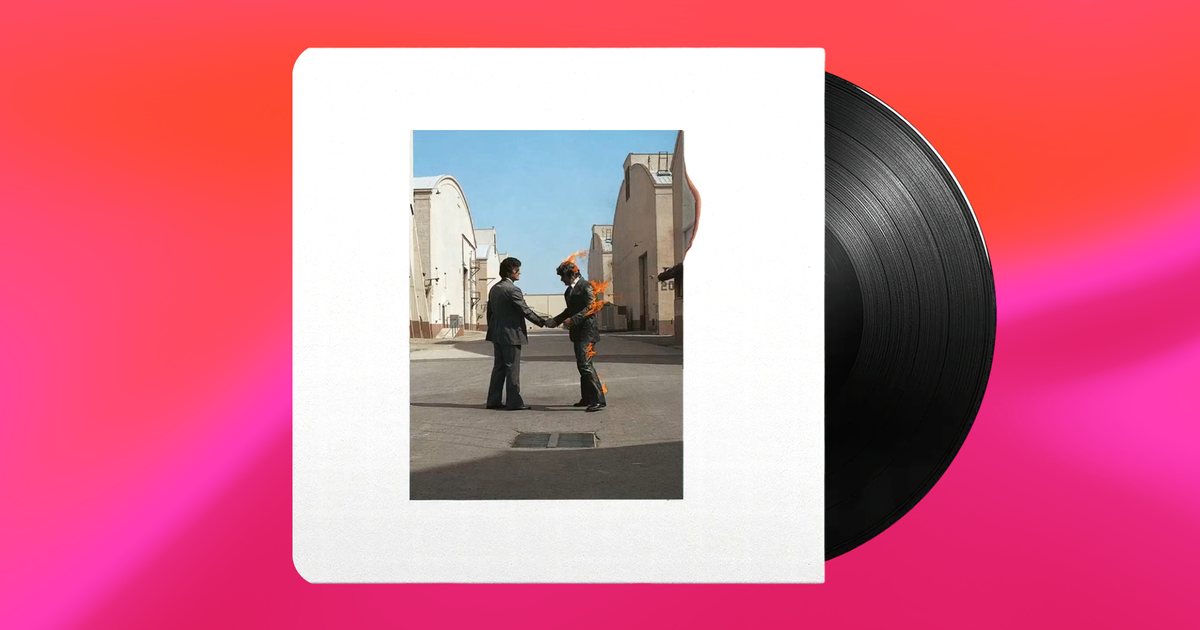
Wish You Were Here – Pink Floyd (1975)
The album cover for Pink Floyd’s Wish You Were Here is tied to the album’s central theme: absence. Many consider the album to be for Syd Barrett. The band’s founding member and original visionary, Barrett, had left due to mental illness.
The cover was created by Storm Thorgerson. Thorgerson recalled asking, “How are we going to set a man on fire?” His answer: “You’re going to have to burn a man for real.” They outfitted a stuntman in a protective suit and fire-retardant gel, setting him ablaze repeatedly. It’s reported he was burned about a dozen times.
Rumours – Fleetwood Mac (1977)
While recording Fleetwood Mac's Rumours, the band was breaking apart: Lindsey Buckingham and Stevie Nicks’ relationship collapsed, fueling dueling songs. Christine and John McVie’s marriage ended, with Christine writing You Make Loving Fun about her new partner. Even Mick Fleetwood was going through his own divorce.
As Biography notes, “each song became a window into the band’s inner lives, creating an album that felt like both a diary and a polished pop record.” Its mix of confessional songwriting and radio-ready harmonies cemented its status as a cornerstone of modern music. With over 40 million copies sold, Rumours became one of the best-selling albums of all time.
Queen II – Queen (1974)
The Queen II cover wasn’t just another band photo; it became their signature silhouette. Shot by Mick Rock, it shows Freddie Mercury with arms crossed, framed by Brian May, Roger Taylor, and John Deacon. Rock later said the image was meant as a dramatic introduction to the world: “Queen wanted to get some attention,” he recalled, since their first album hadn’t yet broken through.
A year later, Freddie insisted the band recreate the pose for the Bohemian Rhapsody video. Filmed on a modest budget, the video opened and closed with those same shadowed faces. It defined the song, which topped the UK charts for nine weeks, and is often credited with launching the modern music video era.
Born in the U.S.A. – Bruce Springsteen (1984)
The cover of Born in the U.S.A. was shot by Annie Leibovitz, one of rock’s most famous photographers. Springsteen joked, “Annie said, ‘Turn around.’ So I stood in front of the flag, and she shot my ass.” The image fed into a misreading of the album. Many took it as patriotic iconography, but the title track tells a different story: a Vietnam veteran returning home to unemployment and disillusionment.
Musically, it was Springsteen’s breakthrough. He recorded dozens of songs across three years, eventually landing on a set that exemplified. The cover remains as famous as the songs. To some, it’s a patriotic statement; to others, it’s ironic. Either way, it cemented Springsteen as both rock star and cultural symbol.
The Rise and Fall of Ziggy Stardust and the Spiders from Mars – David Bowie (1972)
The Ziggy Stardust cover was photographed by Brian Ward on Heddon Street, London. Ward shot Bowie in a jumpsuit, holding a guitar case under a streetlamp, while artist Terry Pastor later hand-tinted the black-and-white image to give Bowie’s hair its orange glow and the scene its otherworldly feel.
Bowie had just invented his persona: Ziggy Stardust, an alien rock star who comes to Earth, achieves fame, and burns out. The cover introduced him as if he were stepping into our world.
The album was a breakthrough: the record reached the UK Top 5. Critics called it ambitious and strange, and fans embraced Ziggy as a new kind of rock icon. The cover became the visual entry point into that persona, and the album is now regarded as one of Bowie’s defining works.
Aladdin Sane – David Bowie (1973)
The Aladdin Sane cover was born when David Bowie told makeup artist Pierre La Roche, “Thoughts go through my head like lightning bolts." To further make the image stand out, the team used a seven-color printing process, not the usual four, making it one of the most expensive covers of its time. The Guardian called that lightning bolt portrait “perhaps the most celebrated image of Bowie’s long career”.
Musically, Aladdin Sane was Bowie stepping beyond Ziggy’s mythology. It leaned harder into American influences, darker themes of decay and madness, and more tension — the album’s title itself riffs on “A Lad Insane.”
Horses – Patti Smith (1975)
The Horses cover was shot by Robert Mapplethorpe, Patti Smith’s close friend. They met during their early days in New York, bounding over their poverty and faith in art. While they both went on to become some of America's most celebrated artists, Mapplethorpe died of AIDS-related complications in 1989, with Smith by his side.
In her memoir Just Kids, Smith recalls shooting the Horses cover: “He took, like, twelve pictures, and at about the eighth one, he said, ‘I have it.’ I said, ‘How do you know?’ and he said, ‘I just know,’ and I said, ‘Okay.’ And that was it.”
This reimagining in video brings that moment alive again.
Enema of the State – Blink-182 (1999)
The Enema of the State cover was taken by photographer David Goldman. It features adult-film actress Janine Lindemulder dressed as a nurse–a nod to the album’s original title: Turn Your Head and Cough. There were several versions of the artwork: the first showed a red cross, but after the American Red Cross objected, it was removed. Later editions added a Parental Advisory sticker, while the Malaysian release covered Lindemulder with a t-shirt
The record itself was anything but censored. With singles like What’s My Age Again?, All the Small Things, and Adam’s Song, Enema of the State launched Blink-182 into global stardom, selling over 15 million copies. The album’s mix of humor and sincerity came to define late-’90s pop-punk.
Purple Rain, Prince (1984)
The Purple Rain cover was made to look cinematic because the album was also the soundtrack to Prince’s first movie. Shot on a Warner Bros. backlot, it shows Prince in a purple suit on a purple motorcycle. The film Purple Rain tells the story of “The Kid,” a young musician based loosely on Prince, struggling with family conflict and trying to make it in the club scene.
Musically, Purple Rain didn’t rely on the film to succeed. It became Prince’s breakthrough on its own terms: the record spent 24 weeks at No. 1 in the U.S., sold over 25 million copies worldwide, and cemented purple as Prince’s signature color.
Highway to Hell, ACDC (1979)
The Highway to Hell cover we know shows the band in silhouette against a dark background, with Bon Scott wearing devil horns and a tail. But originally, AC/DC and their label had a different cover in mind: one that Atlantic Records rejected as “too hellish”. It included flames and a bass neck stretching like a road.
For AC/DC, Highway to Hell was a turning point. The title itself came from Angus Young: after a brutal tour, he described life on the road as “a highway to hell.” The album became their breakthrough, reaching No. 17 on the Billboard 200 and going on to sell millions. Tragically, Highway to Hell would be the last AC/DC album with Bon Scott. He died the following year, in early 1980.