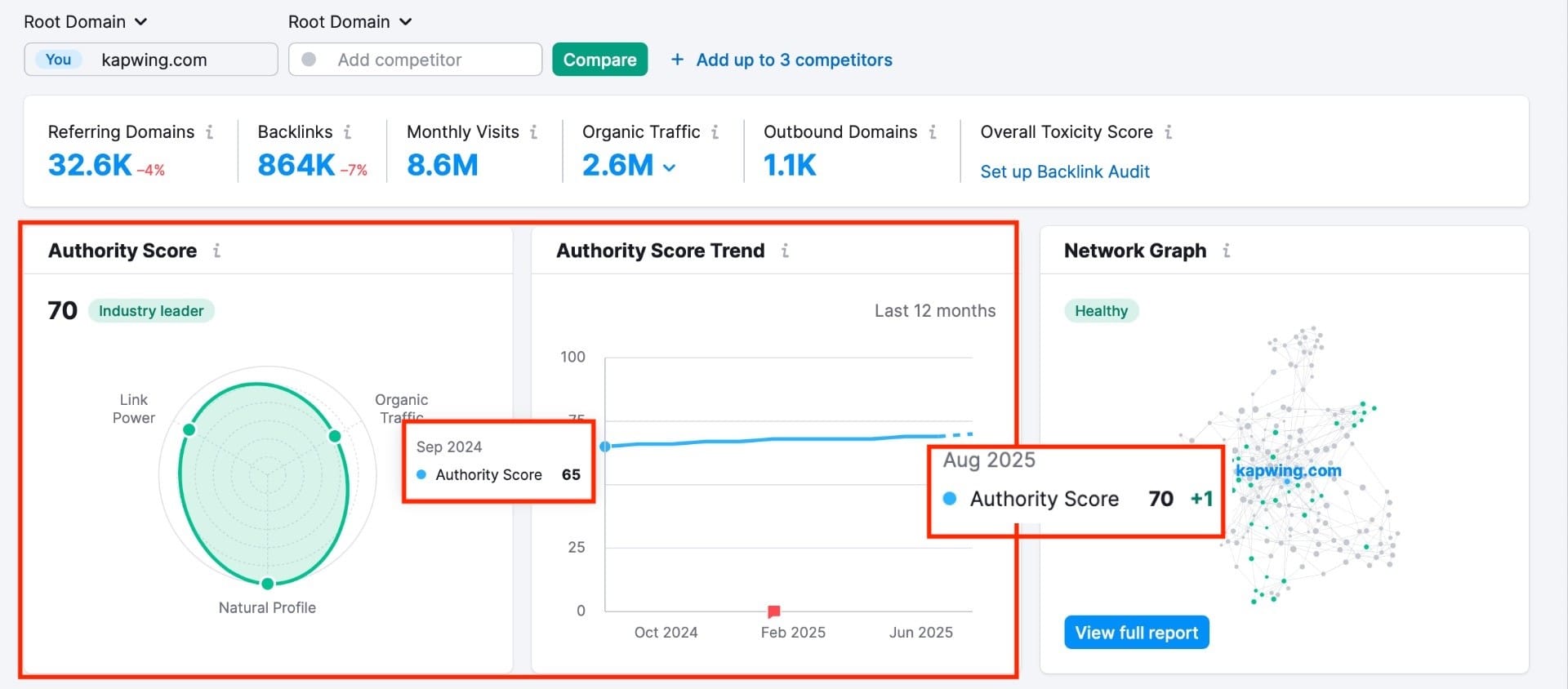
How Our Content Team Grew Kapwing’s Authority Score from 65 to 70
Three people, one SEO plan — and millions more in organic traffic. Here are the strategies that delivered.

Over the last 11 months, we relaunched our content strategy at Kapwing with just three people on the team.
In that time, our Semrush Authority Score climbed from 65 to 70, and organic traffic jumped from 5.2 million to more than 7 million views per quarter. Google Search impressions also hit record highs.
SEO growth is critical for any company, but with a lean team, it’s a grind. How do you keep up with new blog posts, landing page updates, newsletters, social media, and marketing campaigns — without turning everything into ChatGPT-spun text?
Here’s what actually worked for us: the strategies that pushed our traffic and authority score higher, executed by a three-person crew.
Cleaning Up Metadata Tags with Purpose
Metadata tags alone won’t skyrocket your SEO, but they’re not irrelevant either. I saw this firsthand at GRV Media, where SEO details were dissected across more than 50 news sites. Metatags often sent strong topical signals to Google — yet many sites treated them as an afterthought.
At Kapwing, we had the same problem: over 100 scattered tags with no clear structure. We cut them down to 12 keyword-driven categories. Tags like “audio editing,” “volume,” and “sound design” were rolled into one "Audio Production" tag.
We also gave each tag page keyword-rich titles, custom descriptions, and curated content that matched the indexed articles. The result was a clearer topical framework for Google, and a shared taxonomy that aligned our writers with search intent.
Doubling Down on Landing Page Updates
Landing pages were our biggest lever. Unlike metadata tweaks, optimizing them directly affected crawlability, linking, and keyword relevance.
In 2025, we shifted from creating new pages to reviving older ones that had lost visibility after Google updates. With 200+ pages, we built a prioritization model using:
- Click drops (Search Console)
- Average position changes (Search Console)
- Position opportunities (Search Console)
- Conversion data (Amplitude)
Why it worked:
- Existing authority – Updated pages already had backlinks and history, so they were easier to push up in rankings.
- Freshness – Updating timestamps and adding new info tapped into Google’s “Query Deserves Freshness” boost.
- User intent – Adding FAQs, new examples, and broader coverage made pages more relevant for 2025 searchers.
That quarter, we launched just five new landing pages but optimized 58 old ones — including some strategic redirects to resolve keyword cannibalization. Our domain authority went from 66 to 67, and views climbed from 5.3M to 6M.
Creative Backlink Campaigns
Earning quality backlinks is always tough. At Kapwing, we leaned into “backlink stunts" and timely campaigns designed to grab coverage and links.
Some examples:
- Spotify Wrapped Template – Each December, we publish a customizable template. By monitoring Wrapped search traffic across time zones, we stay ahead and earn organic links as the hype grows.
- Netflix Wrapped – In 2024, Spotify Wrapped dropped late. We pitched our Netflix Wrapped tool to 50+ publishers as a timely angle, earning 31 backlinks (avg. DA 72), including TechCrunch, plus syndication.
- Deepfake Search Report – We compiled a Deepfake Global Interest Report, using search data across regions and packaging it with press-ready graphics. This landed 14 backlinks from outlets like Newsweek and The Mirror.
Not every stunt hit, but the wins followed the same formula: sharp timing, a unique angle or dataset, a clear pitch, and journalist-first outreach.
Scoring Projects to Stay Focused
With only three people, we couldn’t tackle everything. We built a simple framework to decide what to work on:
- Impact – potential for traffic, rankings, conversions, or backlinks
- Cost – how much time or engineering effort it would take
- Relevance – whether it aligned with our goals and strengths
We scored every idea and focused only on the top priorities. It kept us from chasing shiny objects and made it easier to say “no” with data behind us.
Final Thoughts
Scaling organic growth with a lean team is tough, but not impossible. At Kapwing, we didn’t win by producing more content than larger teams. We won by prioritizing, staying technically sharp, and being creative with the resources we had.
For other small teams, our biggest advice is this: SEO isn’t about tricks or volume. It’s about serving users better than your competitors, with consistency and care.
For the full overview and more details on our tagging and internal linking strategy, you can visit SEO Buddy, where we published a blog last month highlighting our rise from 65 to 69.